


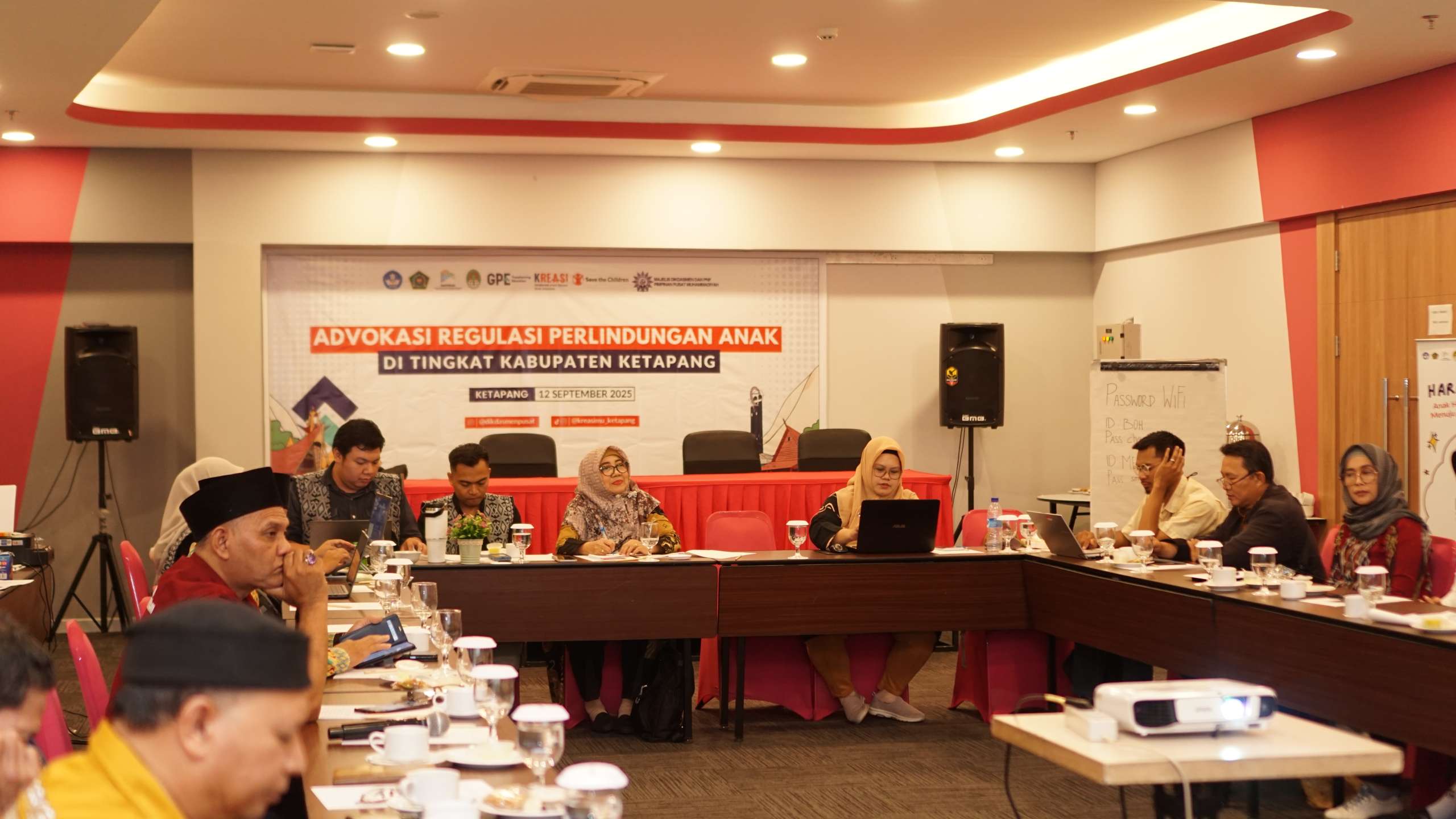
KREASI Ketapang, implemented by Majelis Dikdasmen dan PNF PP Muhammadiyah, held the Child Protection Regulation Advocacy Workshop Batch 3, which presented cross-sector discussions on challenges and solutions for child protection at the local level on Friday (12/9/2025). The activity was attended by representatives from the Religious Court, Ministry of Religious Affairs, KPAD, DSP3AKB, the Police, the Regional Children’s Forum, as well as education leaders and civil society.
In the first session, law expert from Universitas Muhammadiyah Pontianak, Nina Niken presented an analysis of the child protection situation in Ketapang District. She emphasized that the family is the smallest and most influential environment in shaping a child’s character.
“Schools have a role, but teachers face 30 children in one class. Character cannot be built instantly. The family must be the main line of defense,” she said.
Nina also highlighted the impact of technology and the lack of parental control over digital content. She emphasized that regulations such as Law No. 23 of 2002 and Regional Regulation No. 7 of 2018 already exist, but implementation on the ground is still weak.
“We need shelters, reporting SOPs, and trained human resources. Without those, child protection remains just a narrative,” she added.
The second session was led by another law expert from Universitas Muhammadiyah Pontianak, Hazilina, who stressed the importance of cross-sector collaboration. She said the number of child abuse cases in Ketapang is quite high, signaling both growing public awareness and increasing complexity of social challenges.
“Children are seeking identity. Without guidance, they are easily influenced by destructive values on social media,” she explained.
Hazilina emphasized that child protection is not just about law enforcement, but also about rehabilitation and strengthening human resources capacity.
“Teachers, village officials, volunteers—all must be trained. Children who commit violence cannot simply be punished; they must be rehabilitated,” she asserted.
In response, Program Manager KREASI Kalimantan Barat, Julni Rahmawan stated that KREASI acts as a bridge between the community and government. He stressed that child protection is a key program outcome.
“We are pushing for local regulations that support children—whether SOPs, regent regulations (Perbup), or local bylaws (Perda). KREASI is not just a training program but a collective movement to create a sense of safety in schools and communities,” he said.
Julni also noted that KREASI has carried out interventions in 40 schools across three subdistricts, including Delta Pawan, Matan Hilir Selatan, and Benua Kayong.
“We are here to strengthen synergy. Child protection is not the responsibility of one sector alone, but a shared obligation,” he concluded.
Participants’ feedback emphasized the urgency of the issue. The Religious Court recorded 60 child marriage dispensations in one semester, most due to out-of-wedlock pregnancies. DSP3AKB and KPAD pointed out the absence of safe houses and child protection technical units (UPTD). The Police noted challenges in handling child perpetrators due to a lack of proper shelter facilities.
The Regional Children’s Forum presented their initiative, KOPA (Child Complaint Box), which has been socialized in all schools in Ketapang. The program serves as a frontline mechanism for receiving reports of child abuse.
The activity concluded with a recommendation to conduct an analysis of the implementation of child protection regulations in Ketapang and identify enacted legal instruments to serve as the foundation for future advocacy.
_____
The Program of KREASI or Kolaborasi untuk Edukasi Anak Indonesia (Collaboration for the Education of Indonesian Children) is funded by the Global Partnership for Education, developed by the Ministry of Primary and Secondary Education, and the Ministry of Religious Affairs. KREASI in Ketapang is being implemented by Save the Children and local implementing partner Majelis Dikdasmen dan PNF PP Muhammadiyah, support by the Government of Ketapang with aims to improve the quality of education in Indonesia by strengthening teaching, learning, and student development.
_____
Writer: Afriyandi Nur Huda; Editor: Andika Ramadhan
Photo: Afriyandi Nur Huda/KREASI/Majelis Dikdasmen dan PNF PP Muhammadiyah/Save the Children