


What makes children feel safe and comfortable at school? The answer is not always the same. For this reason, building a Safe and Comfortable School Culture (BSAN) must begin with understanding the unique context of each school and listening to children’s voices.
This understanding formed a key part of the training provided by KREASI Morotai to School Child Protection Teams (PAS Teams) from partner schools in Southwest Morotai Sub-district from 22–25 June 2026. As teams responsible for promoting the implementation of BSAN in their respective schools, PAS Team members were equipped with practical knowledge and skills that could be applied directly in the school environment.
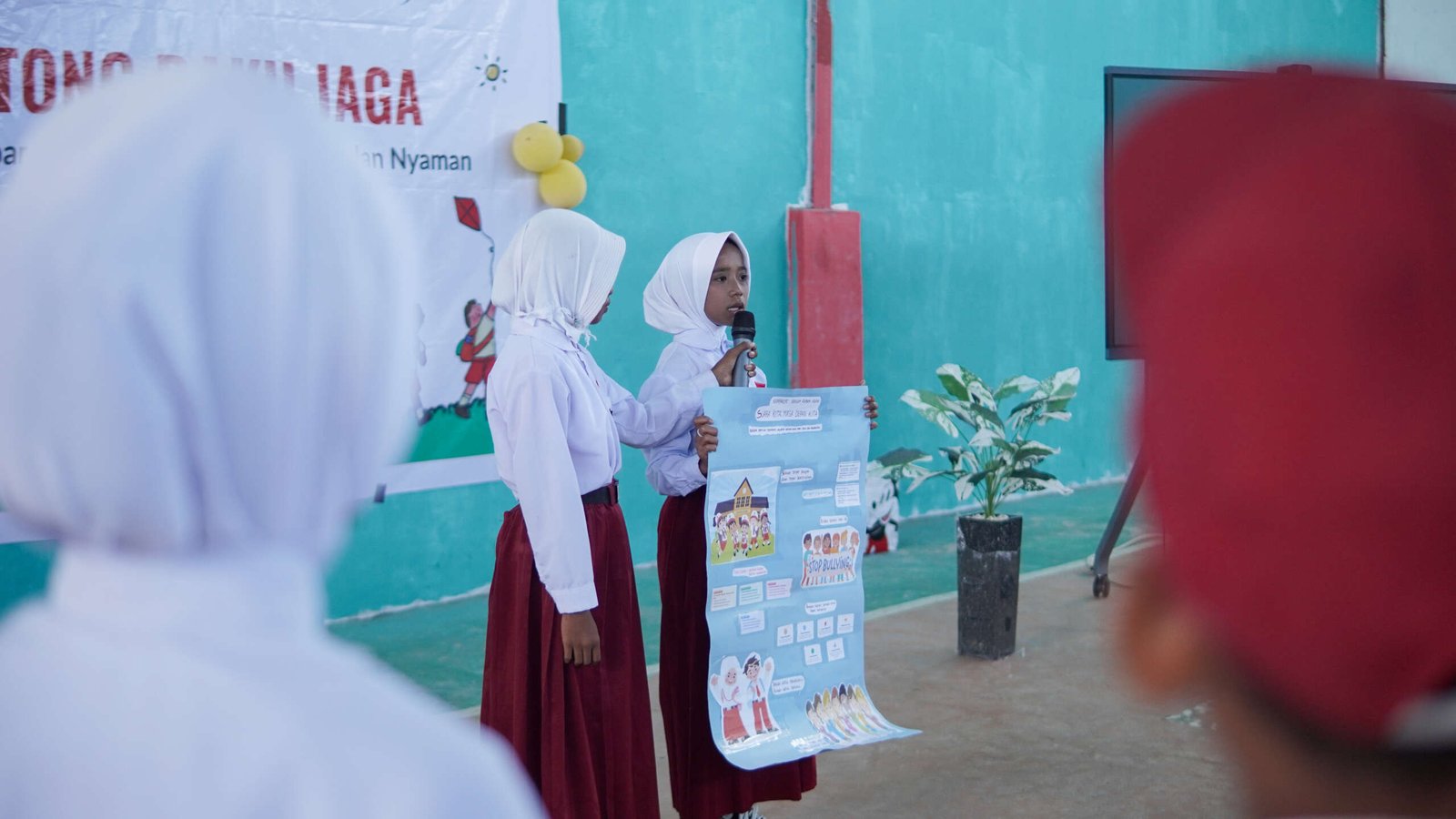
The BSAN Campaign became one of the follow-up activities resulting from the training. Before developing their campaigns, each PAS Team held discussions with children in their schools to understand what students considered important in their learning environment. The findings from these discussions were then used to determine the theme and focus of each school’s campaign.
Because the campaigns were developed based on the specific conditions and discussions within each school, the topics varied significantly. Each PAS Team designed and implemented its own campaign, with children actively involved throughout the process.
The BSAN Campaigns were conducted from 27–29 July 2026 across eight schools in Southwest Morotai Sub-district. In addition to students, the activities involved PAS Team members, school principals, parents, village government representatives, and officials from the Ministry of Religious Affairs, the Education and Culture Office, the Population and Civil Registration Office (Dukcapil), and the Office of Social Affairs, Women’s Empowerment, and Child Protection (Dinsos PPPA).
The involvement of multiple stakeholders created opportunities for schools and adults within the community to better understand the challenges children face from a variety of perspectives. For schools, the process also served as an opportunity to reflect on existing efforts and identify areas that still require improvement.
At one school, for example, discussions with students highlighted bullying as a major concern. Fahima, the school principal, viewed the campaign as an opportunity for both teachers and students to deepen their understanding of bullying prevention.
“Our campaign focused on bullying. Through this campaign, we gained a better understanding of how to prevent bullying. It was valuable for me, the teachers, and the students because everyone learned what actions can help prevent bullying at school and what behaviors should be avoided,” said Fahima.
In addition to engaging children through discussions, attention to their needs was also reflected in a birth certificate data collection process conducted before the campaign. Each school identified students who did not yet possess birth certificates in order to determine which children required further support.
A birth certificate is an essential element of a child’s legal identity and an important document in fulfilling children’s rights as citizens. Therefore, the needs identified through this data collection process did not end with simple documentation.
KREASI Morotai collaborated with the Population and Civil Registration Office (Dukcapil) to follow up on cases involving children who did not yet have birth certificates. This collaboration connected needs identified at the school level with the government institution authorized to issue legal identity documents for children.
For KREASI Morotai, the BSAN Campaign provided an opportunity for PAS Teams to apply the knowledge gained during training while encouraging more stakeholders to become involved in creating safe and supportive environments for children. The process began by listening to children, identifying issues that were relevant to each school, and following up on the needs that emerged through collaboration with relevant institutions.
Through this approach, BSAN goes beyond being a concept understood by PAS Teams. Instead, it becomes a practical part of school life, implemented through concrete actions that are informed by and responsive to children’s needs.
_____
KREASI (Kolaborasi untuk Edukasi Anak Indonesia) adalah program peningkatan kualitas pendidikan dengan memperkuat literasi, numerasi, dan pendidikan karakter. KREASI di Pulau Morotai dikelola Save the Children dan diimplementasi oleh Stimulant Institute, dengan pendanaan Global Partnership for Education (GPE) serta dukungan Pemerintah Kabupaten Pulau Morotai dan Mitra Pendidikan Indonesia yang dipimpin Kementerian Pendidikan Dasar dan Menengah (Kemendikdasmen) dan Kementerian Agama (Kemenag).
Penulis: Ayutama Putri Jordy | Editor: Andika Ramadhan | Foto: Ayutama Putri Jordy/KREASI/Stimulant Institute/Save the Children