


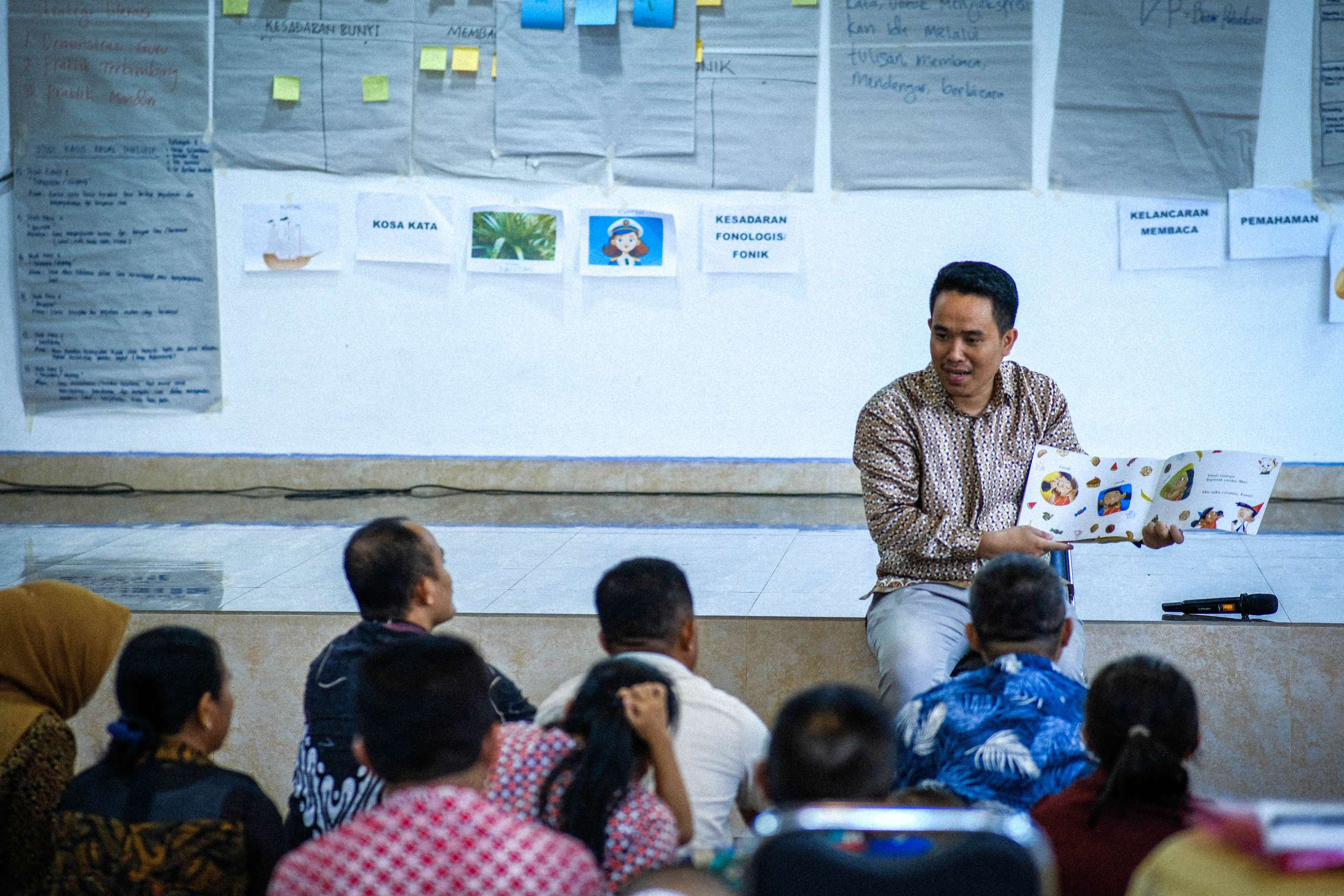
KREASI Nias Utara conducted a series of capacity-building activities for 68 education actors, comprising Local Facilitators for Teacher Professional Development (TPD), Principal Professional Development (PPD), and Safe and Comfortable School Culture (BSAN). Held throughout June 2026 in Lotu, Nias Utara, the activities marked the initial stage of strengthening their capacity before knowledge transfer and mentoring begin at the school level.
As the KREASI Program enters its second year of implementation, strengthening the capacity of education actors is essential to ensuring the program’s sustainability. At this stage, KREASI Nias Utara prepared Local Facilitators, school principals, and relevant stakeholders with aligned knowledge, skills, and mentoring strategies before these are applied with teachers and school communities.
Following this capacity-building stage, the Local Facilitators will support knowledge transfer to teachers at the school level through training, mentoring, and the strengthening of teaching practices tailored to the needs and contexts of individual education units.
The series began with the Literacy Local Facilitator Training (Module 1), held from 2–6 June 2026. The training was attended by 20 participants assigned by the Education Office of Nias Utara District to represent 36 schools assisted by the KREASI Nias Utara Program.
Participants received training from two Local Master Trainers who had previously completed capacity-building training on implementing the Literacy Module through the TPD scheme.
The training was part of efforts to prepare Local Facilitators to support improvements in the quality of literacy instruction in schools. Participants strengthened their understanding of the training materials, facilitation and mentoring skills, and ability to reflect on and adapt their approaches to needs in the field.
With this strengthened capacity, the Local Facilitators are expected to become key actors in supporting teachers to implement more effective and student-centred literacy practices when knowledge transfer begins at the school level.
KREASI Nias Utara subsequently conducted the Literacy School Principal Training (Module 1) for 36 principals from assisted schools on 9–12 June 2026 in Lotu, Nias Utara District. The training was facilitated by four Local Facilitators, with participants divided into two groups to support a more effective learning process.
Through the training, school principals strengthened their capacity as instructional leaders who play a strategic role in creating high-quality, safe, and inclusive education units. The training supported principals in developing instructional leadership, effective school governance, and a positive school culture through character building, collaboration, reflection, and continuous professional development.
In addition to school leadership, the training integrated the principles of Gender Equality, Disability, and Social Inclusion (GEDSI), character education, positive discipline, and child protection. This capacity strengthening is expected to help principals create learning environments that respect diversity, prevent discrimination, and optimally support students’ development.
As part of efforts to create safe and comfortable learning environments, KREASI Nias Utara also conducted the Safe and Comfortable School Culture Local Facilitator Training, attended by 12 participants representing government offices, education stakeholders, and partner organizations. The activity was supported by Master Trainers who had previously received capacity-building training on BSAN implementation.
The BSAN Local Facilitator Training aimed to strengthen the capacity of local facilitators to support the implementation of a safe school culture by improving their understanding, facilitation and mentoring skills, as well as mechanisms for preventing and responding to violence in education settings.
Through the training, participants strengthened their understanding of child protection, the Prevention and Response to Violence in Education Units (PPKSP), facilitation and mentoring skills, and strategies for reinforcing child protection systems in schools. The Local Facilitators are expected to support schools in strengthening the role of School Child Protection Teams (TPAS), providing mentoring, and promoting a safe, comfortable, inclusive, and child-friendly school culture.
The series of activities held throughout June 2026 provided an initial foundation for building a stronger education ecosystem in Nias Utara District. By strengthening the capacity of Local Facilitators, school principals, and education stakeholders, KREASI supports not only individual competencies but also the systems required to ensure that changes can be implemented sustainably at the school level.
Through collaboration with the local government, schools, and various education stakeholders, KREASI Nias Utara remains committed to improving the quality of learning by strengthening literacy, numeracy, and character education, as well as creating safe, inclusive, and comfortable learning environments for all students.
_____
KREASI (Collaboration for the Education of Indonesian Children) is a program to improve the quality of education by strengthening literacy, numeracy, and character education. KREASI in Nias Utara is managed by Save the Children and implemented by Article 33 Indonesia, with funding from the Global Partnership for Education (GPE), as well as support from the Government of Nias Utara and Indonesia’s Local Education Group, led by the Ministry of Primary and Secondary Education (Kemendikdasmen) and the Ministry of Religious Affairs (Kemenag).
Writer: Calvin Telaumbanua | Editor: Andika Ramadhan | Photo: Calvin Telaumbanua/KREASI/Article 33 Indonesia/Save the Children