


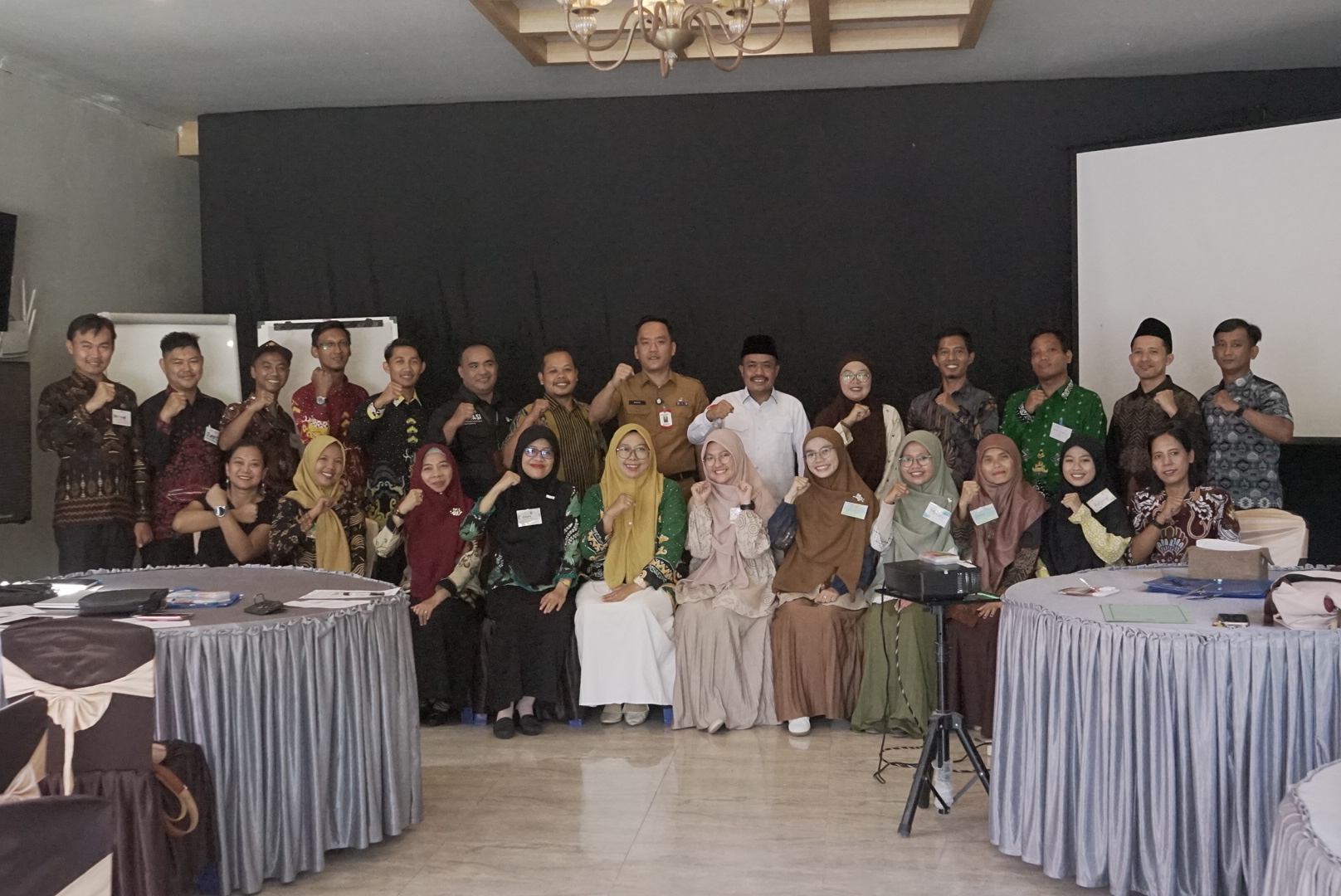
Over five days, from 19 to 23 May 2026 in Krui, Pesisir Barat was filled with a spirit of learning from teachers who came as prospective local facilitators for the KREASI Program. A total of 20 local facilitators took part in a capacity-building training on literacy instruction in the classroom, an initial step before they go on to support 90 teachers in 30 partner schools in the program’s second year.
This training was not merely a space for transferring knowledge. From the first day, participants were encouraged to understand that they are at the forefront of changing learning practices in schools. In their remarks, representatives from the Education Office, the Ministry of Religious Affairs, and the KREASI team emphasized the importance of collaboration in strengthening the quality of education and children’s literacy in Pesisir Barat.
Throughout the training, activities were held intensively from 08.00 to 16.00 each day. However, the classroom atmosphere was far from rigid or formal. The methods used were highly active and participatory. Participants did not only listen to presentations, but were also continuously involved in simulations, role play, microteaching, group discussions, personal reflection, and practice in mentoring teachers.
Various important topics were discussed over the five days. Participants learned about reading habits and how to create a literacy-rich classroom environment, conduct reading assessments, map students’ abilities, and understand differentiated learning, inclusive classrooms, and climate-aware education. They also practiced how to teach vocabulary, reading comprehension, and reading fluency through approaches that are more enjoyable and aligned with students’ needs.
One of the most noticeable aspects of the training was how the teachers’ personal experiences were brought into the learning process. During a reflection session on childhood experiences of learning to read, several participants shared stories that were closely connected to the realities of education in the field. Some admitted that they only became fluent readers in grade three because they felt left behind by their peers. Others learned to read because they were afraid of being punished by adults. From these simple stories, participants came to a shared realization that children’s learning processes should not be built on fear, but on a sense of safety and support.
The learning-by-doing method became the main strength of this training. In almost every session, participants directly practiced what they had learned. They carried out reading assessment simulations, developed lesson plans, practiced interactive learning, and conducted teacher mentoring simulations.
The lead local trainers, Ilona and Pia, did not only deliver materials, but also directly demonstrated how to create learning that is reflective, active, and centered on students.
The training atmosphere felt warm and full of enthusiasm. Participants actively asked questions, shared experiences, and gave each other reflective feedback. Between sessions, participants also took the initiative several times to lead icebreakers and energizers to maintain the learning energy. Although there were some challenges, such as a hot training room and participants’ declining focus before breaks, overall the training was very lively and collaborative.
From the various discussions that emerged, it was clear that teachers in Pesisir Barat have a strong concern for the learning conditions of students in their schools. They discussed low reading culture, limited books, and the challenge of providing learning that meets children’s needs. At the same time, however, this training also opened up new hope that change can begin with simple steps carried out consistently by teachers in the classroom.
Toward the end of the activity, the local facilitators began preparing a Follow-Up Plan (RTL) for teacher training and mentoring in partner schools. They discussed strategies to build teachers’ commitment, maintain communication with schools, and ensure that mentoring can take place without disrupting students’ learning processes in the classroom.
This training is expected to become the beginning of more good literacy practices in schools across Pesisir Barat. The local facilitators are not only expected to be able to train teachers, but also to become mentors who help teachers reflect, grow, and continue learning together.
Through collaboration between schools, teachers, facilitators, and various parties involved in the KREASI Program, it is hoped that more children in Pesisir Barat will be able to experience learning that is enjoyable, inclusive, and truly supports their development.
_____
KREASI (Collaboration for the Education of Indonesian Children) is a program to improve the quality of education by strengthening literacy, numeracy, and character education. KREASI in Pesisir Barat is managed by Save the Children and implemented by Yayasan Guru Belajar, with funding from the Global Partnership for Education (GPE), as well as support from the Government of Pesisir Barat and Indonesia’s Local Education Group, led by the Ministry of Primary and Secondary Education (Kemendikdasmen) and the Ministry of Religious Affairs (Kemenag).
Writer: Clara Sidharta | Editor: Andika Ramadhan | Photo: Clara Sidharta/KREASI/Yayasan Guru Belajar/Save the Children