


Morning in a village in Nias Utara begins with the small footsteps of children heading to school. Some walk along paved village roads, others ride bicycles, and some are dropped off by their parents on motorbikes. For them, school is not just a place to learn, but a hope for a better future.
In the middle of the village stands a primary school. At first glance, it looks like any typical rural school—simple buildings, a spacious yard, and the cheerful noise of children during recess. However, in recent years, gradual changes have begun to take place. Learning is no longer limited to chalkboards and textbooks. Digital learning media have started to be introduced in classrooms, making lessons more interactive and engaging.
This transformation did not happen by chance. Behind it is the role of the school principal, Talibudi, who believes that schools in rural areas can also grow and adapt to changing times.
Talibudi is no stranger to the village. He grew up in the same environment and experienced firsthand the challenges of accessing education. During primary school, he had to walk about two kilometers every day. When he continued to junior secondary school, the distance increased to around six kilometers. These life experiences shaped his perseverance and strong determination.
His journey as an educator began after graduating from high school in 1998, when he started working as a honorary teacher. At first, becoming a teacher was not his main ambition. However, his interactions with students and teaching experiences gradually changed his perspective. He found meaning in the learning process and decided to dedicate himself to education. In 2005, he was appointed as a civil servant, and in 2022, he was entrusted to become the principal of this school.
When he first took on the leadership role, he faced challenges in teaching practices that were still largely conventional. Teachers tended to deliver lessons in a one-way manner, while the use of technology was mostly limited to administrative purposes. Meanwhile, the students they taught were growing up in a digital era.
Efforts for change had already begun with the teachers. However, his involvement in the KREASI Program provided new learning opportunities that further enriched his perspective as a learning leader. Through mentoring from KREASI-supported principals and participation in various training activities, Talibudi gained insights and good practices, which he then adapted to suit the needs and context of his school.
These experiences strengthened his belief that improving learning must be driven collaboratively and continuously. Even before joining the KREASI Program, he had initiated a teacher learning forum called Wordusaming. This activity is conducted regularly every week after school hours.
He has also shared these experiences and good practices with other KREASI-supported principals, particularly during training sessions and workshops on documenting good practices in schools. Through this sharing, he hopes to inspire similar initiatives in other schools.
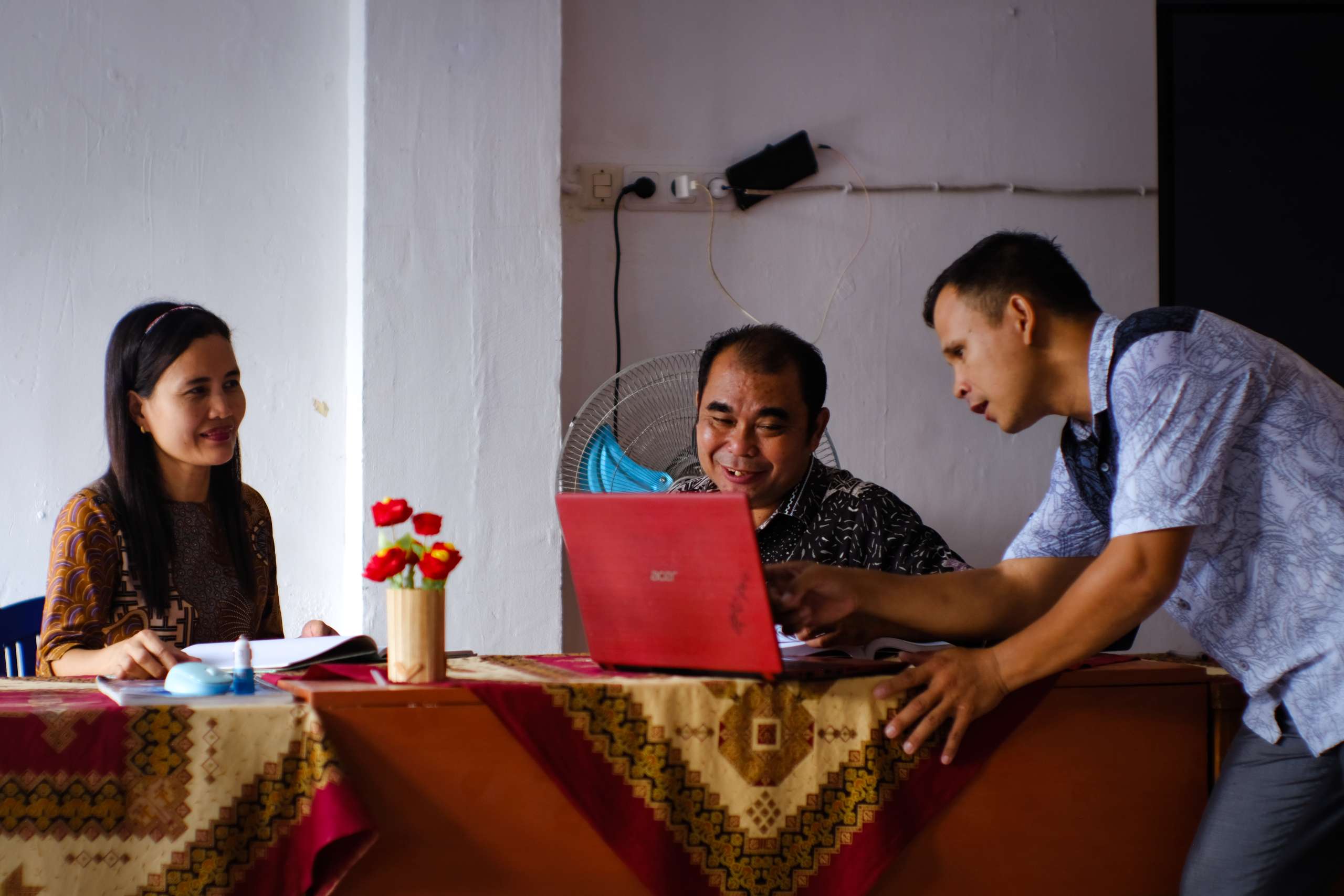
On Fridays, the principal provides sessions on the use of technology in learning. On Saturdays, teachers learn in small groups through a peer-learning approach, where those who are more familiar with technology support their colleagues in learning together.
Through Wordusaming, teachers are encouraged to share practices and try new approaches in teaching. Gradually, they have become more confident in creating simple digital learning media and using various applications to support teaching and learning.
The results are now visible. Around 80 percent of teachers are able to use digital tools independently. Applications such as Canva, Padlet, and even artificial intelligence (AI)-based tools are used to create more varied and engaging lessons. In the classroom, students have become more active, more confident in asking questions, and more involved in the learning process.
For Talibudi, Wordusaming is not just a capacity-building program, but also an effort to build a culture of learning among teachers. He believes that change in education begins with small, consistent steps.
To teachers, he always emphasizes the importance of continuous growth:
“Keep moving forward, never stop learning.”
And to students, he instills a simple belief:
“With practice, you will succeed.”
In this village, change may not happen instantly. However, through reflective and collaborative leadership, supported by continuous learning experiences, these small steps have created meaningful impact. This good practice shows that educational transformation can begin anywhere—even from a small village in Nias Utara—as long as there is a commitment to keep learning and moving forward together.
_____
The Program of KREASI or Kolaborasi untuk Edukasi Anak Indonesia (Collaboration for the Education of Indonesian Children) is funded by the Global Partnership for Education (GPE), developed by the Ministry of Primary and Secondary Education (Kemendikdasmen), and the Ministry of Religious Affairs (Kemenag) in the collaborative consortium Local Education Group (LEG). KREASI is being implemented by Save the Children with Article 33 Indonesia and supported by the Government of Nias Utara. KREASI aims to improve the quality of education by strengthening teaching, learning, and student development.
_____
Writer: Calvin Telaumbanua | Editor: Andika Ramadhan | Photo: Calvin Telaumbanua/KREASI/Article 33 Indonesia/Save the Children