


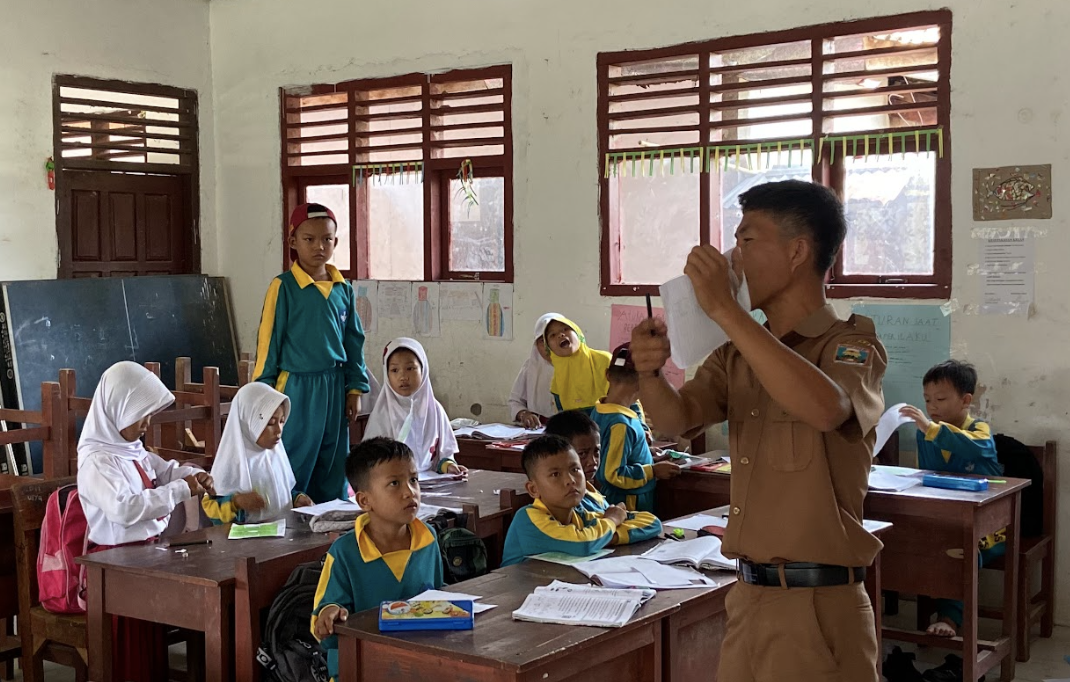
Wahid, an elementary school teacher in Pesisir Barat Regency, still clearly remembers what his school was like before collaborating with the KREASI Pesisir Barat Program. Various limitations were evident and had long been part of daily life.
“There were certainly shortcomings,” he said softly. Yet it was precisely from those conditions that small efforts began to grow.
After attending the training on strengthening literacy-rich environments organized by KREASI Pesisir Barat, Wahid began to imagine changes in his classroom. He recalled a corner of the room that had long stood empty and rarely caught students’ attention. Upon returning from the training, Wahid and his fellow teachers arranged that corner into a reading nook. For them, it was not merely an addition to the classroom, but a simple space expected to bring children closer to books and reading activities.
Wahid did not only ask the children to read; he also encouraged them to write down their feelings. Their responses were often innocent and sometimes mixed up—confusing emotions with new words they had just discovered. Wahid would simply smile. To him, these were not mistakes. “They’re children, after all,” he said.
Change gradually spread to the classroom walls. Once plain and bare, they are now filled with students’ work. In a joking tone, Wahid described it, “The classroom used to look like a face that was too polished—now it has stories to tell.”
Over time, Wahid and the other teachers continued to strengthen reading habits. Before lessons begin, the children are invited to read for a short while. Some read in pairs, while others make use of their break time.
Beyond reading at school, Wahid also took the initiative to share digital book links with homeroom teachers to be forwarded to parents. He realizes that not all parents are able to accompany their children in reading at home. “Many families do not have storybooks,” Wahid explained.
Wahid does not claim that everything is already perfect. He knows there is still much to improve. However, for him, change does not have to be big. It can begin with a reading corner, with classroom walls that begin to speak, and with children who slowly gain the courage to try. There, he sees hope—that education is not only about numbers and grades, but about the process of growing together.
_____
The Program of KREASI or Kolaborasi untuk Edukasi Anak Indonesia (Collaboration for the Education of Indonesian Children) is funded by the Global Partnership for Education, developed by the Ministry of Primary and Secondary Education, and the Ministry of Religious Affairs. KREASI in Pesisir Barat is being implemented by Save the Children and local implementing partner Yayasan Guru Belajar, support by the Government of Pesisir Barat with aims to improve the quality of education in Indonesia by strengthening teaching, learning, and student development.
_____
Writer: Michelle Gabriela | Editor: Nabila Aulia | Photo: Michelle Gabriela/KREASI/Yayasan Guru Belajar/Save the Children