


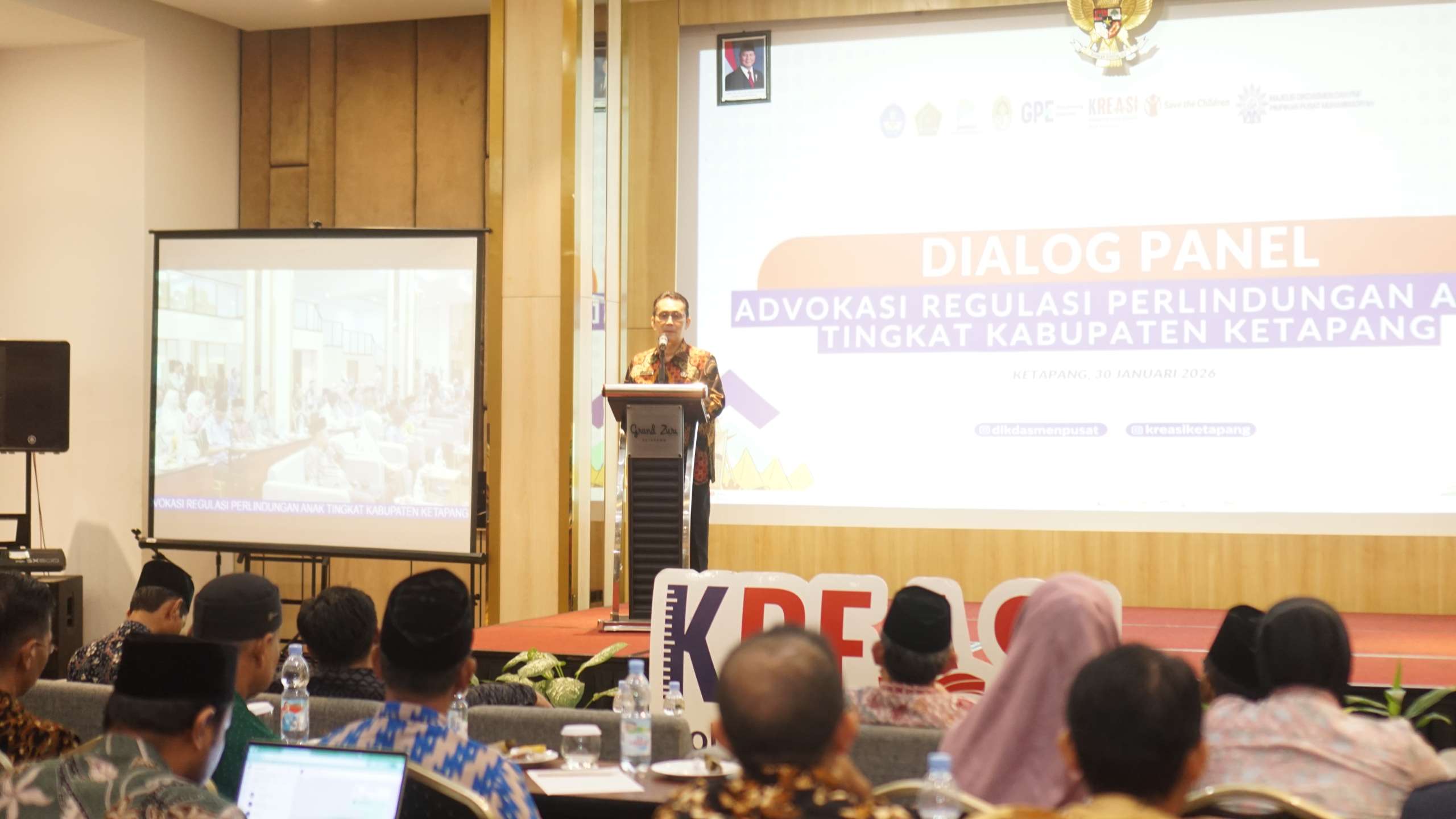
KREASI Ketapang, implemented by the Majelis Dikdasmen PNF PP Muhammadiyah, held a Child Protection Regulatory Advocacy Panel Dialogue on 30 January 2026. This activity was organized as an effort to encourage the realization of a child-friendly ecosystem at the local level, while also strengthening the commitment to a Child-Friendly Regency (KLA).
The event was opened by the KREASI Ketapang Program Project Coordinator, Santoso Setio, the Head of the Ketapang District Education Office, Ucup Supriatna, and the Chair of PP Muhammadiyah, Irwan Akib. A total of 99 participants from government agencies, educational institutions, civil society organizations, and religious leaders attended to jointly formulate steps to strengthen child protection through a more child-sensitive policy framework.
Through this dialogue, participants were invited to review the extent to which existing regulations have accommodated child protection needs in schools and communities, as well as identify policy gaps that still need to be strengthened. The main focus was to ensure that every local policy—both in the education sector and in child protection—is aligned with child rights principles and national mandates related to Child-Friendly Regency.
The panel discussion featured two speakers: Leli Ruspita from DP3AP2KB Kalimantan Barat and Katiman from the Coordinating Ministry for Human Development and Culture (Kemenko PMK). Both emphasized the importance of an inclusive and safe education ecosystem, and explained that the quality of future human resources is largely determined by how well children today are protected and feel safe in their schools and surrounding environment.
Through this activity, KREASI Ketapang hopes that schools in Ketapang District will not only function as places of learning, but truly become a “second home” that is comfortable, free from violence, and supportive of children’s optimal growth and development. This regulatory advocacy is one of the concrete steps to ensure that child protection does not stop at discourse, but becomes embedded in local policies and practices.
_____
The Program of KREASI or Kolaborasi untuk Edukasi Anak Indonesia (Collaboration for the Education of Indonesian Children) is funded by the Global Partnership for Education, developed by the Ministry of Primary and Secondary Education, and the Ministry of Religious Affairs. KREASI in Ketapang is being implemented by Save the Children and local implementing partner Majelis Dikdasmen dan PNF PP Muhammadiyah, support by the Government of Ketapang with aims to improve the quality of education in Indonesia by strengthening teaching, learning, and student development.
_____
Writer: Afriyandi Nur Huda | Editor: Andika Ramadhan | Photo: Afriyandi Nur Huda/KREASI/Majelis Dikdasmen dan PNF PP Muhammadiyah/Save the Children