


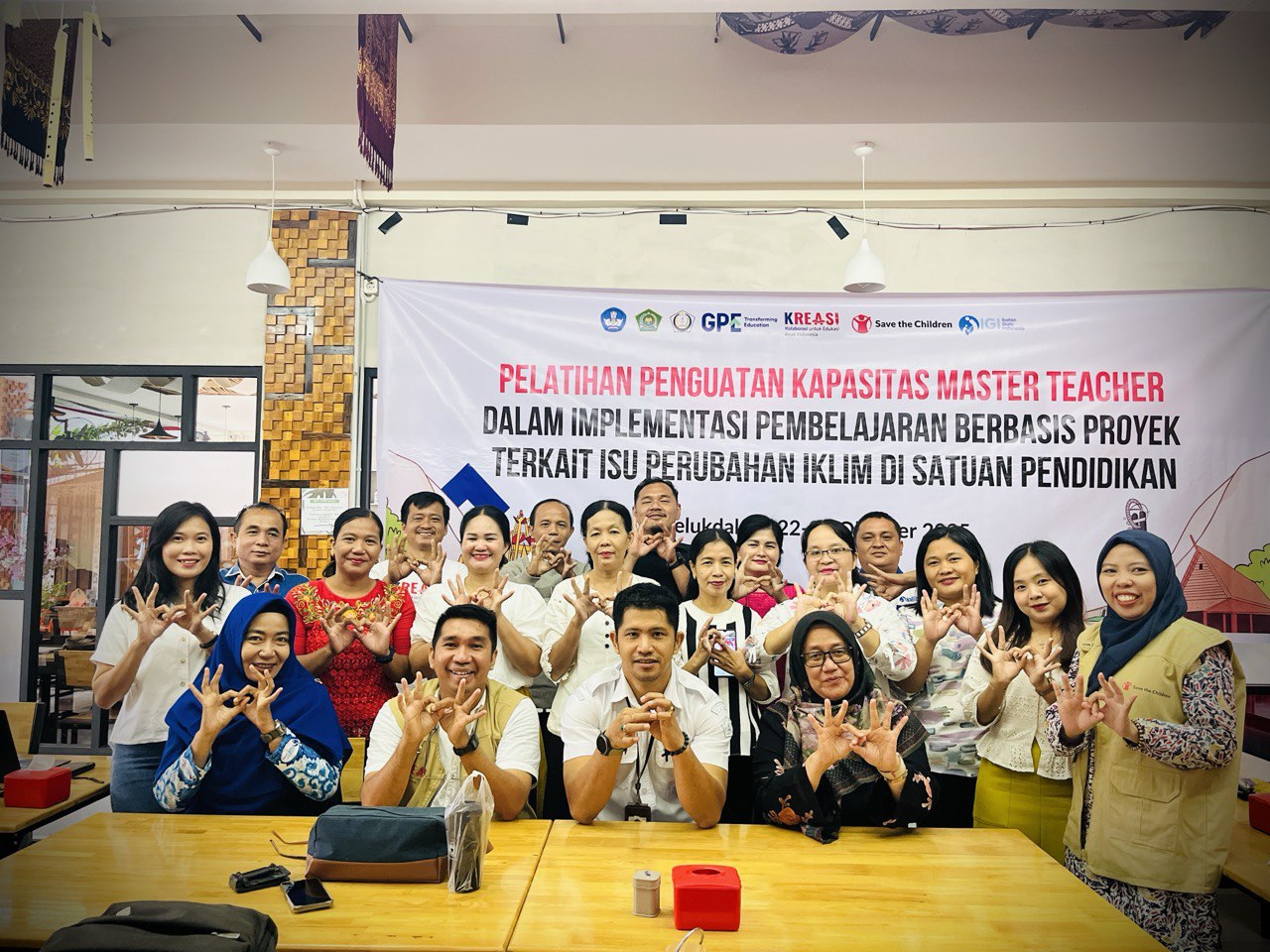
The integration of climate change issues into the primary education curriculum was strengthened through a capacity-building training for master teachers. The training, which focused on applying Project-Based Learning (PBL) methods to climate change topics, was attended by 14 master teachers from 22–24 October 2025. The activity aimed to equip teachers with PBL and inquiry methods that are relevant to environmental challenges, both global and local.
The training was attended by the Head of Nias Selatan Education Office, the KREASI District Representative, Provincial Support staff, and resource persons. The training materials focused on two main approaches to learning. The first was Project-Based Learning (PBL), a series of learning activities used to explore themes stemming from challenging contextual problems, designed to encourage students to investigate, solve problems, and produce products or actions. The second was Inquiry-Based Learning (IBL), a learning approach that emphasizes the process of asking questions, exploring, and independently finding answers by students.
Resource person Siti Amelia highlighted the role of teachers in IBL: “In Inquiry-Based Learning (IBL), teachers are no longer mere providers of information, but facilitators of exploration. This approach trains students’ critical and analytical thinking skills,” she said.
The training specifically explored the links between PBL and IBL and global issues, namely the Sustainable Development Goals (SDGs) and Global Citizenship Education (GCED). SDGs and GCED provide real-world contexts for inquiry, and teachers were encouraged to use real world connection, that is, ways to link classroom lessons with students’ daily lives so that learning feels relevant and important. One example discussed was connecting SDG 12 (Responsible Consumption and Production) with the question, “Where does leftover food at school go?”
As a concrete result of the training, participants designed various Zero Waste School (ZWS) ideas that are relevant for implementation in their schools. These ideas included beach clean-up and plastic waste processing activities, making compost from leftover lunch, establishing a school waste bank called “Tabe” inspired by local Nias values of politeness, and a “one student, one plant” movement.
The implementation of PBL was followed by a discussion on authentic assessment, which evaluates tasks that reflect the real-life context of students, from planning to presenting project data. It is expected that these 14 master teachers will be able to implement significant changes in learning practices in their respective schools, helping to shape students who are environmentally conscious and able to think critically.
_____
The Program of KREASI or Kolaborasi untuk Edukasi Anak Indonesia (Collaboration for the Education of Indonesian Children) is funded by the Global Partnership for Education, developed by the Ministry of Primary and Secondary Education, and the Ministry of Religious Affairs. KREASI is being implemented by Save the Children with Ikatan Guru Indonesia and support by the Government of Nias Selatan. KREASI aims to improve the quality of education in Indonesia by strengthening teaching, learning, and student development.
_____
Writer: Afnidar Dakhi | Editor: Andika Ramadhan | Photo: Afnidar Dakhi/KREASI/Ikatan Guru Indonesia/Save the Children