


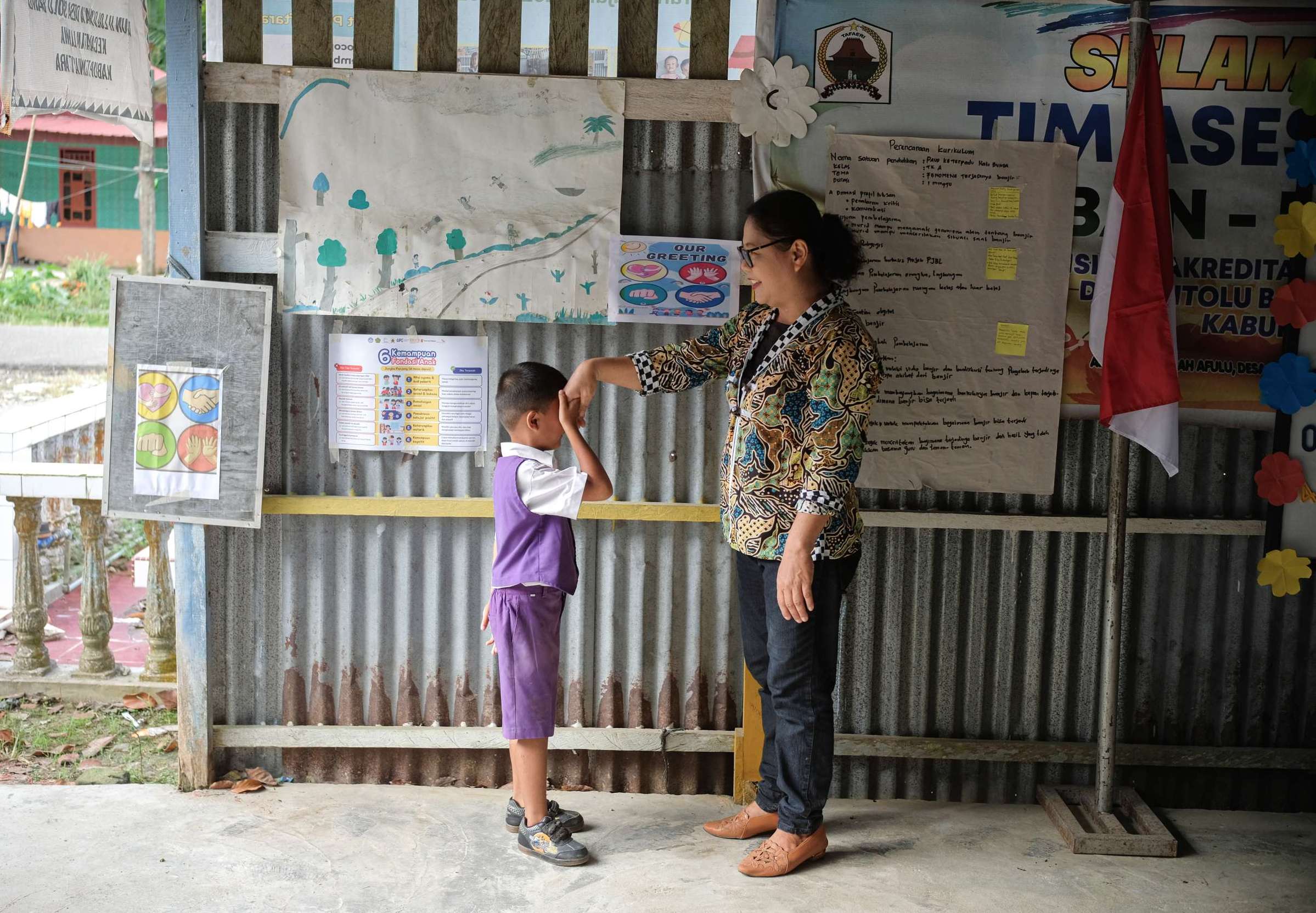
There is nothing more complex than guiding children to think freely without limiting how they see the world. That was the first thing Murniati realized after years of teaching, especially at an early childhood education center (PAUD) in North Nias.
The school stands by the roadside, a simple room of about four by six meters that turns into a classroom every morning and later becomes the family’s vehicle garage. Before the children arrive, Murniati and the other teacher always make sure the small space is clean, swept, and rearranged to resemble a proper learning room.
A graduate of English Literature, she grew up close to words and stories such as Hamka, Sutan Takdir, and old Indonesian novels that slipped into her mind while other children were busy chasing grades. But in that noisy little classroom, all the theory seemed to dissolve into the air. Teaching young children, she said, is like “becoming a child again”, playing again and being amazed again by small things once taken for granted.
For seven years, her routine was almost without surprise: writing lesson plans, greeting the children, writing on the board, singing, then closing the lesson with a prayer. She followed the book or copied what she saw from other teachers, like many others did, and rarely talked about why children so quickly became bored. “We only taught the way we knew,” she said once, “without really understanding how they actually learn.”
Then an invitation camem, a training from the KREASI Program, introducing a Project-Based Learning (PBL) approach for young children. At first she hesitated. Who could guarantee that this new method would work in a small village PAUD? But her curiosity was stronger than her doubt. “I just wanted to know,” she said.
The training showed her a new way of teaching she had never imagined before. Facilitators came from different cities such as Jakarta and even Makassar, bringing many new ideas about how children learn: project-based learning, six foundational abilities for children, and collective reflection. Behind all those formulations, she found one simple message. “We realize that when children play, they are not just having fun. They are actually learning to understand shapes, colors, and relationships between objects.”

One of the first projects she tried with her students was about “floods.” She wanted the children not only to hear an explanation, but to see how water works. They made artificial rain from used bottles, built bridges from cardboard, and watched for themselves how puddles formed. Amid laughter and splashes of water, the children learned cause and effect. It was knowledge born from experience, not just stories.
Of course, not everything went as smoothly as hoped. The early days were full of confusion. The children did not immediately understand what a “project” was, which was natural. Some even lost enthusiasm because they were not used to it. But Murniati knew that understanding takes time. She gave them space to try, to fail, and to laugh at their failures together. “The first three days were tough,” she recalled, “but after that, the class felt full of energy.”
Today, she sees something different in her students’ faces. They are braver, more curious, and more independent. A student who used to cry every time her parents left now plays without tantrums. “She even often leads the prayer before learning,” she said, pointing to the short-haired girl happily singing to herself.
For Murniati, the children’s progress is also a mirror of her own growth. She no longer stands as a teacher who has to know everything, but as a companion who is also searching for answers. “I used to think a teacher’s job was to make children understand,” she said. “Now I ask more questions together with them instead of just telling.”
As a Master Teacher (MT), Murniati now carries another responsibility: sharing these good practices with other teachers. The first time she was asked to cascade what she had learned at her school, she felt awkward, especially because the participants included her own principal. But slowly, the nervousness turned into confidence. She revisited her notes from the training, studied the materials sent through the WhatsApp group, and shared her experience as honestly as she could, without exaggeration. “I don’t judge myself,” she said, “but they told me I did well.”
Interestingly, the story does not stop in the classroom. It is not only Murniati who feels the change. Parents are beginning to see it at home.
Martina, a mother of two PAUD students, shared, “My children now like to wake up early, pray, and not throw trash carelessly. They’ve also started writing, scribbling, even reminding us to pray before going to sleep.”
She added that what she appreciates most is not just academics, but attitudes. Her children have become more polite and more confident socially. “We really support this,” she said. “If the kids are reluctant to go to school, we’re the ones who insist on taking them.”
In that conversation, Murniati’s eyes seemed to sparkle. For her, small things like that are proof that the efforts of teachers are not in vain.
Now, every time she writes a lesson plan, Murniati no longer starts with a list of activities, but with one question: what can make the children curious today?

Among the sounds of laughter, alphabet posters, and crayon scribbles on the walls, she keeps finding answers that constantly change, much like the natural phenomena they once learned about together.
Every day, after class ends, those little tables are pushed aside, the blackboard is moved back against the wall, and the room becomes a garage again. But for Murniati and the other teachers, that space still holds echoes of small voices and a sense of curiosity that is reborn each morning among the tiny chairs and posters of fruits, animals, and colorful pictures on the wall.
_____
The Program of KREASI or Kolaborasi untuk Edukasi Anak Indonesia (Collaboration for the Education of Indonesian Children) is funded by the Global Partnership for Education, developed by the Ministry of Primary and Secondary Education, and the Ministry of Religious Affairs. KREASI is being implemented by Save the Children with Article 33 Indonesia nd support by the Government of Nias Utara. KREASI aims to improve the quality of education in Nias Utara by strengthening teaching, learning, and student development.
_____
Writer: Adzwari Ridzki | Editor: Andika Ramadhan | Photo:Adzwari Ridzki/KREASI/Article 33 Indonesia/Save the Children