


By Aziz Setiawan
In a simple classroom in Pesisir Barat, Lampung, the sound of children laughing and singing is music to my ears. In the past, I thought that silence in the classroom was a sign of successful learning. But now I know: the sound of laughter, movement, and burning curiosity are true signs that the learning process is really happening.
I am Aziz. I have been teaching for more than ten years, and only recently have I felt like I have truly become an educator. The moment of change came when I realized that my approach so far had not really facilitated children to be active, think, and feel happy in learning. I have been “gently slapped” by the realization that learning is not enough. Just filling in worksheets doesn’t mean knowledge is growing. Children need to be involved, play, and feel happy to really learn.
The reality we face in Pesisir Barat is quite challenging. Many young children still struggle with letters by the age of six. A large number have difficulty understanding the basic concepts of numbers 1-10. This is inseparable from the learning approach that is broadly used here, very traditional and centered on the teacher, relying on memorization, and using worksheets as the main way to measure what has been learnt.
Another challenge is the gap in teachers’ understanding of how young children actually learn. Many early childhood and lower-grade teachers aren’t yet accustomed to using active learning methods like storytelling, games, or other joyful approaches.
That started to change for me when I was selected as one of the Master Trainers in the KREASI Program.
The KREASI Program is a strategic initiative of the Government of Indonesia, supported by the Global Partnership for Education (GPE) through the Multiplier Grant. It focuses on early childhood and primary education, aiming to improve foundational skills and strengthen child protection efforts. In Pesisir Barat, the program is implemented by Save the Children Indonesia in collaboration with the local partner Yayasan Guru Belajar (YGB).
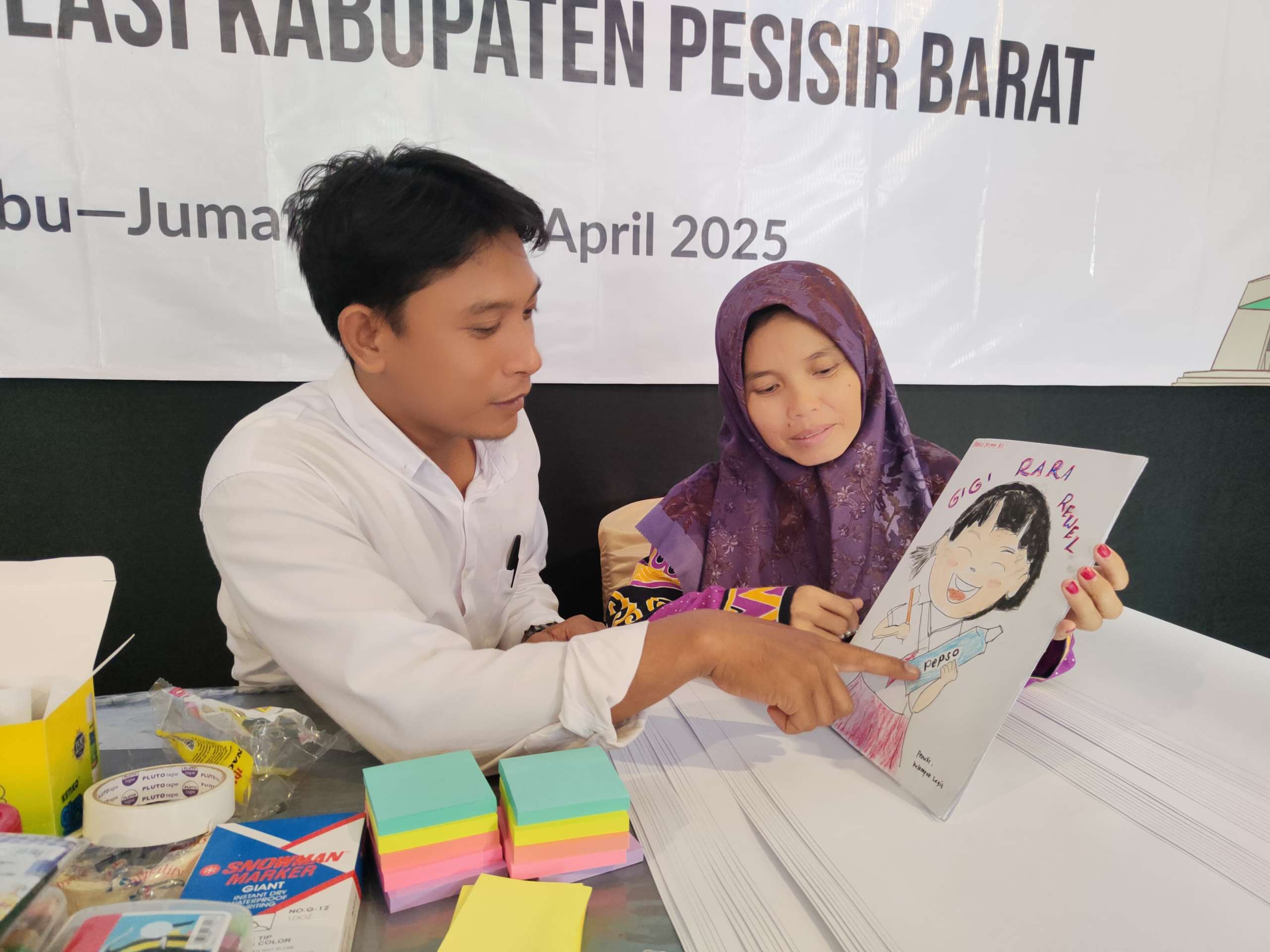
In the training, we received material and direct practice on play-based learning, literacy approaches through storytelling, contextual numeracy strategies, and observation-based formative assessments. More than just theory, this training changed the way we see the classroom and understand children. Interactive training methods such as peer teaching, hands-on practice in class, and reflective discussions made our learning process very enjoyable and meaningful. I felt enthusiasm for learning again, just like the children I teach feel.
After the training, I started implementing a new approach in class. I used folklore as a gateway to literacy, invited children to cook to introduce the sequence and concept of numbers, and inserted traditional songs and games to support their numeracy learning. The results were extraordinary, the children were more enthusiastic, more active, and even understood concepts that previously felt difficult faster.
Not only in my class, but this change also began to spread to colleagues in the Teacher Working Group (KKG). Now, there are 14 teachers who are implementing the play-based learning and storytelling methods. One of them, Vitadi, a grade 2 teacher, said, “I learned that introducing numbers is not only about writing, but also through playing and telling stories.”
From this experience, I learned that literacy and numeracy are not just about being able to read or count, but about how children feel comfortable, happy, and actively involved in the learning process. Meaningful learning only happens when teachers are willing to continue learning and growing.
I hope that initiatives like KREASI can continue to be expanded, reaching more teachers in disadvantaged areas. Support for teacher practice communities, provision of children’s story books, and educational play tools will greatly help strengthen this change.
Change doesn’t always have to be big. Sometimes, a story read with love, a counting song sung together, or a simple game that makes children laugh can all be the beginning of a brighter future. And it all starts with one teacher… who dares to step forward.
Author: Rikson Simanjuntak (KREASI District Representative for Pesisir Barat)
Editor: Laras Sabila Putri (KREASI Communication and Media Manager)
Translator: Anggi M. Nasution (KREASI Innovation, Impact and Knowledge)