


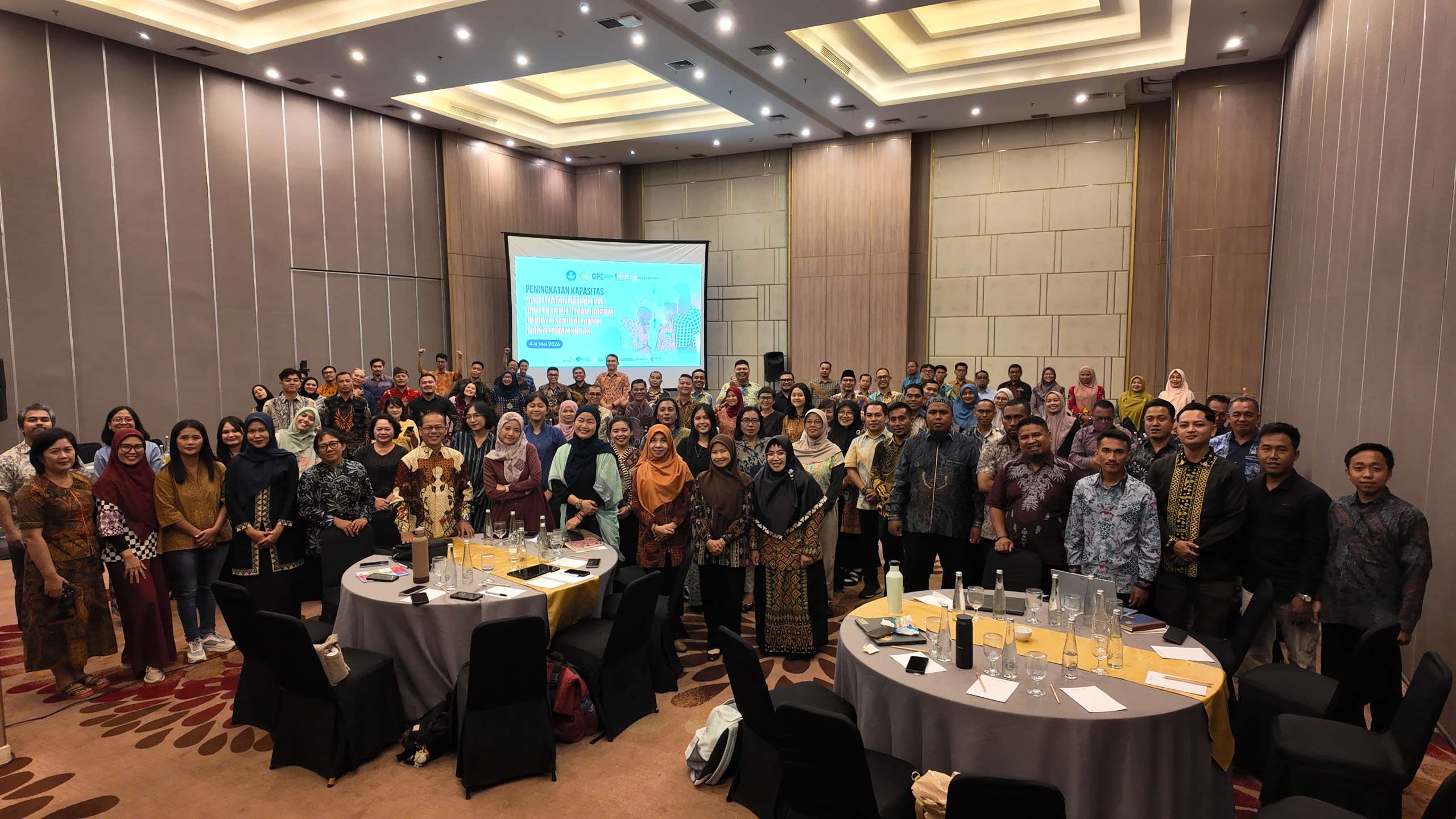
The KREASI Program held a capacity-strengthening activity for Principal Professional Development (PPD), and child protection through Safe and Comfortable School Culture (Budaya Sekolah Aman dan Nyaman/BSAN) bringing together regional facilitators from 8 districts on 5-8 May 2026.
This activity is part of efforts to strengthen facilitators’ capacity in supporting improvements in literacy, numeracy, instructional leadership, and the development of BSAN.
Through tiered training or Training of Trainers (ToT), regional facilitators are expected to be able to support schools and madrasahs more effectively, both in improving the quality of learning and in ensuring children’s safety and comfort within the education environment.
In her remarks, Chief of Party of KREASI Save the Children, Alifah Sri Lestari, emphasized the importance of an integrated approach in program implementation.
“An integrated approach is needed so that children’s learning can run optimally. Therefore, packages such as TPD, PPD, and BSAN are needed and will be implemented by regional facilitators. These are expected to improve literacy and numeracy, as well as strengthen an integrated system for child safety,” said Alifah.
Meanwhile, Head of the Basic and Secondary Education Policy Agency, Ministry of Primary and Secondary Education, Toni Toharudin, in his remarks and official opening of the activity, emphasized that the activity was not merely a training, but a meeting point of major forces in education, namely school leadership, BSAN, and impactful learning.
“Today is not merely a training, but a meeting point of major forces in education: school leadership, BSAN, and impactful learning,” he said.
According to Toni, the KREASI Program is a concrete example that education transformation cannot be carried out alone. Education transformation requires collaborative, cross-sectoral work, as well as a commitment to sustainability.
He emphasized the importance of school leadership in driving changes in the quality of learning. According to him, the quality of a school will not exceed the quality of its leadership. Principals play an important role as leaders of a learning culture and as drivers of teachers in maintaining the quality of classroom learning.
“We must accelerate the improvement of teacher quality in schools. Teacher training can no longer be merely certificate-based or conducted in hotels. Instead, it needs to shift the training mindset into a process of experimenting in the classroom, without leaving the school, monitored by principals and supervisors, and followed by reflection,” he explained.
He emphasized that changes in leadership and learning practices cannot be carried out in a one-way manner. Continuous mentoring is needed in the target areas, along with a dissemination process, so that a stronger education ecosystem can be built.
In this context, the role of regional facilitators becomes highly strategic. Data needs to be used as a tool to map the condition of each school contextually, so that mentoring can be carried out according to the real needs on the ground.
“The role of coaches, such as regional facilitators, is crucial. Data becomes a tool to map the condition of each school, so that interventions are important, appropriate, and contextual,” he said.
Furthermore, Toni emphasized that deep learning will not happen in schools that are not safe. Therefore, BSAN must be seen as the main foundation of learning quality, not as an additional program.
“There is no deep learning in an unsafe school. A safe school enables children to think critically and be creative. BSAN is not an additional program, but the main foundation of learning quality,” he stressed.
He also highlighted that Indonesia has conducted many trainings for teachers, principals, and education personnel, as well as curriculum changes. However, the biggest challenge is ensuring that classroom learning practices truly change. He hopes that various priority strategies implemented over the next three years can drive real improvements in literacy and numeracy.
One of the strategies being promoted is Teacher Experiential Training (TET), an approach that positions teachers as researchers in their own classrooms. Through this approach, teachers are not only training participants, but also conduct data-based diagnosis, map students’ weaknesses, apply the teaching at the right level approach, try out deep learning strategies, and carry out reflection together with principals and supervisors.
“This cycle will continue to repeat. If reflection is carried out regularly, the quality of students and teachers will improve. This is the engine of learning transformation,” said Toni.
Meanwhile, Head of the Sub-Directorate of Curriculum and Evaluation, Directorate of Madrasah Curriculum, Facilities, Institutions, and Student Affairs, Directorate General of Islamic Education, Ministry of Religious Affairs, Abdul Basit, emphasized that building BSAN is not enough if it is only carried out within schools and madrasahs. According to him, parents and communities also need to be involved so that a safe and comfortable learning environment can truly be realized.
“Building BSAN is not enough if it is only done within schools and madrasahs. It must also involve students’ parents. In this way, a safe and comfortable environment can be realized, including preventing the re-emergence of violence, the definition of which has also continued to evolve,” he said.
He also stated that the presence of KREASI through tiered training down to schools and madrasahs is expected to build a shared perception among education stakeholders. According to him, BSAN should not be seen merely as a program, but as part of a culture and a shared responsibility.
“This is not only a program, but an effort to build a Safe and Comfortable School culture as a shared responsibility, while taking into account the heterogeneity of schools and madrasahs,” he added.
Basit also expressed hope that participants would disseminate the learning to other schools and madrasahs. This is important because not all education units have the same opportunity to participate in the training directly.
Through this capacity-strengthening activity, KREASI hopes that regional facilitators can strengthen their role in supporting schools and madrasahs. PPD and BSAN are expected to encourage real change in teacher-student interactions in the classroom, so that the quality of learning improves and education for all can be achieved.
This activity also used a participatory approach through various learning methods, such as discussions, case studies, reflection, and practice. This approach is expected to make the training more contextual, applicable, and impactful for participants and the education units they will support.