


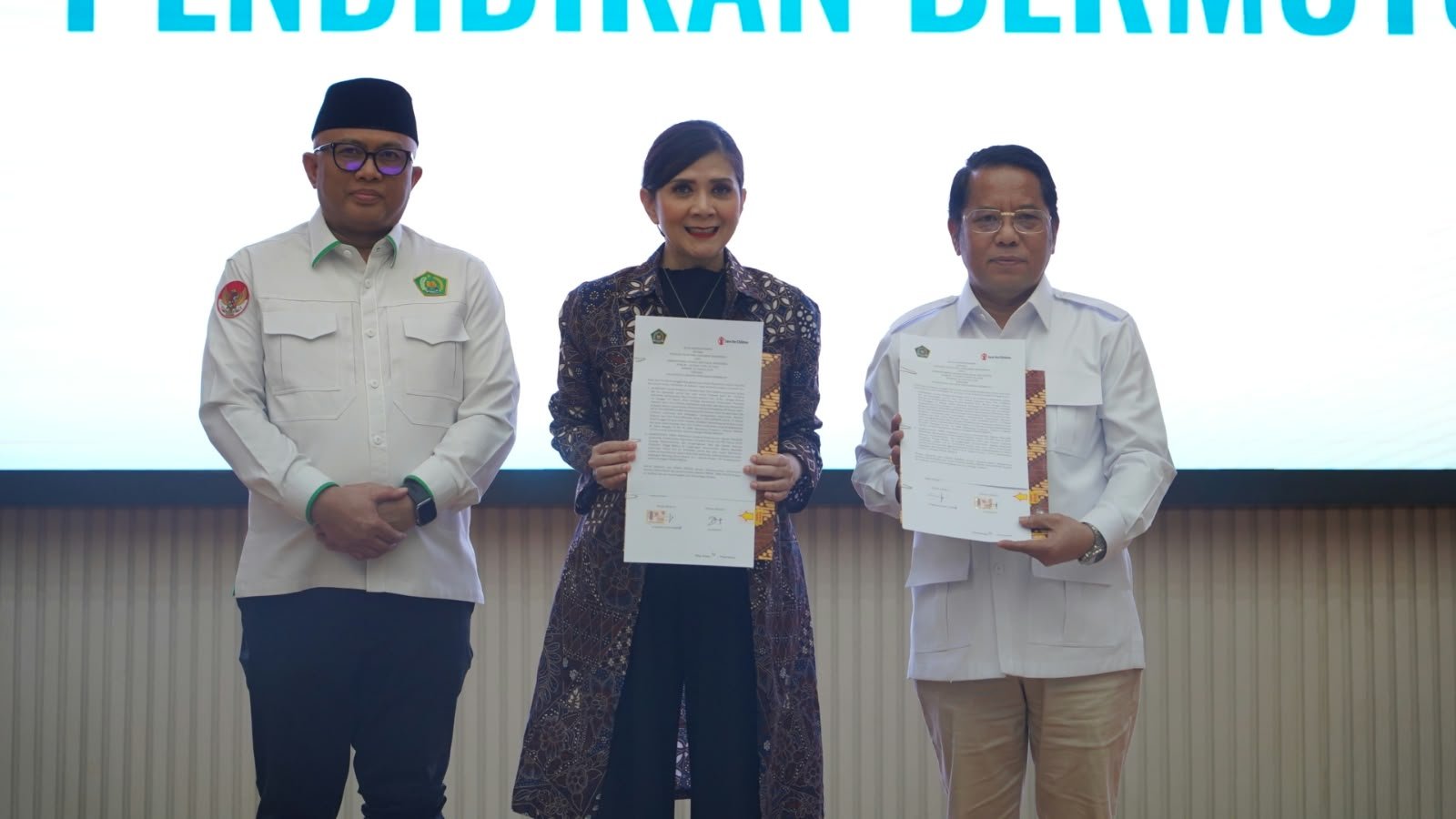
The Ministry of Religious Affairs of the Republic of Indonesia and Save the Children Indonesia signed a Memorandum of Understanding on Supporting Quality Education Services in Jakarta on 21 September 2026. The partnership marks an important step toward strengthening the ecosystem of madrasahs and Islamic boarding schools (pesantren) to become safer, more inclusive, equitable, child-friendly, and more resilient to climate change and disasters.
“This collaboration between the Ministry of Religious Affairs and Save the Children Indonesia is a noble step toward preparing Indonesia’s future generations. It should not stop at a signed document, but serve as a foundation for concrete programs that improve the quality of education services, particularly for madrasahs, pesantren, and other religious education institutions,” said Kamaruddin Amir, Secretary General of the Ministry of Religious Affairs.
The partnership focuses on strengthening the capacity of teachers, education personnel, and school leaders in areas including literacy and numeracy, school management, child protection, gender equality, mental health support, child participation, and disaster preparedness and resilience in the face of climate change.
This collaboration also brings together faith-based educational values and environmental stewardship. Through an ecotheology approach, students can be encouraged to understand that protecting the environment is a shared responsibility toward both current and future generations.
The partnership builds on a range of experiences and good practices that have already been implemented to support education and children’s rights.
Through the KREASI Program (Kolaborasi untuk Edukasi Anak Indonesia), supported by the Global Partnership for Education and the Indonesia Local Education Group (Mitra Pendidikan Indonesia), co-chaired by the Ministry of Primary and Secondary Education and the Ministry of Religious Affairs, efforts have been made to strengthen literacy and numeracy, enhance child protection, and create safe and inclusive learning environments in Indonesia’s frontier, outermost, and disadvantaged regions (3T areas).
Meanwhile, through the We See Equal (WSE) Program, supported by Procter & Gamble, Save the Children Indonesia and the Ministry of Religious Affairs have worked together to promote gender equality, strengthen child protection, and expand mental health support within madrasahs.
These experiences are further complemented by lessons learned from the Climate Generation Action Campaign (Aksi Generasi Iklim/AGI), which encourages children and young people to actively participate in addressing climate change. In addition, through its humanitarian programs, Save the Children Indonesia has supported efforts to strengthen the resilience of children and educational institutions in responding to disasters, climate change, and various crisis situations.
“This partnership reflects Save the Children Indonesia’s commitment to supporting the fulfillment of children’s rights in Indonesia, including ensuring every child’s right to education, particularly within religious education institutions under the Ministry of Religious Affairs. We demonstrate this commitment by continuously aligning our programs with the Ministry’s priority initiatives, such as the Love-Based Curriculum, Ecotheology, and Child-Friendly Madrasahs and Pesantren, so that our collaboration can generate broader benefits and greater impact for children across Indonesia,” said Dessy Kurwiany Ukar, CEO of Save the Children Indonesia.
Through this Memorandum of Understanding, Save the Children Indonesia hopes that the lessons learned and good practices developed through these initiatives can be connected with the Ministry’s policies and priorities, creating opportunities for further adaptation, expansion, and replication across more madrasahs and pesantren.
Moving forward, both institutions are expected to translate this partnership into concrete actions, including capacity-strengthening initiatives, policy and guideline development, knowledge exchange, program integration, and the scaling up of effective practices.
Ultimately, this collaboration seeks to support education services that go beyond academic achievement alone. It aims to ensure that every child can learn in an environment where they are safe, able to grow and thrive, heard and included, and provided with protection and equal opportunities to reach their full potential.