


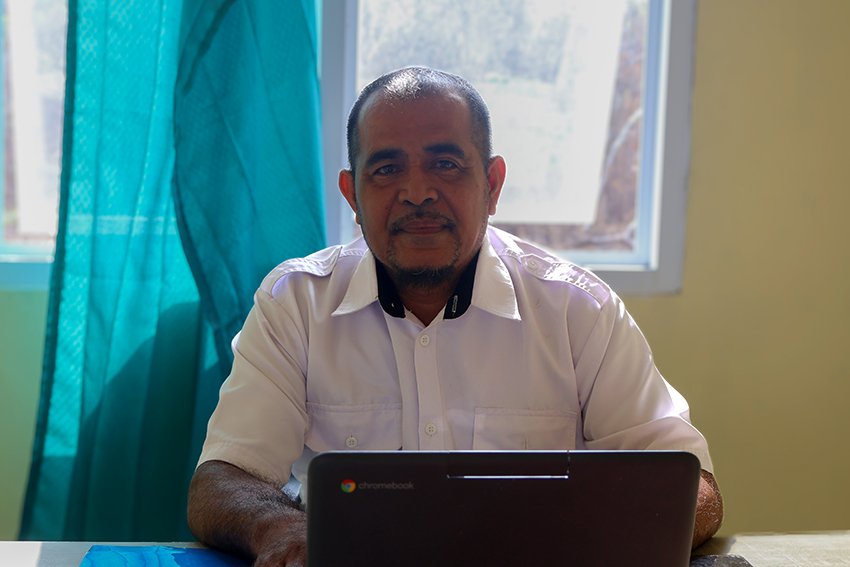
For years, Simson’s school supervision followed a familiar routine: checking whether teachers had completed their lesson plans, syllabuses, and other required documents. If the paperwork was in order, it was usually taken as a sign that teaching was going well.
But after joining KREASI’s training and mentoring activities, Simson began to question that assumption. A complete lesson plan, he realised, did not always reflect what was actually happening in the classroom or whether students were learning.
“My supervision used to focus on administration rather than students. I would check whether teachers had their lesson plans and syllabuses. If a teacher scored highly on administrative requirements, we assumed they were doing a good job. But when we looked at what was actually happening in the classroom, we found that the paperwork didn’t always match the teaching practices,” Simson explained.
This also affected how teachers spent their time. Some were more focused on completing administrative requirements than on what students needed during lessons. Simson still considers lesson plans and other teaching documents important, but he now sees them as only one part of effective teaching.
When his school first became part of the KREASI Programme, Simson was not immediately convinced that the programme would be helpful. In fact, he worried it would mean more work for him and his teachers.
“When I first heard that KREASI was coming to our school, I thought, ‘Oh, this is definitely going to mean more work.’ But as we went through the process together, I realised it was different. KREASI actually helped make our work easier and offered ways to address the problems we were facing,” he recalled.
Through KREASI’s training and mentoring, Simson began changing how he conducted supervision. Alongside reviewing teaching documents, he started spending more time observing lessons, looking at how teachers explained the material, how students responded, and where they might be struggling.
He also began bringing his observations to KREASI’s Peer Learning sessions, where headteachers from different schools meet to discuss challenges and exchange ideas.
“The topics in Peer Learning vary, but every session brings up issues we’re thinking about or dealing with at school. What I appreciate is that we’re not there to lecture one another. We share solutions that we can actually try in our own schools. Previously, our teacher and headteacher working groups, KKG and K3S, focused more on administrative matters. It was through KREASI that I started having discussions about how to solve teaching challenges and encourage teachers to be more creative,” Simson said.
One issue they discussed was the frequent use of lecture-style teaching. When teachers spent most of the lesson explaining material, students sometimes struggled to stay focused. During Peer Learning, Simson and the other headteachers explored ways to make lessons more engaging by using learning materials such as cards, videos, and interactive boards already available at school.
When teachers began trying these approaches, Simson noticed that students were paying more attention and participating more actively. Problems he had identified during classroom observations were no longer simply recorded as supervision findings. They became topics for discussion, followed by changes that teachers could try in their lessons.
Simson also noticed a difference in how teachers responded to children who struggled with reading or numeracy. In the past, students who could not read fluently or solve basic calculations were sometimes reprimanded or told to practise more at home. Now, teachers were beginning to offer more individual support, guiding children through tasks step by step.
“Now, when a student struggles to read, the teacher comes closer and guides them through it. The teacher shows them what to do, patiently and clearly. With this approach, students no longer feel afraid. They begin to realise that learning doesn’t have to be difficult or frightening,” Simson explained.
He recalled one student who had become so uncomfortable during lessons that they were reluctant to come to school. After the teacher tried a different approach to literacy instruction, the child gradually began taking part in classroom activities again alongside their classmates.
For Simson, this was an important change. Classroom supervision was no longer just about identifying what teachers had or had not prepared. It gave him a way to understand the difficulties students faced and work with teachers to address them.
The process has also changed what happens after a classroom observation. Rather than keeping supervision findings as administrative records, Simson can discuss them with fellow headteachers, consider different approaches, and work with teachers to try practical solutions.
“The point is, we should be focusing on students and teachers, not administration.”
_____
KREASI is a program aimed to improving education quality by strengthening literacy, numeracy, and character development across eight districts in four provinces of Indonesia. KREASI is managed by Save the Children, implemented by local partners, and funded by Global Partnership for Education (GPE), with supported by Indonesia Local Education Group, led by the Ministry of Primary and Secondary Education (Kemendikdasmen) and the Ministry of Religious Affairs (Kemenag).
Writer: Ayutama Putri Jordy | Editor: Laras Sabila Putri | Photo: Ayutama Putri Jordy/KREASI/Stimulant Institute/Save the Children