


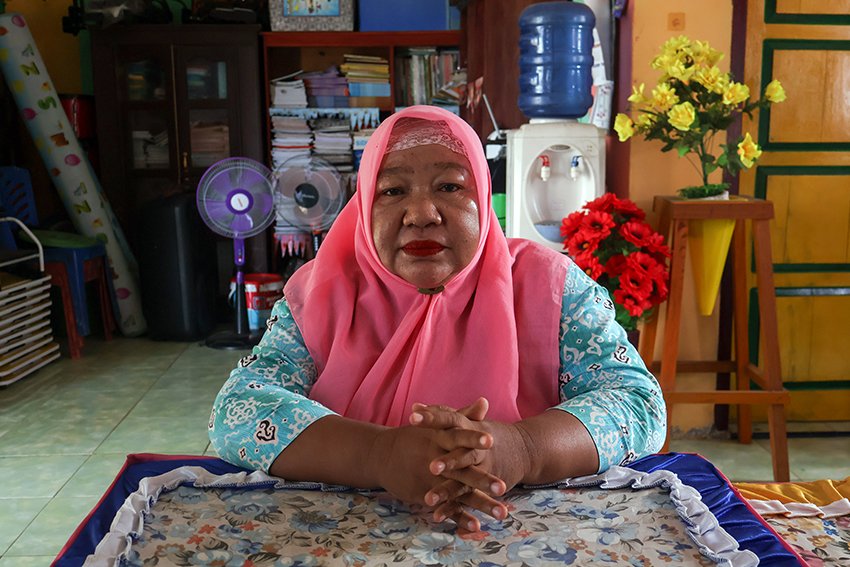
Every day, students in Grades 1, 2, and 3 at Nuryati’s school have 15 minutes set aside for reading. But the activity was not working quite as she had hoped. Children were often asked to read on their own, with little guidance from their teachers.
“The children usually just read by themselves, so they weren’t very motivated,” recalled Nuryati, a headteacher at a KREASI-supported school in Morotai, North Maluku.
Nuryati has been a headteacher since 2006. Every six months, she conducts academic supervision, reviewing teachers’ lesson plans and other teaching documents while also observing classroom activities. Over the years, she noticed that teachers tended to focus more on completing their teaching documents and delivering lessons according to plan.
“In the past, what mattered was that the material had been taught. Whether the children actually understood it wasn’t always given much attention,” she said.
After taking part in KREASI training and mentoring, Nuryati began using a classroom observation checklist to look more closely at how teachers conducted their lessons. She identified several areas for improvement, such as teachers not connecting new lessons to what children already knew, difficulties in classroom management, and the absence of classroom agreements established with students before lessons began.
Previously, these findings were mostly discussed within individual schools. School supervisors were not always able to visit in person, either. This made KREASI’s Peer Learning sessions particularly useful for Nuryati, giving headteachers from neighbouring schools a chance to meet, share experiences, and discuss the challenges they faced.
“In Peer Learning, we don’t just talk about teaching documents. We also discuss how teachers put their plans into practice, including how they manage the classroom and explain lessons to students,” she explained.
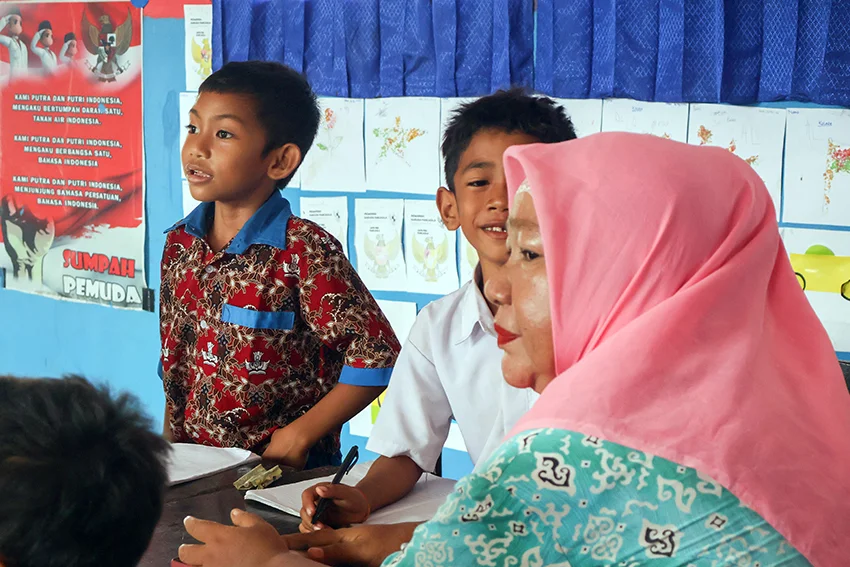
Through these discussions, Nuryati picked up ideas that she later shared with teachers at her school. One was to make better use of equipment they already had, such as projectors and televisions, which had rarely been used for teaching.
She also introduced syllable cards made from paper and cardboard. Teachers could mix up the cards and ask children to arrange them into words, turning reading practice into a simple game.
Another area Nuryati paid attention to was reflection at the end of a lesson. She found that some teachers were still not in the habit of checking whether students had understood what they had learned.
“During Peer Learning, we also discussed how some teachers weren’t yet reflecting at the end of their lessons. Reflection is important because it helps us see how well children understand the material and forms part of the learning assessment,” she said.
For Nuryati, reflection does not have to be complicated. After a reading activity, for example, teachers can ask children to identify a new word and break it into syllables. The Indonesian word sepatu (shoe) can be broken down into se-pa-tu, with children clapping along to each syllable. Teachers can also use pictures of fruit to help children recognise vowel sounds in familiar words.
When Nuryati returned to observe classes some time later, she began to notice changes. Teachers in Grades 1 and 2 were using projectors during lessons, and the daily 15-minute reading activity was being done differently.
Instead of reading alone, children now sat in groups while their teacher read stories aloud. They listened and followed the stories together. Reading corners that had previously seen little use were also becoming part of classroom activities.
“I think KREASI’s mentoring has also helped make teaching practices more focused. Through the KREASI activities, I’ve gained experiences and ideas that I can share with the teachers,” Nuryati said.
Nuryati still sees lesson plans and teaching documents as an important part of a teacher’s work. But her experience with Peer Learning has encouraged her to pay closer attention to what happens after those plans are written: how teachers deliver their lessons, how children respond, and what can be done when students struggle to understand.
Today, Nuryati’s supervision findings are no longer just notes she keeps for herself. She can bring them to Peer Learning sessions, hear how other headteachers approach similar challenges, and return to her school with practical ideas to try alongside her teachers.
_____
KREASI is a program aimed to improving education quality by strengthening literacy, numeracy, and character development across eight districts in four provinces of Indonesia. KREASI is managed by Save the Children, implemented by local partners, and funded by Global Partnership for Education (GPE), with supported by Indonesia Local Education Group, led by the Ministry of Primary and Secondary Education (Kemendikdasmen) and the Ministry of Religious Affairs (Kemenag).
Writer: Ayutama Putri Jordy | Editor: Laras Sabila Putri | Photo: Ayutama Putri Jordy/KREASI/Stimulant Institute/Save the Children