


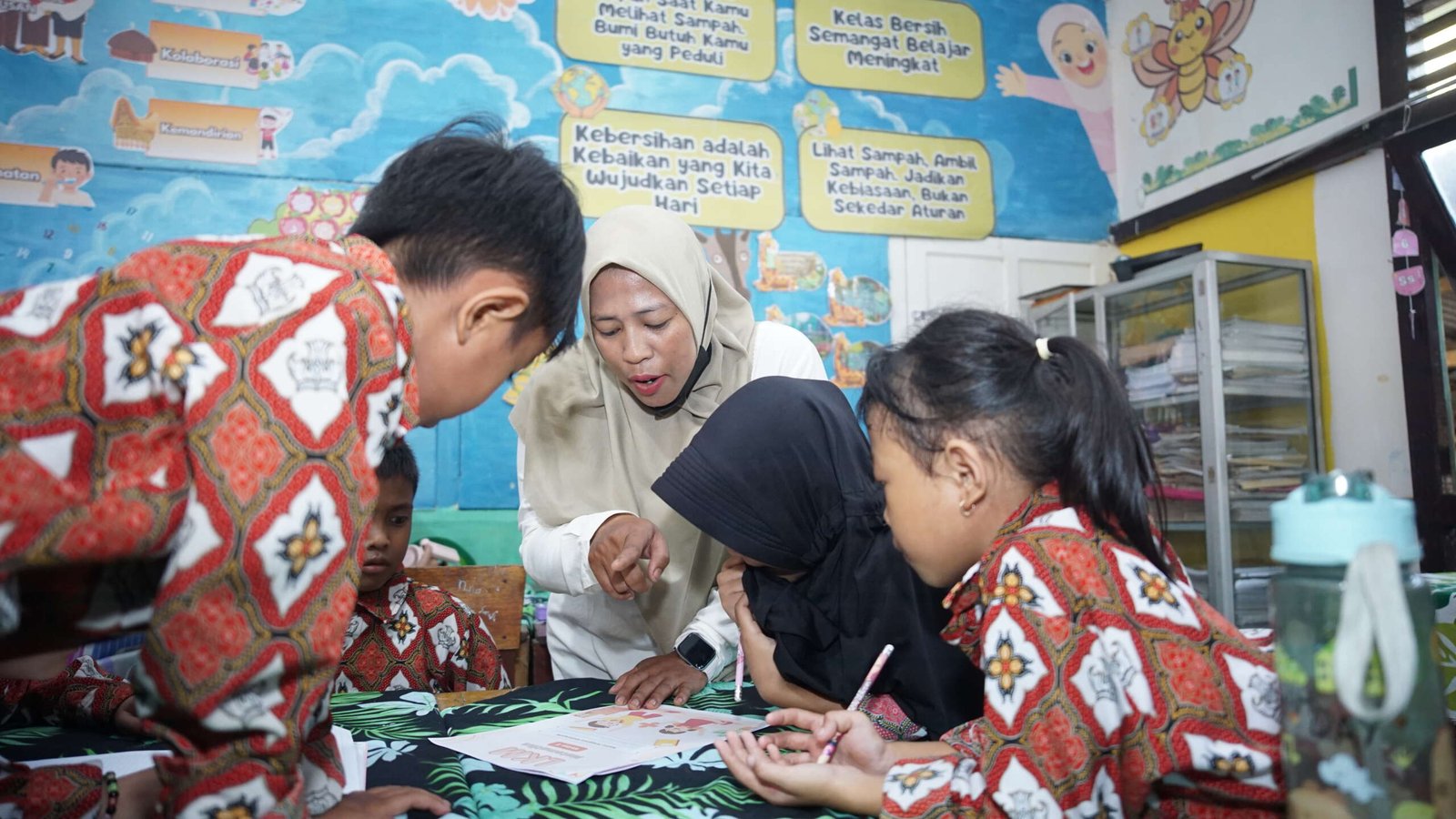
“If we want to change children’s learning environment, we have to start with ourselves. From recycled cardboard to wall paint, what matters most is creating a warm space where children feel comfortable growing and learning,” said Mirna.
Serving as an early grade teacher for many years has not been without challenges, especially in a school with limited learning resources and facilities. This was the reality Mirna faced in her classroom. Before the KREASI Ketapang Program was introduced, the classroom she taught in had faded yellow walls and dusty cement floors. Teaching practices were also largely confined to traditional methods, relying on reading textbooks aloud in front of a blackboard, an approach that often struggled to capture students’ attention. The school’s Education Report Card indicators, which remained in the yellow category, highlighted the urgent need to strengthen literacy outcomes.
The series of trainings provided through the KREASI Program became a significant turning point in Mirna’s teaching journey. Limited materials for classroom activities did not diminish her enthusiasm. Whenever resources ran out, she took the initiative to print pictures of animals and use discarded cardboard to create word-segmenting activities and letter-guessing games. She even transformed used paint containers decorated with astronaut images into interactive number maze learning tools.
“To be honest, I’m not very creative when it comes to drawing freehand. But when we ran out of materials, I asked for pictures to be printed, traced them, and attached them to recycled cardboard. Even the trainers were surprised and asked, ‘How did you come up with that idea?’ I simply kept thinking about how to make learning materials available for the children,” Mirna recalled.
Her efforts did not stop with developing teaching materials. Mirna wanted to transform the entire learning environment. She independently set aside part of the transportation allowance she received from KREASI training activities to purchase white paint, paper, and string. With support from her husband, who helped repaint the classroom walls, and a relative who contributed educational murals, the once dusty classroom was completely revitalized. An interactive reading corner was also created, featuring lanterns, hanging decorations made by students, and a variety of engaging reading materials.
“I saved part of the transportation allowance from KREASI activities to buy white paint. Our classroom walls used to be yellow, so we painted them white first to make the artwork stand out better. My husband painted the walls, and a relative who is good at painting helped create the murals. This classroom is truly the result of collective effort,” she explained.
The physical transformation of the classroom was matched by changes in Mirna’s teaching practices. She began combining interactive digital content with storytelling in the children’s Mother Tongue, helping students understand lessons more easily. The reading corner quickly became a favorite place for students, who were eager to spend time there even during breaks. For children who struggled with reading or came from vulnerable family backgrounds, Mirna adopted a personalized one-on-one approach rooted in empathy rather than punishment. As a result, students who initially could not recognize letters began reading and decoding words fluently within just a few months.
“Children today want to be appreciated and given attention. When a child misbehaves or falls behind, we cannot simply scold them in front of everyone. I invite them to talk privately, and I support them as if they were my own children. Now, instead of fighting, they proudly come to me every morning and say, ‘Teacher, I’ve already read two books today!’” Mirna said with a smile.
The transformation of Mirna’s classroom did not happen in isolation. As other teachers observed the vibrant learning environment she had created, the school designated her classroom as a model classroom. Inspiration spread naturally throughout the school. Teachers from other grades began visiting her classroom to exchange ideas, learn how to create reading corners, and seek guidance on decorating and improving their own learning spaces.
“Thankfully, many of my fellow teachers have started following similar approaches. When they say they do not know how to make learning materials, I help them print resources. I tell them, ‘If you do not have a laminating machine, just use tape to make the materials last longer,’” she added. By the end of the first year of the KREASI Program, these efforts produced remarkable results. The school’s Education Report Card indicators officially improved from the yellow category to the green category.
Mirna’s journey demonstrates that meaningful educational transformation often begins with simple acts of dedication, creativity, and persistence within a single classroom. What started as one teacher’s determination to create a better learning environment ultimately sparked broader change across the entire school community.