


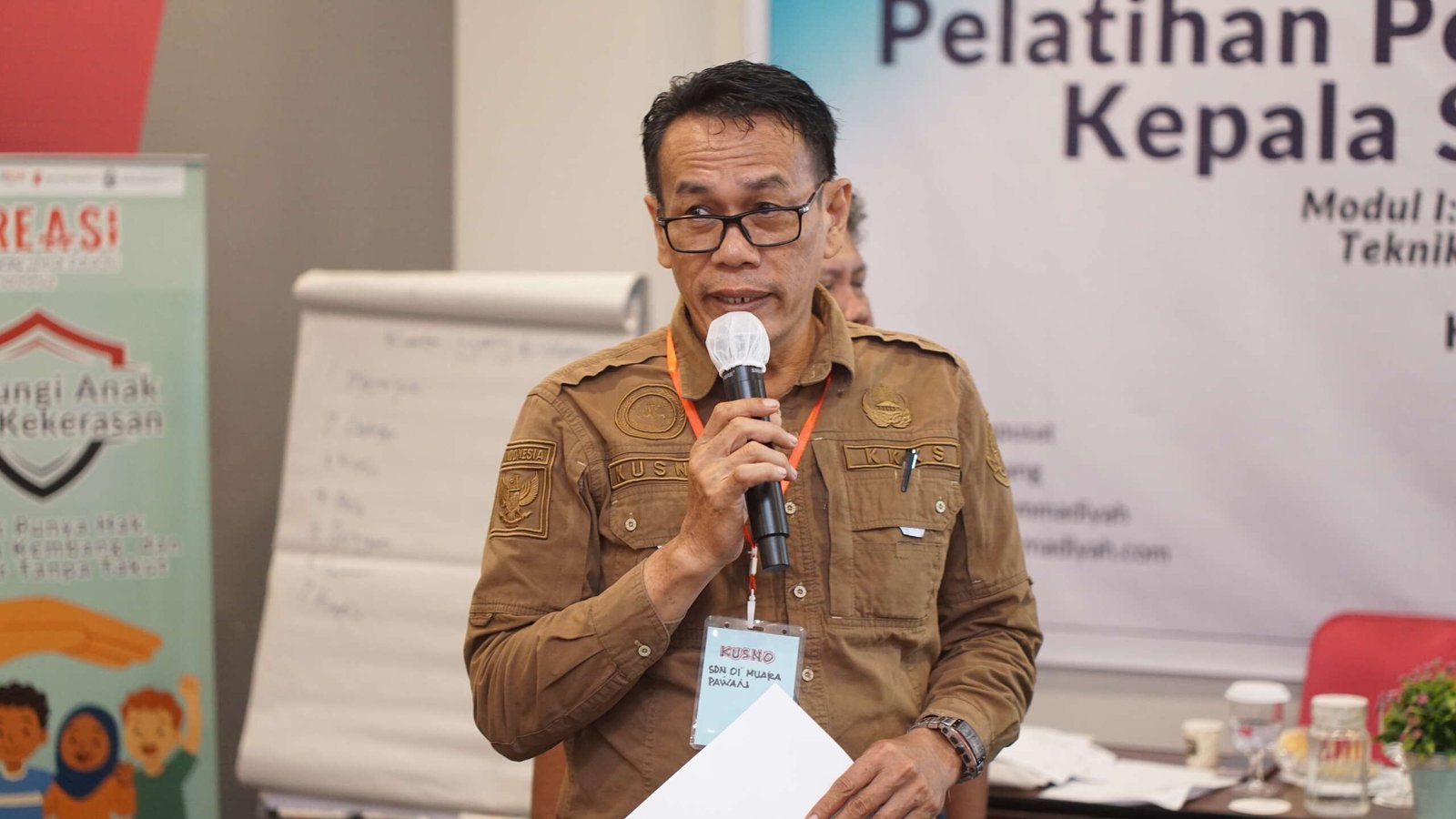
As a principal who has led a public primary school in Muara Pawan, Ketapang, for seven years, academic supervision has long been a routine responsibility for Kusno. However, his participation in KREASI Program training introduced a new perspective on how he supports teachers.
School supervision has often been perceived merely as an administrative obligation or formal assessment. Through KREASI’s supervision and facilitation materials, Kusno began transforming it into a mentoring process. Instead of simply recording shortcomings, he now focuses on listening, asking reflective questions, and appreciating the positive practices already taking place in classrooms. This approach has fostered more open and collaborative working relationships to improve the quality of student learning.
“Supervision is not about how many of a teacher’s mistakes we can document, but about how we support teachers through reflective discussions so they can find their own solutions,” Kusno said.
Applying the Approach in the Classroom: Building Reflective Conversations
Kusno applied this new approach while supervising a class implementing Deep Learning. After completing the observation, he did not immediately deliver a one-way evaluation. Instead, he opened the discussion by expressing appreciation and asking simple questions:
“Which part of today’s lesson do you think went as expected? If you were to teach this lesson again, which part would you like to improve?” he asked.
Through these questions, the teacher was encouraged to reflect on the lesson she had just delivered. She was able to identify challenges independently, including the limited opportunities provided for students to engage in discussion. Kusno and the teacher then worked together to develop practical and realistic improvements. This non-judgmental communication approach made the supervision process feel more comfortable for the teacher.
Transforming School Meeting Dynamics
Kusno also applied the facilitation principles he gained from the training to formal school meetings. He began providing more opportunities for teachers to share the challenges they faced and their classroom experiences.
By asking open-ended questions, Kusno made the meetings more dynamic. One young teacher who was usually quiet found the confidence to propose using simple digital learning media. Her suggestion prompted responses from other teachers. Meetings that had previously been dominated by instructions from the principal gradually became spaces for interactive discussion among teachers.
Gradual Changes in the Working Culture
For Kusno, the changes taking place in his school are part of an ongoing process. The most noticeable results have been teachers’ growing openness to feedback and their willingness to evaluate their own teaching practices. “Education continues to evolve, so our leadership approaches must also adapt. School principals do not only serve as administrators but also as instructional mentors for teachers. When teachers become accustomed to reflecting and developing their capacities, classroom learning will gradually improve,” Kusno said.
_____
KREASI (Collaboration for the Education of Indonesian Children) is a program to improve the quality of education by strengthening literacy, numeracy, and character education. KREASI in Ketapang is managed by Save the Children and implemented by Majelis Dikdasmen dan PNF PP Muhammadiyah, with funding from the Global Partnership for Education (GPE), as well as support from the Government of Ketapang and Indonesia’s Local Education Group, led by the Ministry of Primary and Secondary Education (Kemendikdasmen) and the Ministry of Religious Affairs (Kemenag).
Writer: Afriyandi Nur Huda | Editor: Andika Ramadhan | Photo: Afriyandi Nur Huda/KREASI/Majelis Dikdasmen dan PNF PP Muhammadiyah/Save the Children