


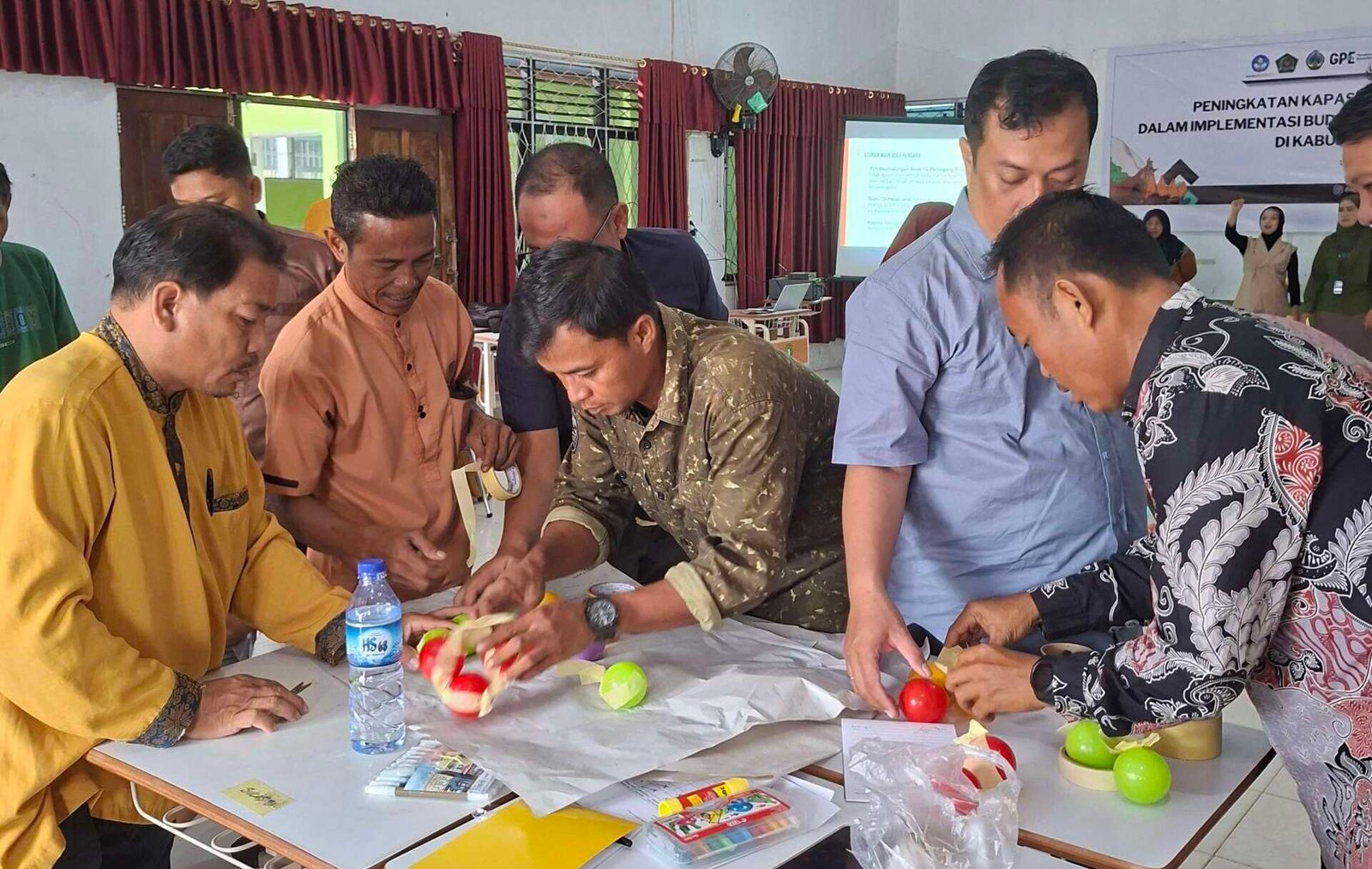
Creating schools that are safe, supportive, inclusive, and child-friendly requires more than the existence of policies and regulations. It demands strong commitment and collective action to ensure that these policies are effectively implemented in everyday school life. This spirit formed the foundation of the Workshop on Preparing the Establishment of the Safe and Supportive School Culture Working Group (BSAN Working Group) in Kayong Utara District, held on 7 July 2026.
During the event, Kayong Utara District Head Romi Wijaya emphasized that building a positive and supportive educational ecosystem requires the active involvement of all stakeholders. He expressed hope that the establishment of the BSAN Working Group would strengthen the commitment of various institutions and partners to creating schools and madrasahs that are safe, comfortable, inclusive, and child-friendly, thereby supporting the healthy growth and development of students.
The workshop discussions focused on translating policy commitments into concrete actions. Referring to the Minister of Primary and Secondary Education Regulation No. 6 of 2026 on Safe and Comfortable School Culture, participants examined four key areas: the fulfillment of spiritual needs, physical protection, psychological well-being and sociocultural safety, as well as digital citizenship and online safety. The forum also encouraged the development of an action plan that clearly defines the roles and responsibilities of each stakeholder in fostering a safe and supportive learning environment.
Rezky Farnanda, Project Manager of KREASI Kayong Utara, explained that the BSAN Working Group is expected to serve as a collaborative platform that strengthens coordination in preventing and addressing issues within the education sector. The need for such a platform stems from several ongoing challenges, including policies that have not yet been fully translated into practice, differing perceptions regarding the boundaries between discipline and violence, uneven teacher capacity, limited parental engagement, and coordination among local government agencies that is not yet fully integrated.
To address these challenges, the preparation process for establishing the BSAN Working Group focused on three key priorities: building a shared understanding of relevant policies and regulations, identifying potential vulnerabilities within education institutions, and strengthening collective commitment among schools, students, parents, and school committees. Through these efforts, the BSAN Working Group is expected to become more than an administrative mechanism. Instead, it is envisioned as an integral part of a broader system that ensures every child can learn in an environment that is safe, supportive, and conducive to their development and well-being.
_____
KREASI (Collaboration for the Education of Indonesian Children) is a program to improve the quality of education by strengthening literacy, numeracy, and character education. KREASI in Kayong Utara is managed by Save the Children and implemented by Majelis Dikdasmen PNF PP Muhammadiyah, with funding from the Global Partnership for Education (GPE), as well as support from the Government of Kayong Utara and Indonesia’s Local Education Group, led by the Ministry of Primary and Secondary Education (Kemendikdasmen) and the Ministry of Religious Affairs (Kemenag).
Writer: Arif Kudianta| Editor: Andika Ramadhan | Photo: Arif Kudianta/KREASI/Majelis Dikdasmen PNF PP Muhammadiyah/Save the Children