


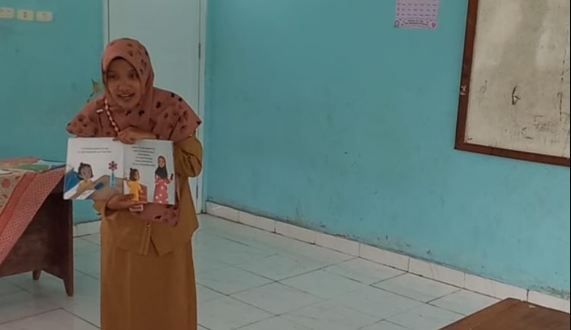
A more vibrant learning atmosphere can now be felt in the classroom led by Siti Rukhyati Ningsih, a Grade 3 teacher at an elementary school in Tanggamus District. The transformation began with her determination to increase students’ interest in reading after participating in training and mentoring activities through the KREASI Tanggamus Program.
Ningsih realized that the teaching methods she had previously used were largely teacher-centered and often failed to fully engage her students. Lessons typically followed the same routine: the teacher explained the material at the front of the classroom, wrote on the board, and asked students to copy the notes. For young learners who need opportunities for exploration, visual stimulation, and enjoyable learning experiences, this approach often led to boredom and disengagement.
“Classroom interaction used to be very passive. The children’s reading skills developed slowly because literacy was still seen as a rigid academic task rather than something enjoyable,” Ningsih recalled.
The turning point came when she participated in KREASI’s teacher capacity-building program. Through the training, Ningsih gained new insights into child-centered literacy instruction. She learned that creating a comfortable, enjoyable learning environment and incorporating elements of play can help children become more receptive to learning.
According to her, when children feel safe, comfortable, and happy in the classroom, their motivation to learn grows naturally. This sense of well-being provides an important foundation for developing literacy skills.
Armed with this new understanding, Ningsih began making changes in her classroom. One of her first steps was transforming the reading corner into a more attractive and child-friendly space. The area was decorated with bright colors, engaging illustrations, and a collection of storybooks suited to her students’ ages and interests. The design was intended to spark curiosity and encourage children to interact more frequently with reading materials.
The changes extended beyond the classroom’s physical appearance. Ningsih also adopted a more structured and differentiated approach to literacy instruction based on her students’ individual needs. Her teaching incorporates four key components of foundational literacy: phonological awareness, vocabulary, reading fluency, and reading comprehension.
To ensure that every student receives appropriate support, she first conducts an initial assessment to identify each child’s literacy level. The assessment helps her determine which students need additional support in phonological awareness, which need vocabulary enrichment, and which are ready to further develop reading fluency and comprehension skills.
Based on the assessment results, students are divided into learning groups. To prevent stigma and help children avoid feeling self-conscious about their reading abilities, each group is given the name of an animal rather than being identified by skill level.
“We use animal names so the children do not feel labeled or compared based on their reading abilities. Instead, they feel happy and proud of their groups. This approach allows me to provide support that is better suited to the needs of each group,” Ningsih explained.
Gradually, the approach began producing positive results. The colorful reading corner soon became a favorite gathering place where students could browse storybooks, look at illustrations, and discuss what they were reading with their classmates. Without constant encouragement from their teacher, students began showing a greater interest in reading activities.
Within just a few months of implementation, noticeable changes began to emerge. A classroom that was once relatively passive became more active and interactive. Students participated more enthusiastically in learning activities, while reading was no longer viewed as a tedious assignment.
“Learning is now more relaxed and enjoyable. The children feel much more comfortable in the classroom. What used to be a quiet class has become far more lively. Alhamdulillah, even though we have only been using these methods for a few months, the changes are already visible. The children are no longer reluctant when invited to read,” said Ningsih.
Ningsih’s experience demonstrates how simple changes within a classroom can have a meaningful impact on children’s learning. By creating an environment that is welcoming, engaging, and responsive to students’ needs, literacy becomes more than just a learning target. It becomes an enjoyable part of every child’s educational experience.
_____
KREASI (Collaboration for the Education of Indonesian Children) is a program to improve the quality of education by strengthening literacy, numeracy, and character education. KREASI in Tanggamus is managed by Save the Children and implemented by LP Maarif NU, with funding from the Global Partnership for Education (GPE), as well as support from the Government of Tanggamus and Indonesia’s Local Education Group, led by the Ministry of Primary and Secondary Education (Kemendikdasmen) and the Ministry of Religious Affairs (Kemenag).
Writer: Dony Eri Pratama| Editor: Andika Ramadhan | Photo: Dony Eri Pratama/KREASI/LP Maarif NU/Save the Children