


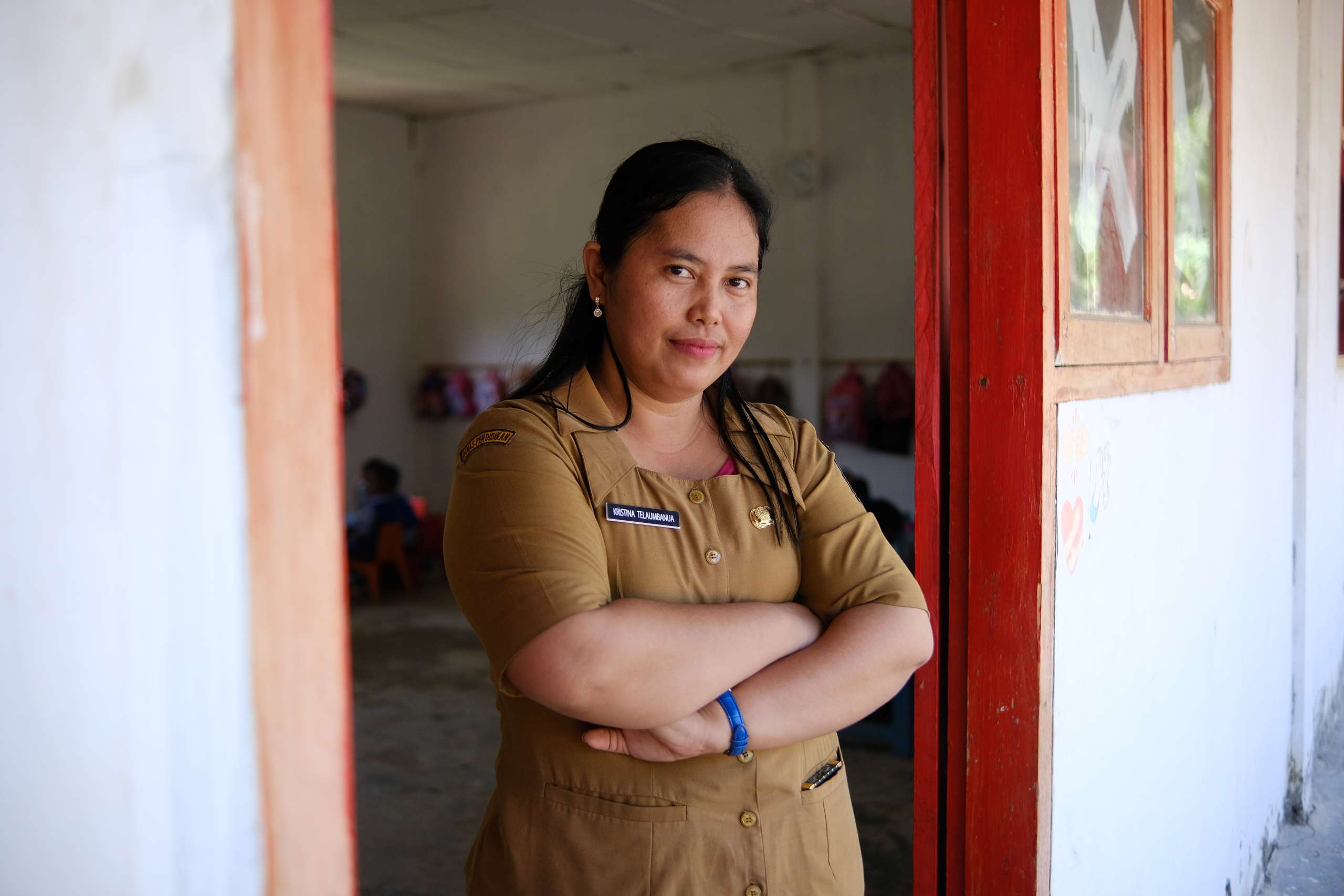
That morning, the courtyard of a public kindergarten in Nias Utara was filled with activity: parents hurriedly accompanied their children all the way into the classroom, while the children walked together in small steps, not yet fully ready to part from their parents. For some, it was an ordinary scene—a daily routine that was rarely questioned.
But for Kristina Telaumbanua, behind the crowd, she saw something deeper: children who were not truly ready to start the day, an environment that was not yet fully safe, and a school-parent relationship that had not fully nurtured children’s independence. Her perspective did not emerge overnight. It grew from her long journey as an educator—from her experience teaching and interacting with children to her understanding that every child comes to school with different needs, not only to learn, but also to feel accepted.
From the beginning of her career as a teacher, Kristina was known as someone who was close to the children. She was used to greeting them, listening to their simple stories, and even noticing small changes in their behavior. From this, she learned one important lesson: children learn more easily when they feel safe and loved. This experience later shaped her leadership approach when she was entrusted to become the school principal.
When she began leading the kindergarten, she did not immediately introduce a major program. She chose to observe. She was present in the morning, standing in the school courtyard, paying attention to how children arrived, how parents interacted with them, and how the school atmosphere was formed from the very start of the day. Through this observation, she realized that change needed to begin from the earliest moment: when children first set foot at school.
She then initiated a simple approach that she named “My School, a Home Full of Love.” For Kristina, this concept was not merely a slogan, but a direction for leadership—how every decision at school should begin with the question: does this make children feel safe and loved?
Her first step was to reorganize the drop-off and pick-up routine. She set a designated boundary area for parents, allowing children to begin learning to walk independently to their classrooms. At the same time, however, she made sure the children did not feel alone. Teachers were assigned to welcome them at that point—not merely to receive them, but to truly greet them with warmth.
This is where her leadership practice became clearly visible. She did not simply create rules; she built understanding. She invited teachers to discuss the changes, explained the reasons behind them, and ensured that all teachers shared the same vision. She also involved parents, opening spaces for dialogue so they could understand that this step was part of the process of building children’s independence.
The change was introduced gradually, without force. She gave children and parents time to adapt. She also continued to reflect together with the teachers on what had worked well and what still needed improvement. This approach made the change feel like a shared process, not merely a policy handed down by the school leader.
Over time, the school atmosphere began to change. Every morning, teachers stood at the designated drop-off boundary, welcoming children with smiles, greetings, and warmth. The children walked to their classrooms with greater confidence. The school courtyard became more orderly and safer. Parents also began to fully entrust their children to the school during learning hours.
What was felt most strongly was the change in atmosphere. The school no longer felt rigid or rushed. Warmth was present from the morning, a sense of safety grew within the children, and the relationship between the school and parents became stronger.
For Kristina, this is the essence of leadership in early childhood education. It is not about how many programs are implemented, but about how deeply a school is able to understand children’s needs. She believes that great change does not always begin with major policies, but with care for the small things that are often overlooked.
From this journey and conviction, “My School, a Home Full of Love” has become not only a good practice, but also a reflection of the values she holds as an educator. When children feel safe, valued, and loved, school truly becomes a second home for them.
And from a home full of love, meaningful learning will naturally grow.
_____
KREASI (Collaboration for the Education of Indonesian Children) is a program to improve the quality of education by strengthening literacy, numeracy, and character education. KREASI in Nias Utara is managed by Save the Children and implemented by Article 33 Indonesia, with funding from the Global Partnership for Education (GPE), as well as support from the Government of Nias Utara and Indonesia’s Local Education Group, led by the Ministry of Primary and Secondary Education (Kemendikdasmen) and the Ministry of Religious Affairs (Kemenag).
Writer: Calvin Telaumbanua | Editor: Andika Ramadhan | Photo: Calvin Telaumbanua/KREASI/Article 33 Indonesia/Save the Children