


Dawn slowly breaks. The call to prayer echoes from the mosques, piercing the silence and blending with the crisp morning air. The hum of engines returns, signaling the start of daily routines. The motorcycle that has faithfully accompanied Nasir for more than a decade slowly roars to life. For Nasir, it is more than just a means of transportation—it is a witness to his journey of service. Every scratch and every sound of its engine carries stories of perseverance, patience, and the life choices he has made.
It is this motorcycle that carries him each day across district and city boundaries, from Gunungsitoli City to Lahewa Sub-district in Nias Utara. The 71-kilometer journey, which takes about one and a half hours, is no short distance. Yet it has never felt burdensome. At the end of the road, his madrasah students are waiting. There, Nasir fulfills his role—not merely as a principal, but as an educator who chooses to be present, steadfast, and to walk alongside his students.
Nasir’s journey in education began with a simple dream. Since his school days, he had aspired to become a teacher. The desire grew not out of ambition, but from a belief that education is a pathway to transform lives. He has always upheld the values of openness and integrity, both personally and professionally. These values eventually led to his appointment as one of the madrasah principals in Nias Utara.
Becoming a principal was never part of his original plan. He began simply as a teacher, holding firmly to one conviction: children must be treated as whole human beings, not merely as objects of instruction or numbers in reports. Behind this journey stands someone who never stopped believing in him—his wife. Through her prayers and unwavering support, she believed that to create change, Nasir had to be brave enough to take on leadership. That belief slowly became the spark that pushed him beyond his comfort zone.
Prayer, patience, and courage bore fruit. Nasir was entrusted with helping to improve a State Islamic Elementary School (Madrasah Ibtidaiyah Negeri/MIN). Over time, trust grew, and he was eventually asked to lead the madrasah. That MIN has since become the space of his devotion to this day. Not because he chose it, but as if the madrasah had chosen him to be part of its journey.
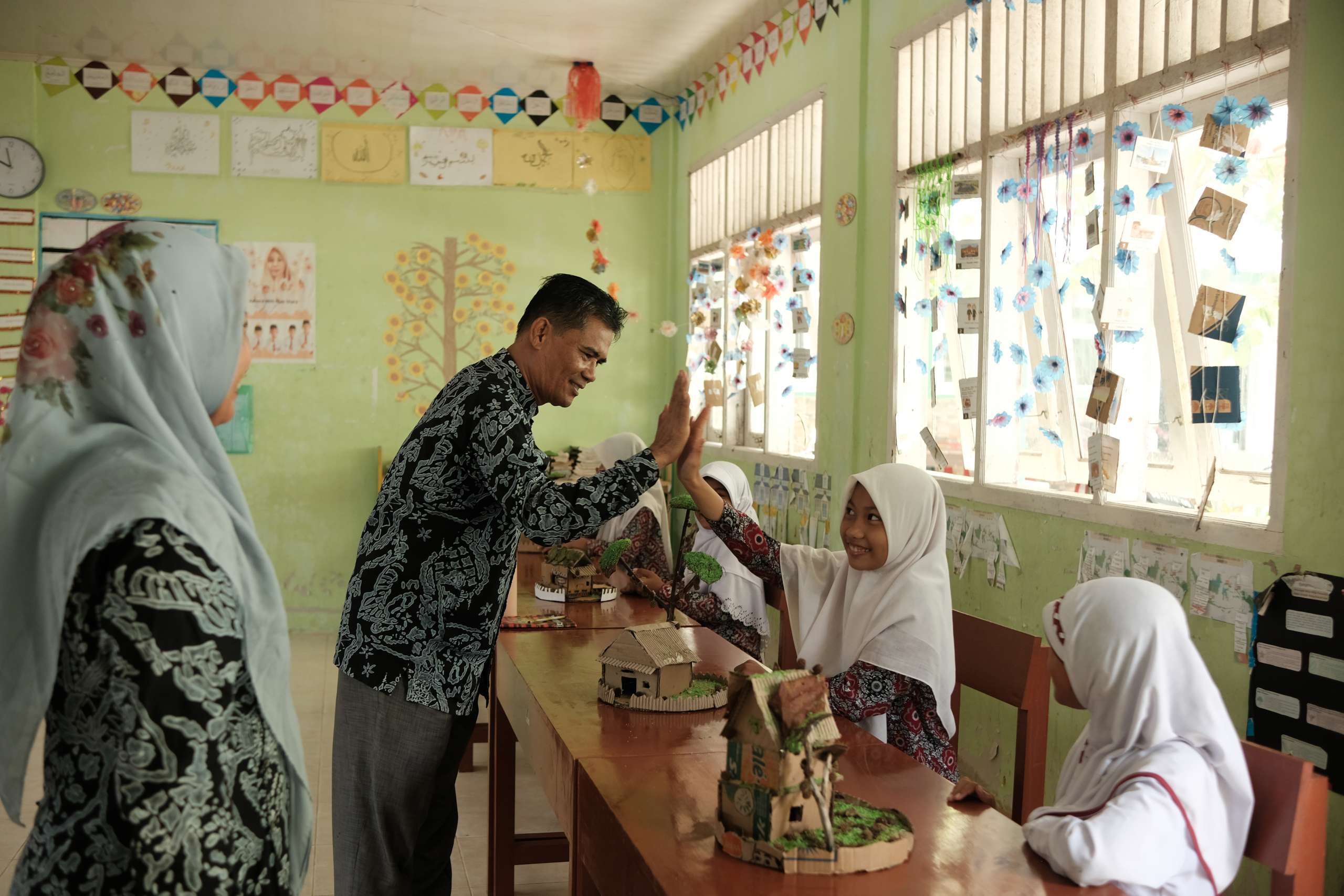
Every morning at MIN Nias Utara, he sees innocent faces carrying their parents’ hopes and their own futures. The madrasah stands upon Islamic values, where knowledge and character grow side by side. For Pak Nasir, this is where service finds its meaning. “Being a teacher is not only about teaching, but about accompanying children in discovering the meaning of learning,” he once said.
The year 2024 became an important point of reflection. The Education Report Card showed that the school’s literacy achievement remained in the “low” category. In the Madrasah Science Competition, the school he led had yet to achieve distinction. For Pak Nasir, those numbers were not merely data—they were a mirror. “I realized there were things we needed to improve together. Not only how we teach, but how we build a culture of learning,” he reflected.
He identified one root cause: students’ low interest in reading. Yet he also believed that literacy without character would never stand strong. From this concern was born a promising initiative titled “Character-Based Literacy Toward Achievement.” Pak Nasir invited teachers and education staff to sit together, map out solutions, and involve parents and the Madrasah Committee. “Schools cannot work alone. A child’s education is a shared responsibility between teachers, parents, and the community,” he emphasized.
The literacy program was designed to be simple yet consistent. Every morning from 8:10 to 8:30 a.m., students participate in literacy activities outside regular class hours. Reading corners are available in every classroom. The literacy process is implemented gradually: cultivating a habit of reading, retelling stories, understanding and summarizing texts, and connecting learning to character development through dhuha prayer and Friday sharing activities.
Change, of course, did not always come easily. Evaluations showed that some students still struggled with reading fluency and comprehension. Teacher supervision was not yet optimal, parental involvement was uneven, and some students were not fully engaged. Yet rather than retreat, Pak Nasir chose to improve from within. Teachers were re-empowered, parents were invited into dialogue, and students were approached with empathy. “Change is not born from blame, but from the courage to improve,” he said.
Gradually, the atmosphere of the madrasah transformed. Books no longer felt unfamiliar. Children began to speak up, express ideas, and understand what they read. Literacy was no longer a burden, but a habit. The results soon became visible. In 2025, four MIN students won four championships at the Nias Utara Regency level and advanced to the North Sumatra Provincial level in the Indonesian Madrasah Olympiad. Achievements in Mathematics and Integrated Science (IPAS) proved that character-based literacy can lead to academic success.
Yet for Pak Nasir, the greatest achievement is not trophies. “Awards are a bonus. What truly matters is when children grow confident, uphold good character, and are willing to learn throughout their lives,” he said humbly. From his long journey as a teacher to becoming a principal, he holds firmly to one leadership principle: “Humanizing people so they can become individuals who contribute to the nation and the country is our duty as teachers.”
At MIN, this promising practice continues to live on—not as a temporary program, but as a culture. A testament that leadership rooted in values, courage, and togetherness can transform challenges into hope.
_____
The Program of KREASI or Kolaborasi untuk Edukasi Anak Indonesia (Collaboration for the Education of Indonesian Children) is funded by the Global Partnership for Education, developed by the Ministry of Primary and Secondary Education, and the Ministry of Religious Affairs. KREASI is being implemented by Save the Children with Article 33 Indonesia nd support by the Government of Nias Utara. KREASI aims to improve the quality of education in Nias Utara by strengthening teaching, learning, and student development.
_____
Writer: Calvin Telaumbanua | Editor: Nabila Aulia | Photo: Calvin Telaumbanua/KREASI/Article 33 Indonesia/Save the Children