


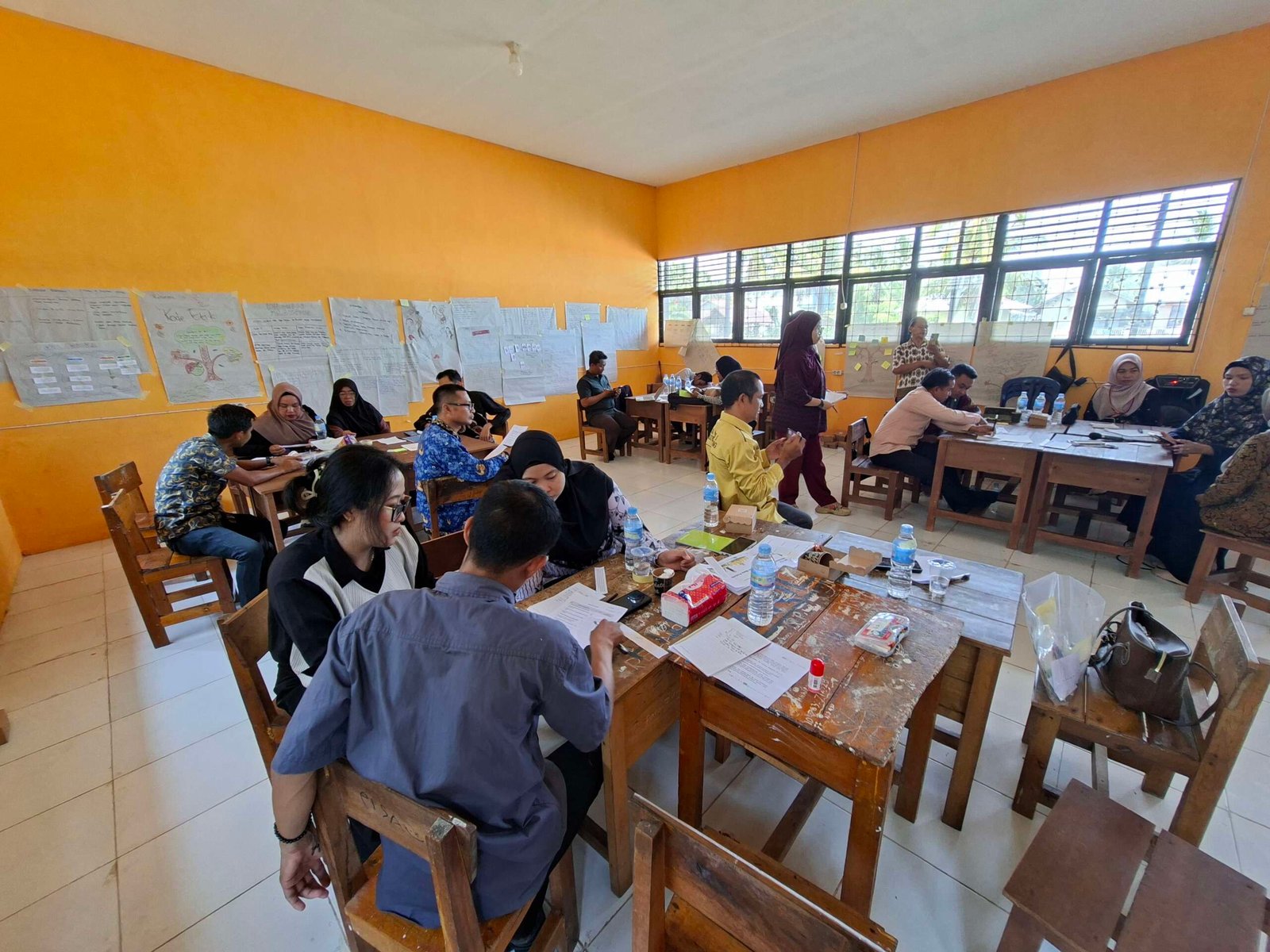
Continuing its commitment to education transformation, the KREASI Program in Kayong Utara organized a series of capacity-building trainings for schools to strengthen the implementation of a Safe and Comfortable School Culture (BSAN). The training was conducted in two locations: Simpang Hilir Sub-district from 4-7 August 2026 and Teluk Batang Sub-district from 11-14 August 2026.
The training in both locations adopted an experiential learning approach using the REAL (Relate, Explore, Apply, Learn Again) methodology, equipping educators with the knowledge and skills needed to create school environments that are safe, inclusive, and free from violence.
Policy Understanding and GEDSI
Participants strengthened their understanding of relevant policies through the nine core principles of BSAN and the application of the GEDSI (Gender Equality, Disability, and Social Inclusion) approach. This component emphasized the importance of ensuring protection for vulnerable groups and children with disabilities.
Early Detection and Reporting Systems
The training introduced frameworks for identifying early signs of violence and safeguarding concerns by recognizing indicators across five dimensions: behavioral, physical, emotional, digital, and social. Participants also learned how to establish child-friendly complaint and reporting mechanisms based on the principles of accessibility, safety, and responsiveness, while applying the 3A and 4T approaches.
Ethical Case Management
Participants strengthened their capacity to manage child protection cases using a care-centered approach. The training covered the provision of Psychological First Aid through the 3L approach (Look, Listen, Link), the development of referral systems, and the importance of protecting children’s privacy through the ETHICS principle, which emphasizes secure handling and restricted access to sensitive information.
Sustainability and Meaningful Participation
To ensure sustainability, participants worked on integrating School Action Plans (RAS) into school planning and budgeting mechanisms, including school work plans and education programs. Schools were also encouraged to design meaningful campaigns that actively involve children’s voices and participation in promoting a safe and positive school culture.
From Commitment to Action
The training sessions in Simpang Hilir and Teluk Batang concluded with the development of concrete Follow-up Action Plans (RTL) tailored to the specific needs of each school.
This process ensures that commitments to creating safe and comfortable school environments go beyond formal requirements and are translated into sustainable institutional practices. Ultimately, the readiness of child protection focal points and school leaders is measured not by the number of documents they produce, but by their ability to ensure that protection systems function effectively and consistently for every child.
_____
KREASI (Collaboration for the Education of Indonesian Children) is a program to improve the quality of education by strengthening literacy, numeracy, and character education. KREASI in Kayong Utara is managed by Save the Children and implemented by Majelis Dikdasmen PNF PP Muhammadiyah, with funding from the Global Partnership for Education (GPE), as well as support from the Government of Kayong Utara and Indonesia’s Local Education Group, led by the Ministry of Primary and Secondary Education (Kemendikdasmen) and the Ministry of Religious Affairs (Kemenag).
Writer: Arif Kudianta| Editor: Andika Ramadhan | Photo: Arif Kudianta/KREASI/Majelis Dikdasmen PNF PP Muhammadiyah/Save the Children