


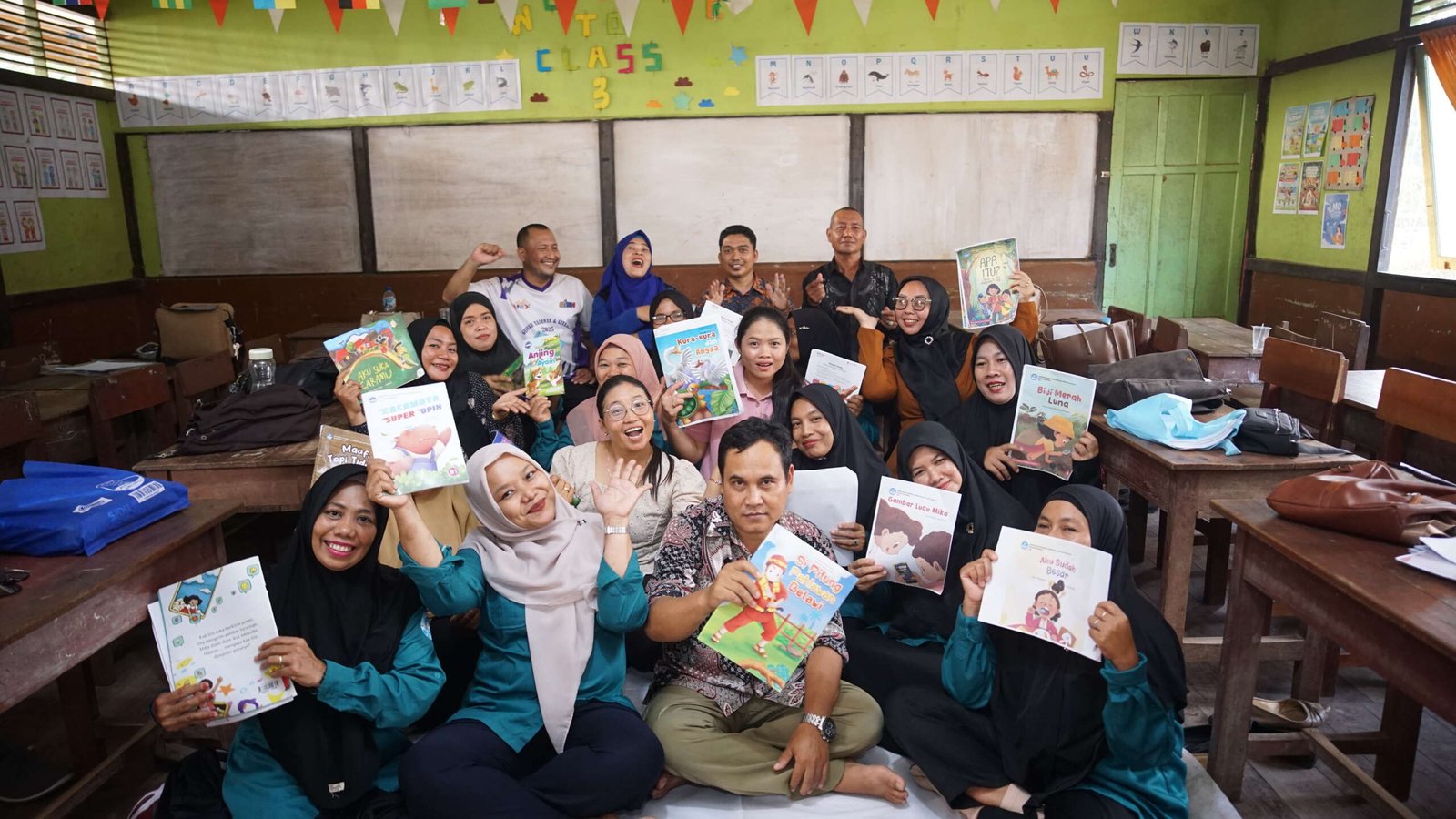
Laughter and eager hands filled the classroom during the second round of KREASI Ketapang’s Teacher Professional Development (TPD) mentoring sessions. The raised hands, however, did not belong to primary school students, but to teachers enthusiastically role-playing as cheerful and active early-grade learners.
Amid the interactive atmosphere was Monic, one of the teachers supported by the KREASI Program. On that day, during a peer-learning session, Monic stepped forward to demonstrate an engaging literacy teaching method.
A Meaningful and Engaging Microteaching Experience
Without any special preparation on site, Monic was appointed by her fellow teachers from the Nanga Tayap sub-district group to represent them in a teaching simulation. Equipped with a mini lesson plan that had been developed collaboratively, she delivered a story expressively while holding an illustrated storybook. Meanwhile, the other teachers enthusiastically took on the role of students, eagerly competing to answer questions.
“The most memorable and meaningful moment for me was when I stood in front of my fellow teachers to tell a story. I played the role of a teacher, while my colleagues pretended to be students,” Monic recalled with a smile. “Even though I was chosen unexpectedly, thank God everything went smoothly because we had already prepared the mini lesson plan together, and it was a lot of fun!”
Through this microteaching simulation, teachers not only practiced new methods introduced by KREASI Ketapang’s District Facilitators, but also experienced firsthand what it feels like to be students actively engaged in the learning process.
Applying New Strategies in the Classroom: Addressing Diverse Student Abilities
The success of the training-room simulation had a direct impact when Monic returned to her classroom. Faced with early-grade students who had varying levels of reading ability, the methods introduced through the KREASI Program provided practical solutions to everyday teaching challenges.
Before beginning shared reading activities, Monic implemented a crucial step by conducting an initial assessment to identify and group students according to their learning levels.
This initial step not only helped introduce and strengthen key vocabulary before the story began, making it easier for children to understand the text, but also enabled Monic to assign learning tasks that matched the abilities of each student group.
“Before storytelling sessions in class, I first assess my students and group them according to their abilities. The most helpful part is introducing vocabulary before starting the story. After that, it becomes much easier for me to assign tasks that are appropriate to the learning levels I have identified,” Monic explained.
Building a Sustainable Learning Ecosystem
Monic’s experience reflects the essence of KREASI’s continuous professional development approach: providing teachers with opportunities to practice, reflect on their teaching, and gradually improve their instructional skills.
From the enthusiasm seen in the training sessions to the increased confidence in managing diverse learning needs in the classroom, the transformation of literacy instruction is now delivering tangible benefits for both teachers and students across Ketapang District.
_____
KREASI (Collaboration for the Education of Indonesian Children) is a program to improve the quality of education by strengthening literacy, numeracy, and character education. KREASI in Ketapang is managed by Save the Children and implemented by Majelis Dikdasmen dan PNF PP Muhammadiyah, with funding from the Global Partnership for Education (GPE), as well as support from the Government of Ketapang and Indonesia’s Local Education Group, led by the Ministry of Primary and Secondary Education (Kemendikdasmen) and the Ministry of Religious Affairs (Kemenag).
Writer: Afriyandi Nur Huda | Editor: Andika Ramadhan | Photo: Afriyandi Nur Huda/KREASI/Majelis Dikdasmen dan PNF PP Muhammadiyah/Save the Children