


For nearly two decades, Najir dedicated himself to teaching at a primary school in Pulau Morotai. When he was appointed principal in 2023, his responsibilities grew. He began exploring different ways to improve the quality of his school, including using data as the basis for developing improvement programs.
During this process, Najir realized that there was still much for him to learn. Previously, he mainly understood assessments as tools for measuring students’ learning outcomes. Through training and mentoring provided by KREASI, however, he began to understand the Education Report Card (Rapor Pendidikan), which provides an overview of school quality based on National Assessment data, including students’ literacy and numeracy achievements. Through this support, he learned to use the Education Report Card as the basis for developing school improvement measures.
“Previously, I did not fully understand how to improve the literacy and numeracy indicators in the Education Report Card. I only understood assessments. After receiving support from KREASI, I learned how to develop interventions for literacy, numeracy, and character education,” Najir said.
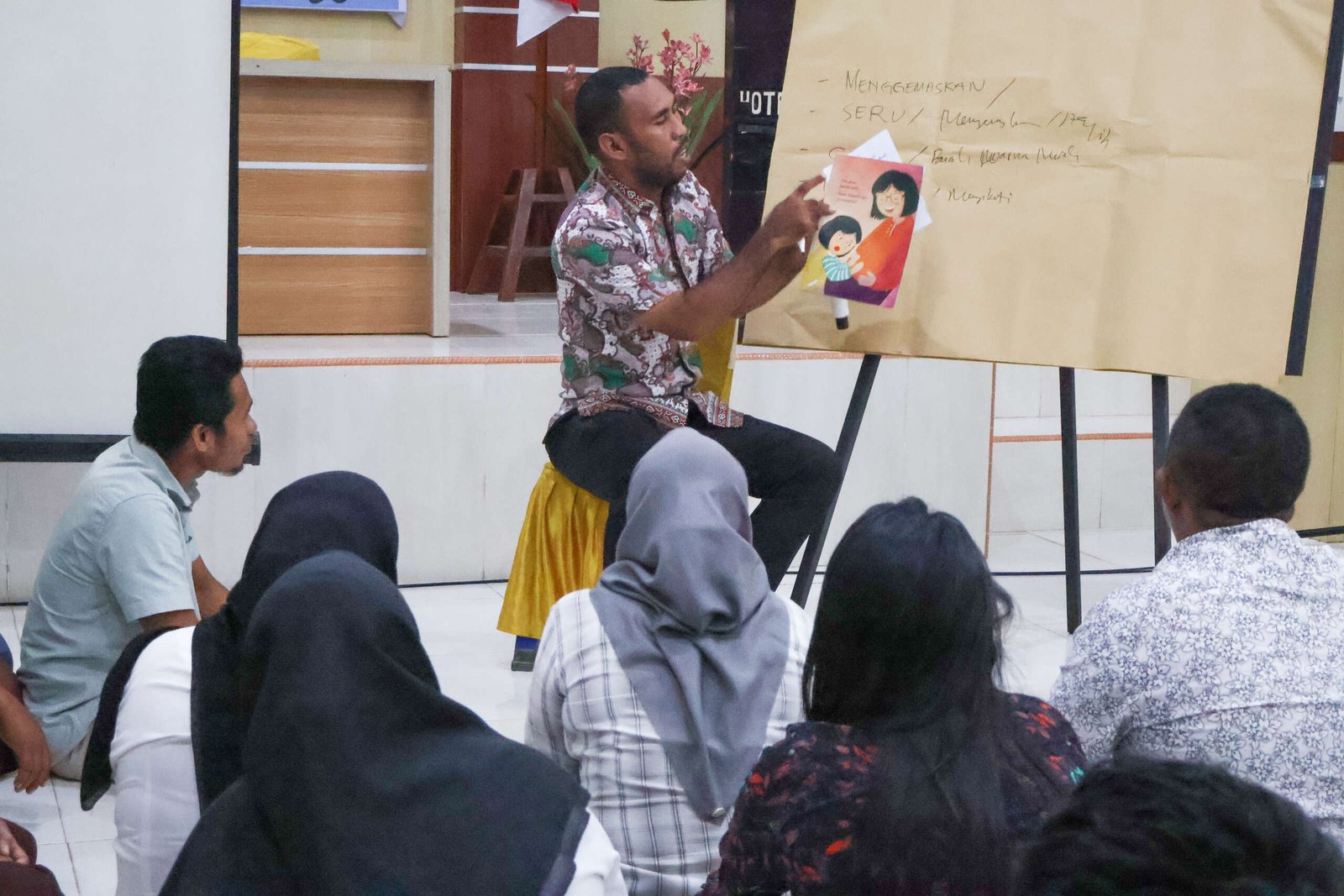
Najir did not keep this new understanding to himself. He shared every lesson gained from KREASI training with the teachers at his school. Together, they began applying what they had learned, from developing the School-Level Curriculum (KSP) and teaching materials such as lesson modules to exploring Universal Design for Learning so that instruction could better meet the needs of every student.
According to Najir, KREASI’s training and mentoring methods were among the factors that made it easier for teachers to implement new practices at school. Limited internet access in Morotai made independent online learning and training difficult for teachers to access.
“KREASI introduced a different approach. The training was conducted in person and included practical exercises, mentoring, and continuous guidance for teachers during implementation. I believe this approach made the changes more tangible,” Najir said.
This face-to-face approach ensured that teachers not only received training materials but also received support in applying them in the classroom.
One of the approaches introduced by KREASI to strengthen literacy and numeracy among early grade students was the Literacy and Numeracy Catch-Up Club (CUC). After receiving training, teachers and the principal developed it into a regular school activity. The club provides additional classes for students in Grades 1 to 3 who continue to experience difficulties with literacy and numeracy. Students are grouped according to their abilities, making the learning process more targeted and accessible. Learning activities use play-based approaches and various materials to make students more interested in learning.
According to Najir, the approach helped teachers provide support that was better suited to each student’s abilities. His school later expanded the approach to students up to Grade 5.
These consistent efforts gradually began to produce results. In the 2023 and 2024 Education Report Cards, before the school received support from KREASI, its literacy and numeracy indicators remained in the red category. In 2025, the first year KREASI was implemented in Morotai and Najir’s school became one of the assisted schools, the literacy indicator moved into the yellow category, while numeracy reached the green category. By 2026, following support from KREASI, both indicators had reached the green category.
For Najir, this achievement was not the work of one individual but the result of the entire school community consistently applying what they had learned.
“If I had worked alone, the impact would not have been significant. I shared the knowledge I gained with the teachers, and we applied it consistently. We can now experience the results together,” Najir said.
Seeing these changes further convinced Najir that the mentoring had delivered tangible benefits for his school.
“I feel happy because what we learned during the KREASI mentoring was not in vain. This support has genuinely made a difference to our school.”
The experience also encouraged him to continue contributing to improving education quality across Pulau Morotai District. In 2026, Najir participated in an open selection process organized by KREASI Morotai to become a Local Facilitator for SD/MI school principals and was selected for the role. After completing Local Facilitator training, he shared his knowledge with 40 SD/MI school principals from schools assisted by KREASI during the program’s second year.
“I felt called to contribute to improving literacy and numeracy because my school is one of the schools supported by KREASI. Through this program, I have directly experienced various positive changes, including improvements in our Education Report Card. This experience motivated me to continue working to improve education quality across Pulau Morotai District,” Najir said.
For Najir, the change from red to green is not the end of the journey. Instead, the experience has equipped him to support more school principals in using the Education Report Card as a basis for strengthening learning and driving change in their respective schools.
_____
KREASI (Kolaborasi untuk Edukasi Anak Indonesia) adalah program peningkatan kualitas pendidikan dengan memperkuat literasi, numerasi, dan pendidikan karakter. KREASI di Pulau Morotai dikelola Save the Children dan diimplementasi oleh Stimulant Institute, dengan pendanaan Global Partnership for Education (GPE) serta dukungan Pemerintah Kabupaten Pulau Morotai dan Mitra Pendidikan Indonesia yang dipimpin Kementerian Pendidikan Dasar dan Menengah (Kemendikdasmen) dan Kementerian Agama (Kemenag).
Penulis: Ayutama Putri Jordy | Editor: Andika Ramadhan | Foto: Ayutama Putri Jordy/KREASI/Stimulant Institute/Save the Children