


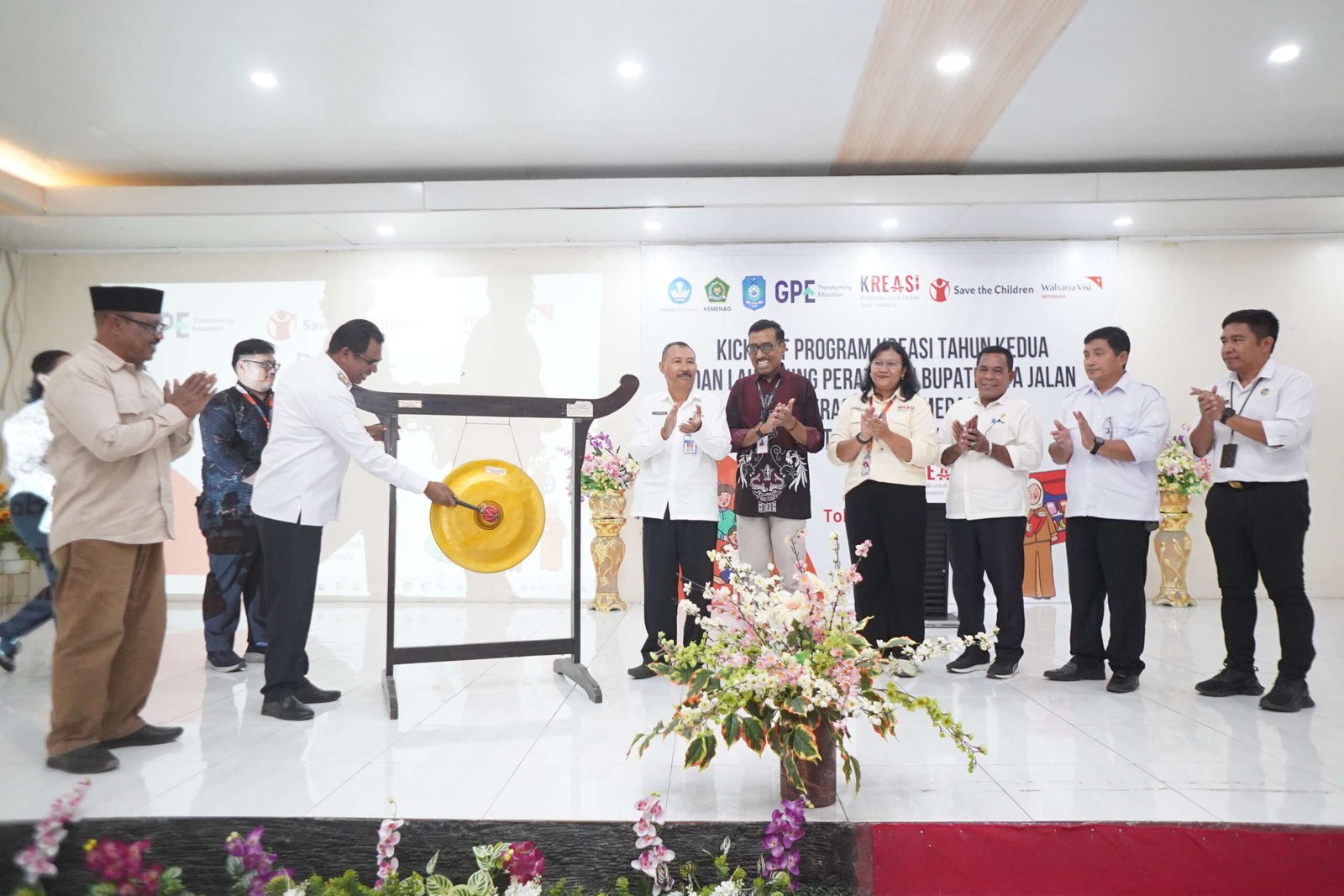
The Government of Halmahera Utara District has strengthened its commitment to improving the quality of education through the issuance of District Head Regulation No. 38 of 2026 on the Literacy and Numeracy Roadmap. This policy marks an important milestone in the district’s efforts to develop high-quality human resources through systematic and sustainable improvements in literacy, numeracy, and character education.
The Literacy and Numeracy Roadmap was developed through collaboration among various stakeholders and the KREASI Program. The document serves as both a policy framework and a strategic guide for the district government and development partners in designing and implementing education programs throughout the 2026–2030 period.
Through this roadmap, the district government has established a number of priorities and strategies that serve as a common reference for all stakeholders within the education ecosystem. In addition to outlining policy directions and development targets, the roadmap also clarifies the roles and responsibilities of each stakeholder in supporting efforts to improve education quality across Halmahera Utara.
Kasman Hi. Ahmad, Vice District Head of Halmahera Utara, emphasized that the roadmap provides a clear direction for all stakeholders to work together toward meaningful change.
“Strategic interventions for students, as well as for education systems and institutions, have been clearly defined, including the roles and responsibilities of each stakeholder. The question now is whether we are ready to follow this path of change. This roadmap serves as a guide toward regional progress. Regions with strong human resources always begin with improvements in literacy, numeracy, and character education,” he said.
The implementation of the KREASI Program in Halmahera Utara has now entered its second year. As the implementing partner, World Vision Indonesia (WVI) is supporting 44 primary schools and madrasahs across seven sub-districts as part of efforts to strengthen learning quality and improve education governance.
In its second year, the KREASI Program continues to expand collaboration by engaging stakeholders across the education ecosystem. At the school level, the program involves school principals and teachers. At the cluster level, collaboration takes place through Teacher Working Groups (Kelompok Kerja Guru or KKG), School Principal Working Groups (Kelompok Kerja Kepala Sekolah or KKKS), and Madrasah Principal Working Groups.
At the district level, the collaboration involves a range of government agencies and strategic institutions, including the Regional Development Planning Agency (Bappeda), the Education and Culture Office, the Ministry of Religious Affairs Office, the Women’s Empowerment, Child Protection and Family Planning Office (DP3AKB), as well as other relevant local government agencies that contribute to improving education quality.
Through the Literacy and Numeracy Roadmap, the Government of Halmahera Utara District hopes that all stakeholders will move in the same direction to create sustainable change. With strong collaboration, shared commitment, and well-coordinated implementation, efforts to strengthen literacy and numeracy are expected to nurture a generation of Halmahera Utara children who are resilient, productive, responsible, and well-prepared for future challenges.
_____
KREASI (Collaboration for the Education of Indonesian Children) is a program to improve the quality of education by strengthening literacy, numeracy, and character education. KREASI in Halmahera Utara is managed by Save the Children and implemented by Wahana Visi Indonesia, with funding from the Global Partnership for Education (GPE), as well as support from the Government of Halmahera Utara and Indonesia’s Local Education Group, led by the Ministry of Primary and Secondary Education (Kemendikdasmen) and the Ministry of Religious Affairs (Kemenag).
Writer: Revian Luther Hontong | Editor: Andika Ramadhan | Photo: Revian Luther Hontong/KREASI/Wahana Visi Indonesia/Save the Children