


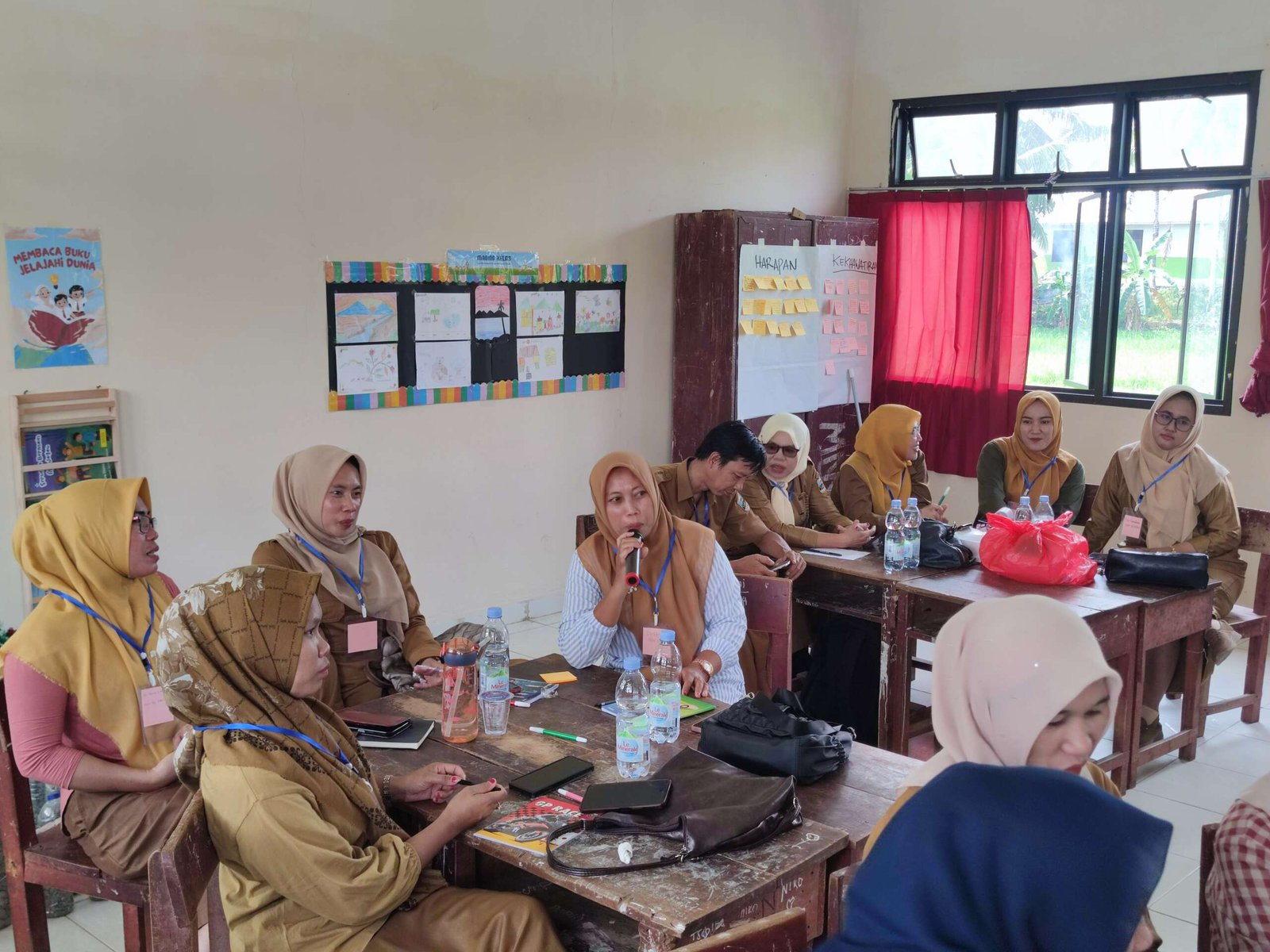
Teaching children to read is not simply about ensuring they can recognize letters and pronounce words. Teachers also need to understand each student’s abilities, identify the challenges they face, and provide support that meets their individual learning needs.
This perspective on literacy instruction became a key part of the learning experience for 90 Grade 1–3 teachers who participated in the KREASI Teacher Professional Development (TPD) program from 20–25 July 2026. Over six days, teachers learned and practiced new approaches across four school clusters located in different parts of Pesisir Barat District.
Throughout the training, teachers explored a range of strategies to help them better understand and develop students’ literacy skills. Topics included building reading habits and literacy-rich classroom environments, conducting reading assessments, and designing instruction that responds to students’ varying abilities through the use of children’s storybooks.
These concepts were reinforced through hands-on practice. Teachers took turns role-playing as both teachers and students while conducting reading assessments, mapping reading abilities, developing lesson plans, and participating in simulations followed by peer feedback sessions. This practical approach allowed participants to reflect on how the concepts introduced during the training could be applied in their own classrooms.
Across the four clusters, the training unfolded with different experiences and dynamics.
In Cluster 1, which brought together teachers from Karya Penggawa and Way Krui, reading assessment practice became one of the most engaging learning experiences. Teachers learned to observe reading skills in greater detail, including letter recognition, letter sounds, word-reading accuracy, fluency, intonation, pronunciation, and reading comprehension. The results were then used to map students’ reading abilities and determine more appropriate instructional strategies.
For participants, this experience highlighted that students within the same classroom can demonstrate very different reading abilities. As a result, teaching approaches do not always need to be the same for every student. The TPD program also provided opportunities for teachers from different schools to connect with one another. One participant from Cluster 1 noted that the training served not only as a valuable reference for improving teaching practices but also as an opportunity to strengthen relationships with fellow educators from diverse schools and backgrounds.
In Cluster 2, teachers from Pesisir Tengah and Krui Selatan explored literacy instruction through the context of their own students’ experiences. One discussion focused on the use of familiar language as a bridge to learning. Teachers examined how students’ everyday language can help them understand the meaning of words and texts, particularly when encountering unfamiliar vocabulary. Discussions such as these helped ensure that the training remained grounded in classroom realities rather than theoretical concepts alone.
In Cluster 3 in Ngambur, one participant described the literacy content as easy to understand and delivered in a creative and engaging way. The learning materials and examples were also viewed as highly relevant to teachers’ needs and readily applicable in classroom settings. This experience reinforced the importance of providing teachers with opportunities to practice. Rather than simply receiving examples of effective instruction, participants developed learning materials, conducted simulations, and received feedback from facilitators and fellow teachers. For many participants, this hands-on experience helped bridge the gap between what they learned during training and what they could implement in their classrooms.
In Cluster 4 in Pesisir Selatan, learning activities focused heavily on practical classroom simulations. Teachers practiced integrating multiple literacy components into a single lesson, including vocabulary development, reading fluency, phonics, and reading comprehension. Following each simulation, participants and facilitators provided feedback using the 3-2-1 method. In this environment, mistakes and shortcomings were not viewed as something to hide. Instead, they became opportunities for reflection and improvement. The process continued with the development of Teacher Learning Journals and one-month follow-up action plans to support the application of training outcomes in participants’ schools.
The six-day training has now concluded, and teachers have returned to their schools carrying new knowledge, skills, and experiences gained throughout the program. They now have new ways of understanding and developing students’ reading abilities, along with a range of instructional strategies they are eager to implement. Back in their classrooms, teachers will once again face diverse learning situations and students with varying reading abilities and learning needs. The classroom will now become a space where teachers can test and adapt what they learned during the training. Through these experiences, they will be able to identify what works well, what needs adjustment, and what areas require further learning. While the training itself has ended, the learning journey of being a teacher continues. This time, it continues alongside their students, who are also learning every day.
_____
KREASI (Collaboration for the Education of Indonesian Children) is a program to improve the quality of education by strengthening literacy, numeracy, and character education. KREASI in Pesisir Barat is managed by Save the Children and implemented by Yayasan Guru Belajar, with funding from the Global Partnership for Education (GPE), as well as support from the Government of Pesisir Barat and Indonesia’s Local Education Group, led by the Ministry of Primary and Secondary Education (Kemendikdasmen) and the Ministry of Religious Affairs (Kemenag).
Writer: Clara Sidharta | Editor: Andika Ramadhan | Photo: Clara Sidharta/KREASI/Yayasan Guru Belajar/Save the Children