


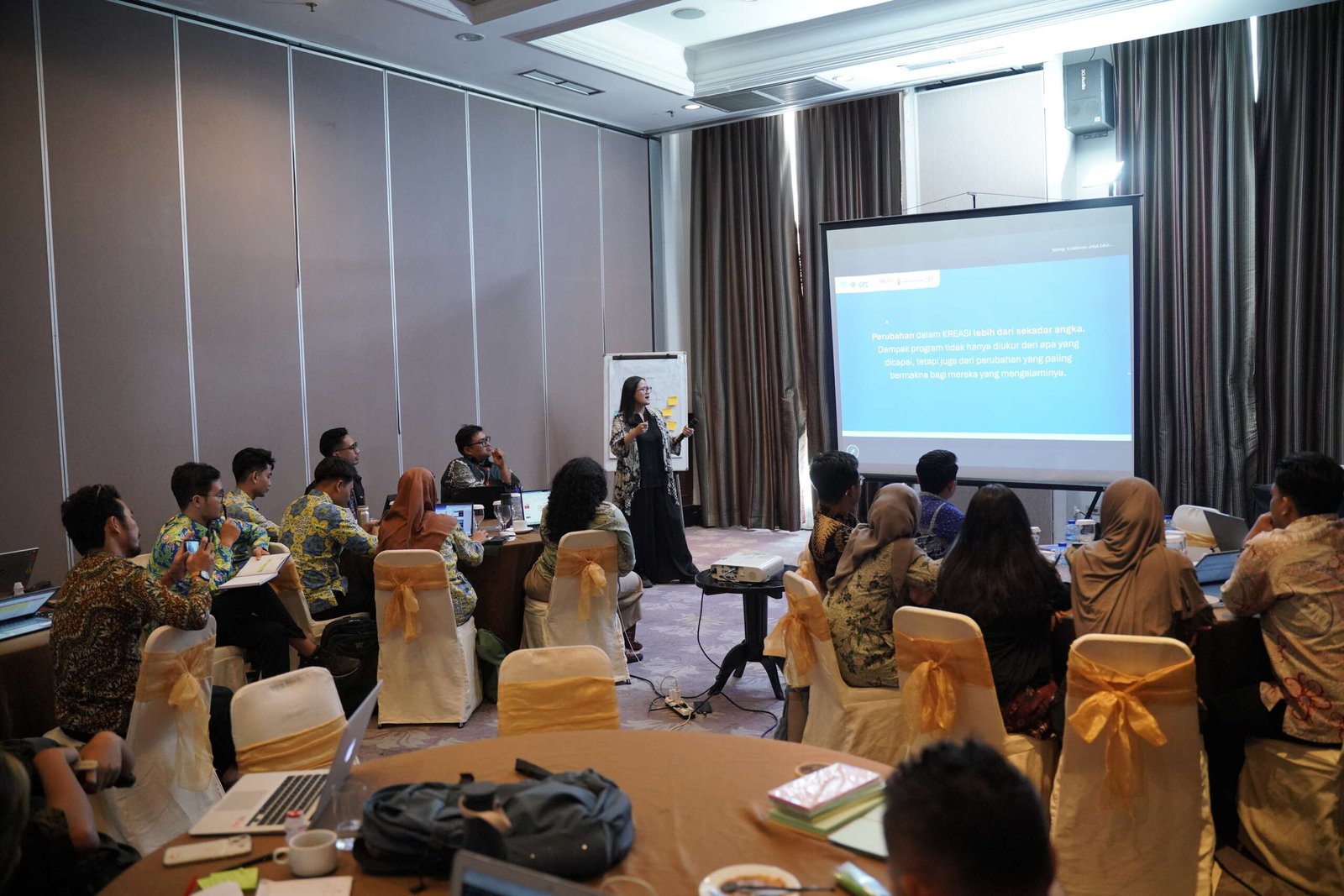
The KREASI Program organized a MEAL Capacity Building Workshop from 27–31 July 2026 in Jakarta. The workshop brought together MEAL Coordinators and Officers from implementing partner organizations across KREASI-supported districts. It was conducted alongside capacity-building workshops for the Communication and Media and Catch-Up Club teams, and was officially opened by Muhammad Yusro, Secretary of BKPDM at the Ministry of Primary and Secondary Education (Kemendikdasmen), and Abdul Basit, Head of the Subdirectorate of Curriculum and Student Affairs for Madrasahs at the Ministry of Religious Affairs (Kemenag), representing the Co-Chair of the Indonesia Education Partnership.
The workshop aimed to strengthen partners’ capacity in managing Monitoring, Evaluation, Accountability, and Learning (MEAL) systems, while also enhancing their ability to identify, document, and manage program learning and good practices that have emerged throughout the implementation of KREASI.
In her opening remarks, Alifah Sri Lestari, Chief of Party of KREASI, emphasized the importance of utilizing data and learning as a foundation for program decision-making.
“Program quality is not determined solely by the implementation of activities, but also by how we learn from data, understand the changes taking place, and use that evidence to improve the interventions we deliver,” she said.
During the five-day workshop, participants received training on various aspects of KREASI’s second-year implementation, including an understanding of the Results Framework, program indicator measurement mechanisms, roles and responsibilities in data management, and the use of monitoring tools such as coaching checklists, activity reporting systems, and monitoring dashboards.
In addition to technical MEAL components, the workshop also included capacity-strengthening sessions on managing good practices and evidence-based communications. Participants received guidance on identifying good practices across KREASI program packages, developing Most Significant Change (MSC) stories, conducting simple research, and producing communication materials that can be used for advocacy and the dissemination of program learning.
One of the key sessions focused on data quality standards, routine verification processes through Data Quality Assessments (DQA), data protection, and the application of informed consent principles, particularly in managing data involving children. Through these sessions, participants were expected to strengthen their ability to apply ethical and data security standards throughout the collection, management, and reporting of program information.
As a key outcome of the workshop, participants developed MEAL work plans for the coming implementation period and provided feedback on the KREASI MEAL systems, tools, and guidelines currently in use. This feedback will serve as the basis for continuous improvement efforts to support more effective program implementation across all KREASI-supported districts.
Through this workshop, KREASI aims to further strengthen partners’ capacities in managing data, documenting learning, developing good practices, and utilizing evidence and information to support the improvement of foundational education quality for children across Indonesia.