


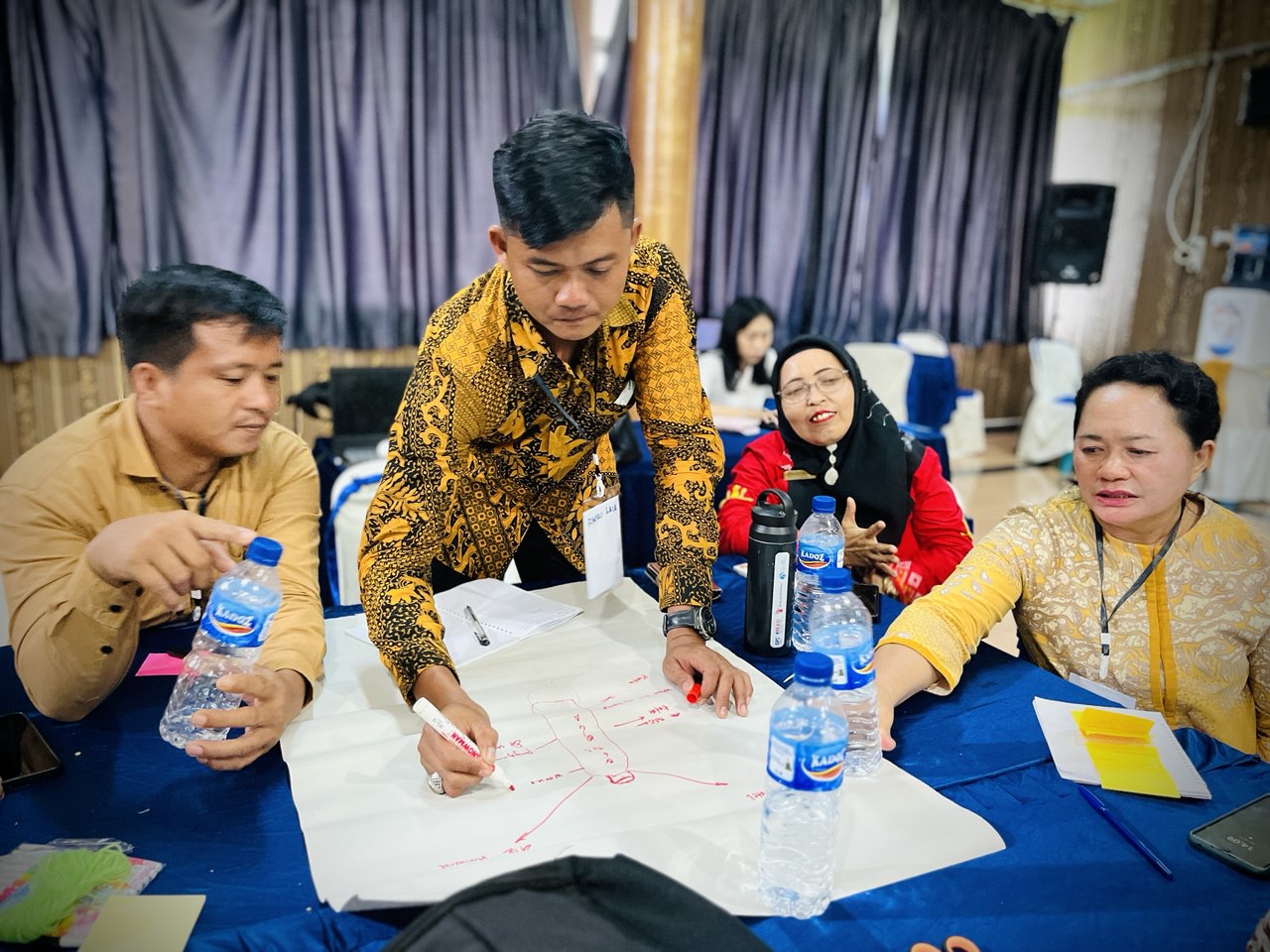
The training “Capacity Strengthening for Supervisors, School Heads, Teachers, and Lead Trainers in the Joyful Transition from Early Childhood Education to Primary School” was held over three days, 9–11 October 2025, and was attended by 22 selected participants consisting of supervisors, school principals, and teachers.
The activity was officially opened by Head of Nias Selatan Education Office, Nurhayati Telaumbanua. The main goal of this training was to strengthen educator capacity and ensure that the transition from early childhood education to primary school is joyful and meaningful. District Representative KREASI Nias Selatan, Reinhard Simanjuntak, specifically expressed the hope that this program would improve the quality of education in Nias Selatan so that the education report card scores will increase in the coming years.
During the training, participants were equipped with knowledge and practical skills through a series of intensive sessions. The core material began with a joint reflection on the challenges and concept of a joyful transition from early childhood education to primary school, focusing on child-centered efforts and sustained collaboration between PAUD, primary schools, and parents to create a friendly and inclusive learning environment.
Participants then learned about strategies to strengthen literacy and numeracy. It was emphasized that these two competencies are not limited to reading, writing, or calculating, but also include problem-solving, logic, and critical thinking, where literacy consists of six core skill areas and numeracy has five domains of competence. The next session discussed joyful transition learning through creating inclusive and differentiated classroom environments, as well as implementing Deep Learning in early childhood education based on the principles of being mindful, meaningful, and joyful. Another integrated approach introduced was STEAM (Science, Technology, Engineering, Art, and Mathematics), which was practiced through contextual play-based experiences using the TANDUR steps (Tumbuhkan – Grow, Alami – Experience, Namai – Name, Demonstrasikan – Demonstrate, Ulangi – Repeat, Rayakan – Celebrate).
The program also responded directly to challenges in the field, especially for schools with limited access to training. One participant, Martine, a school principal, voiced the issue of training gaps:
“For 3–4 years as a school principal, only this year have we been included in a training like this after the KREASI program came. We hope the Education Office and institutions will pay attention to remote schools, so they are also invited to trainings like this, not only schools in town getting these positive changes,” she said.
This highlights the importance of KREASI in bringing change to remote schools that previously were not reached by training opportunities. In addition, this activity aimed to address common gaps among teachers in the area of lesson planning.
On the final day, participants presented their TANDUR and STEAM lesson designs, which received key feedback from the facilitators on the need for child-friendly learning media and triggers that are appropriate for children in the transition age who still think concretely. The training concluded with the formulation of an Action Plan for implementing the PAUD–primary school transition by school principals and a Monitoring Action Plan by the Education Office, Ministry of Religious Affairs, and school supervisors.
_____
The Program of KREASI or Kolaborasi untuk Edukasi Anak Indonesia (Collaboration for the Education of Indonesian Children) is funded by the Global Partnership for Education, developed by the Ministry of Primary and Secondary Education, and the Ministry of Religious Affairs. KREASI is being implemented by Save the Children with Ikatan Guru Indonesia and support by the Government of Nias Selatan. KREASI aims to improve the quality of education in Indonesia by strengthening teaching, learning, and student development.
_____
Writer: Afnidar Dakhi | Editor: Andika Ramadhan | Photo: Afnidar Dakhi/KREASI/Ikatan Guru Indonesia/Save the Children