


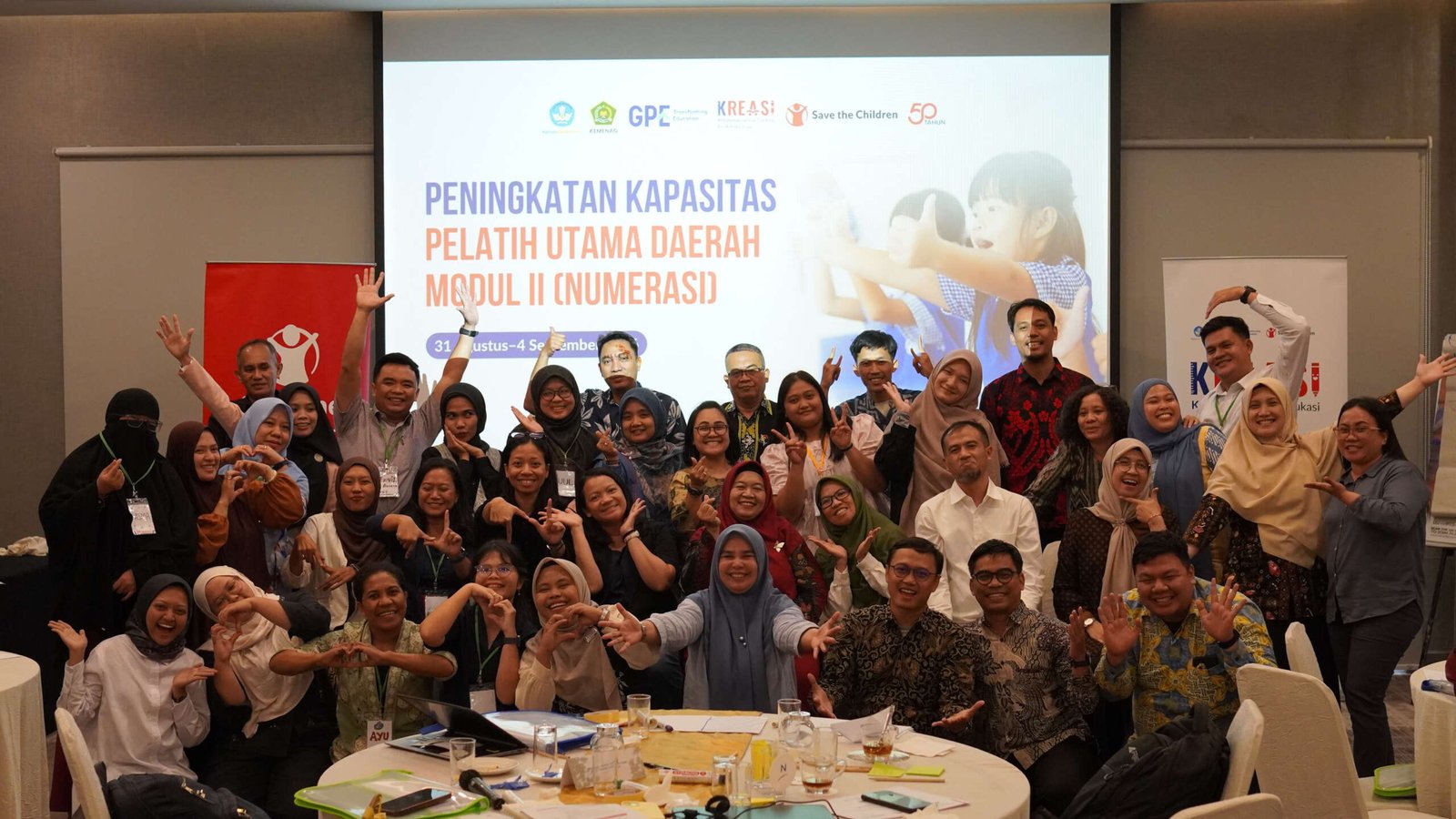
KREASI Save the Children conducted the Numeracy Module II Training for Master Trainers (Pelatih Utama Daerah/PUD) under the Teacher Professional Development (TPD) program from 31 August to 4 September 2026 in Jakarta. The training formed part of KREASI’s efforts to strengthen the quality of numeracy instruction in primary schools and Madrasah Ibtidaiyah (MI) through a cascading teacher professional development system. Participants included master trainers and representatives of local implementing partners from KREASI’s eight partner districts.
Alifah Sri Lestari, Chief of Party of KREASI Save the Children, emphasized that strengthening the capacity of master trainers is a critical step in ensuring that improvements in numeracy instruction can reach more teachers and students in a sustainable manner.
“Master Trainers play a strategic role in ensuring the quality of Numeracy Module implementation across all program areas. Through this training, we aim to build a shared understanding of key numeracy concepts while strengthening participants’ facilitation skills so they can effectively mentor local facilitators and teachers. Ultimately, investing in educators’ professional development is expected to contribute to improving Indonesian children’s numeracy skills,” she said.
Over the five-day training, participants explored the core content of Numeracy Module II, including foundations of mathematics teaching and learning, numeracy concepts, classroom management, number sense, mathematical operations, fractions, measurement, geometry, data and uncertainty, and the development of student-centered lesson plans. Participants also took part in microteaching sessions, training simulations, and facilitation practice to strengthen their readiness to train local facilitators in their respective districts.
In addition to deepening participants’ understanding of numeracy content, the training integrated character education, climate change awareness, Gender Equality, Disability, and Social Inclusion (GEDSI) principles, and classroom management practices that support inclusive and meaningful learning experiences for all students.
The training also provided a forum for participants to exchange experiences and discuss challenges related to numeracy instruction in their local contexts. Through a collaborative learning approach, participants were encouraged to develop more contextualized teaching strategies capable of strengthening students’ mathematical thinking skills.
At the conclusion of the training, all participants developed follow-up action plans to guide the implementation of Numeracy Module II training for local facilitators and teachers in their respective districts. These plans are expected to strengthen mentoring processes and support the effective application of numeracy teaching practices at the school level.
Through this initiative, KREASI continues to reinforce its commitment to supporting the Government of Indonesia in improving the quality of literacy and numeracy learning. At the same time, the program seeks to ensure that every child has access to better learning opportunities through competent teachers who are supported by sustainable professional development and mentoring systems.