


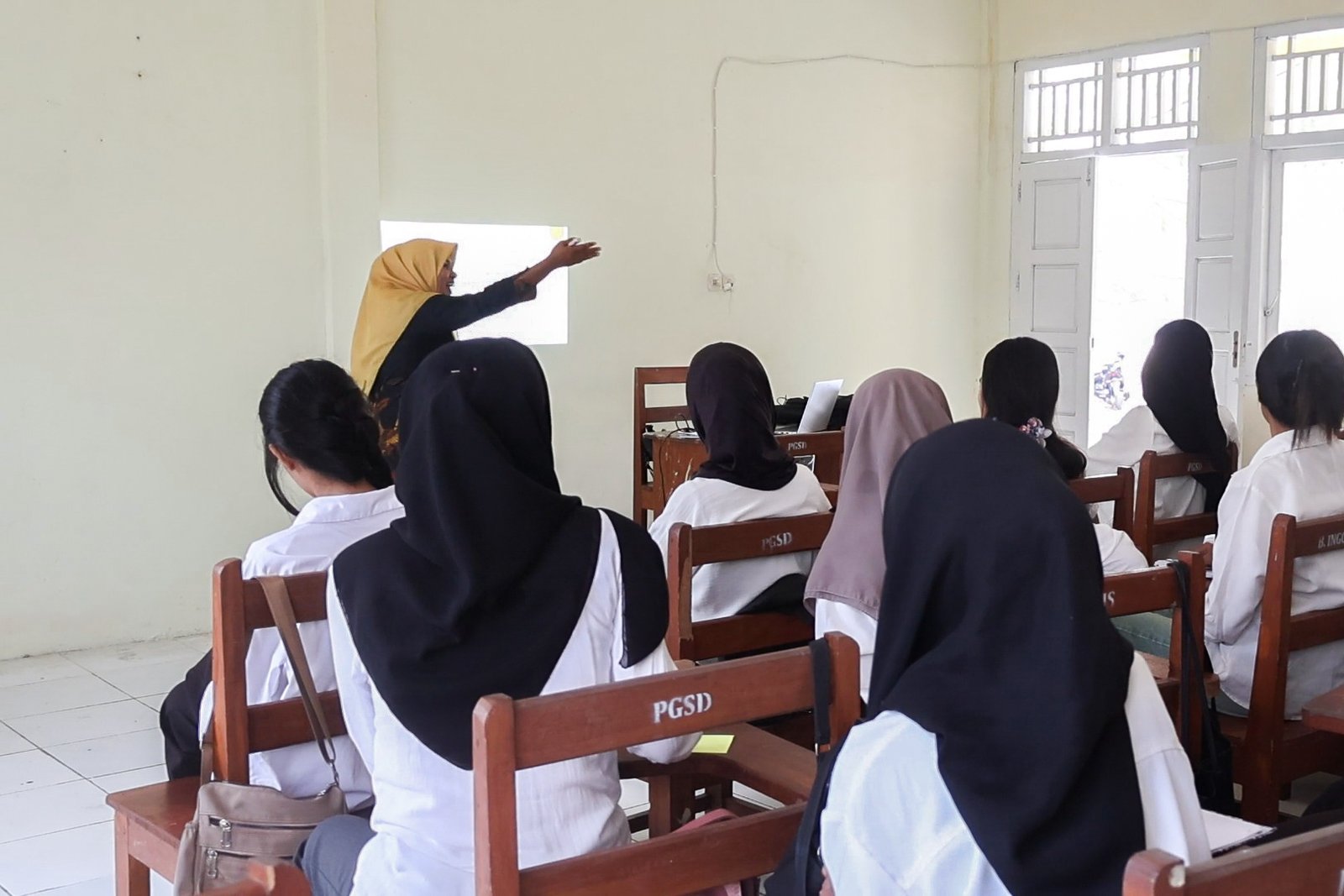
When a program has a defined timeline, the next challenge is ensuring that the good practices it has developed do not disappear once the program ends. For Universitas Pasifik (Unipas), one opportunity to sustain the approaches introduced through the KREASI Program in Morotai lies in the university’s role in preparing future teachers.
This idea became increasingly relevant for Fahmi, Dean of the Faculty of Teacher Training and Education (FKIP) at Unipas, after recognizing that prospective teachers still needed additional support in several areas. During an evaluation of the Teaching Practicum Program (PPL) in 2025, Fahmi and Ira, an FKIP lecturer, found that student teachers continued to face challenges in preparing instructional materials, including lesson modules.
The PPL evaluation was also used to assess students’ teaching practices, use of technology, classroom management skills, and readiness to handle real-world teaching situations. From the findings, Fahmi concluded that teaching methodology was one of the areas that needed further strengthening.
“When we reviewed how students developed lesson modules, we found there were still gaps. We then asked ourselves what the root cause was. Was it related to teaching practices, technology, instructional materials, classroom management, or other factors? We found that teaching methods were one of the areas that needed improvement,” Fahmi explained.
At the same time, Fahmi saw the approaches developed through the KREASI Program as valuable learning opportunities for student teachers. After participating in and observing various KREASI activities, he recognized that initiatives such as the Literacy Play Club (KBL) and Safe and Comfortable School Culture (BSAN) could be adapted and introduced within higher education settings.
According to Fahmi, KBL is not only relevant as an approach to strengthening literacy and numeracy in schools, but also as an example of effective teaching strategies for future teachers. These approaches, for example, could be incorporated into microteaching courses and other practical teaching experiences offered to teacher education students.
This opportunity has been further strengthened by a cooperation agreement between Unipas and Stimulant Institute, Save the Children’s local implementing partner for the KREASI Program. For Fahmi, the partnership creates space for the exchange of knowledge and educational practices developed through KREASI within the university environment.
“Since the mission of Unipas is to prepare future teachers, why shouldn’t we also apply the approaches and practices we have learned from KREASI within higher education?” Fahmi said.
One example of this knowledge-sharing process involves Oniy, a teacher from a KREASI-supported school and a graduate of Unipas. Oniy also serves as a KBL District Facilitator. Fahmi observed notable changes in Oniy’s motivation and engagement after participating in KREASI activities. This experience became one of the reasons Fahmi viewed KREASI practices as valuable lessons that could be shared with future teachers.
Ira later invited Oniy to share her experiences and learning from KREASI with FKIP students. Among the approaches she introduced was KBL, including practical strategies for supporting children who continue to face literacy challenges. For Fahmi, real-world experiences from practicing teachers complement the theoretical knowledge provided to student teachers.
However, introducing practices from a relatively new program, first implemented in 2025, into a university setting requires broader institutional support. According to Fahmi, this effort cannot depend on a single individual or faculty alone.
At the university level, support has come from institutional leaders, including the Rector, the Vice Rector for Academic Affairs, who serves as a District Facilitator for Primary and Islamic Primary School Principals, and the Vice Rector for Student Affairs, who serves as a Master Trainer for Safe and Comfortable School Culture after receiving training through KREASI. Within FKIP, the Dean plays a key role in integrating new approaches into teacher education programs. Lecturers who have participated in KREASI activities have also contributed ideas on how the program’s practices can be adopted within the faculty.
As a result, knowledge gained through KREASI has not remained limited to individual participants. Fahmi noted that several lecturers have shown interest in participating in KREASI activities to broaden their professional experience and knowledge, while balancing their academic responsibilities.
For Fahmi, this knowledge-sharing process has also provided the university with a fresh perspective. Prior to collaborating with KREASI, internal university programs were already in place, but opportunities to exchange teaching methodologies with school principals and education practitioners were relatively limited. Through engagement with KREASI, lecturers have been able to gain insights into teaching practices currently being implemented in schools.
Fahmi has also observed positive changes among teachers who have participated in KREASI activities. In his view, teaching practices previously tended to follow routine approaches, and many teachers still required additional guidance. After receiving support through KREASI, teachers became more motivated and gained new knowledge and skills to improve their classroom practices.
These experiences prompted Fahmi to consider a broader question: how can these practices continue after the program concludes?
“Building something is relatively easy, but sustaining what has already been built is much more challenging. KREASI also has a limited timeframe. Therefore, once the program ends, the important thing is how we maintain the good practices that have already been established,” Fahmi said.
One important step, in his view, is involving a wider range of stakeholders within the university. Leaders and lecturers who have participated in KREASI activities can not only benefit personally but also bring that knowledge back to the campus community.
For Fahmi, sustainability should not rely solely on the individuals currently involved. Another important group must be considered: future teachers themselves.
This is where the roles of Unipas and KREASI intersect. KREASI equips teachers already working in schools with practical knowledge and teaching approaches, while Unipas prepares the next generation of educators who will eventually enter the teaching profession.
“KREASI has already developed valuable practices and methods for teachers. We can adopt those good practices and use them as part of the learning experience for future teachers,” Fahmi explained.
By bringing relevant educational practices from schools into teacher education programs, the partnership between KREASI and Unipas creates a pathway for the program’s impact to endure beyond its implementation period. The approaches developed through KREASI will not remain solely with the teachers who have received support but can continue to be introduced, studied, adapted, and expanded by future teachers who will carry them into classrooms for years to come.
_____
KREASI (Collaboration for the Education of Indonesian Children) is a program to improve the quality of education by strengthening literacy, numeracy, and character education. KREASI in Pulau Morotai is managed by Save the Children and implemented by Stimulant Institute, with funding from the Global Partnership for Education (GPE), as well as support from the Government of Pulau Morotai and Indonesia’s Local Education Group, led by the Ministry of Primary and Secondary Education (Kemendikdasmen) and the Ministry of Religious Affairs (Kemenag).
Writer: Ayutama Putri Jordy | Editor: Andika Ramadhan | Photo: Ayutama Putri Jordy/KREASI/Stimulant Institute/Save the Children