


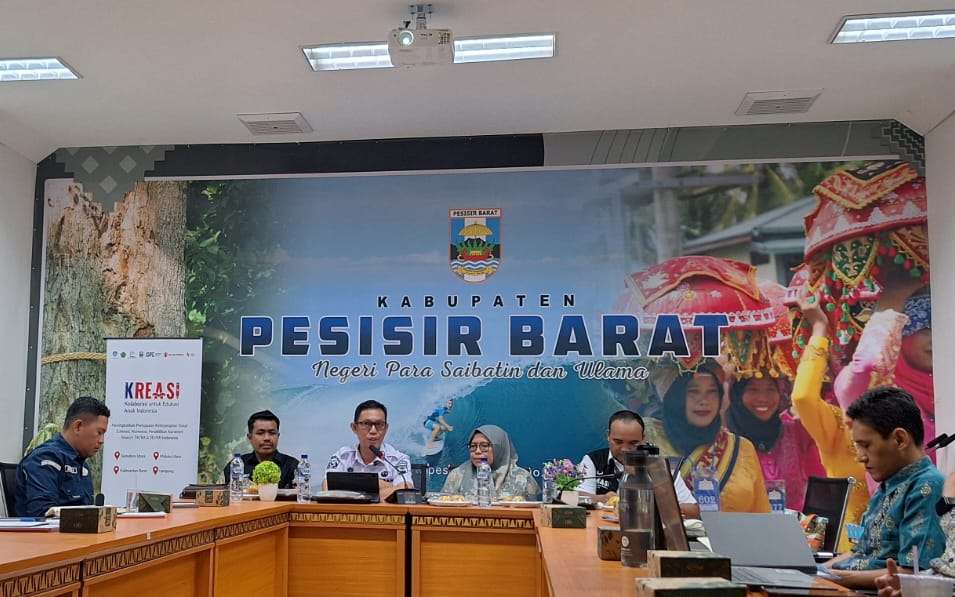
This opinion article by Gunawan, Head of the Regional Development Planning, Research, and Innovation Agency (Badan Perencanaan Pembangunan Riset dan Inovasi Daerah/Bappeda) of Pesisir Barat Regency
_____
There is one of the most honest ways to see the future of a region: do not look at its buildings, look at its children today. That is where the true direction of development is determined—not by what is visible, but by whom we are preparing for the future.
We are often fascinated by the physical achievements of development. Roads are built, buildings are erected, and economic growth figures increase. All of these are important, but they are not enough. Development that is only visible on the surface often conceals a more fundamental question: are the people within it also growing, or are they being left behind?
The Qur’an has provided a very clear principle of change: “Indeed, Allah will not change the condition of a people until they change what is in themselves” (QS. Ar-Ra’d: 11). This message emphasizes that the core of development is human beings. Without improvements in the quality of people, all physical development loses its meaning.
Today, Pesisir Barat actually has a strong direction. The 2025–2029 Regional Medium-Term Development Plan (Rencana Pembangunan Jangka Menengah Daerah/RPJMD) has established a progressive vision: to realize a prosperous, advanced, civilized, and religious region as a leading tourism destination. This direction is further reinforced in the 2027 Regional Government Work Plan (Rencana Kerja Pemerintah Daerah/RKPD) through the theme of accelerating quality regional development based on local potential.
Conceptually, there is nothing wrong with this. The planning is already on the right track. However, the reality of development always tests planning itself.
Data show that economic growth has reached a fairly positive level. The Human Development Index has also improved. Yet at the same time, poverty persists, and the quality of human resources has not been fully able to respond to future challenges. These are not merely numbers, but signals that our development still faces an imbalance between physical achievements and human quality.
In the education sector, this contradiction becomes even more apparent. Expected years of schooling have increased, but the average years of schooling still lag behind. Our children are entering school, but not necessarily graduating with strong thinking skills. They are present within the system, but have not fully received the quality of learning they need.
This phenomenon does not occur only in Pesisir Barat. The world refers to it as a learning crisis—when schools no longer guarantee learning. Under these conditions, educational development can no longer focus solely on access. It must focus on quality.
This is where the critical point of our development lies. If we continue with the old approach, development will continue, but it will not significantly change the future. However, if we dare to shift our focus—from physical infrastructure to people—then development will create long-term impact.
It is at this point that the KREASI Program finds its relevance.
KREASI is not present merely as an additional program, but as an answer to the most fundamental problems in human resource development. It does not simply provide training, but builds systems. It does not only reach teachers, but also principals, students, and the education ecosystem as a whole. Its focus is clear: literacy, numeracy, and character—three fundamental pillars that determine the quality of future generations.
The approach used is also different. KREASI does not work partially, but through strengthening the ecosystem. Local governments, schools, teachers, and communities are involved within a collaborative framework. Furthermore, the program is designed based on evidence and continuous evaluation, so that it does not stop at activities, but moves toward systemic change.
This is where its strategic strength lies.
What KREASI is truly doing is translating the RPJMD and RKPD into concrete action. When planning documents speak about improving the quality of human resources, KREASI delivers concrete interventions in classrooms. When the RKPD targets the improvement of children’s intellectual capacity and character, KREASI works directly within the learning process. When development requires collaboration, KREASI presents a collaborative working model across multiple stakeholders.
This means that KREASI does not operate outside the system, but instead strengthens the system itself.
Amid the many existing programs, the presence of targeted initiatives becomes highly important. Development is no longer measured by the number of activities conducted, but by the precision of the interventions. And KREASI stands exactly at that point—addressing the root causes, not merely the surface issues.
Developed countries have proven that investment in people is the key to progress. Finland places teacher quality as its top priority. Japan builds character as the foundation of education. South Korea has made education the engine of economic transformation. They did not begin with buildings, but with people.
This message aligns with the teaching of the Prophet Muhammad (peace be upon him): “Whoever follows a path in pursuit of knowledge, Allah will make easy for him a path to Paradise” (Narrated by Muslim). In the context of development, knowledge is not only a spiritual path, but also a path to progress.
Therefore, the fundamental question we must answer today is no longer how much we have built, but how appropriately we are building.
Has our development truly touched people, or is it still limited to physical infrastructure? Because in the end, the future of Pesisir Barat is not determined by what we build today, but by whom we prepare for tomorrow.
If our children are strong, then this region will be strong. If our children are intelligent, then this region will progress. But if our children are left behind, then all development will become nothing more than structures without a future.
And it is at this point that we must make a decision: continue as usual, or begin building in the right way.