


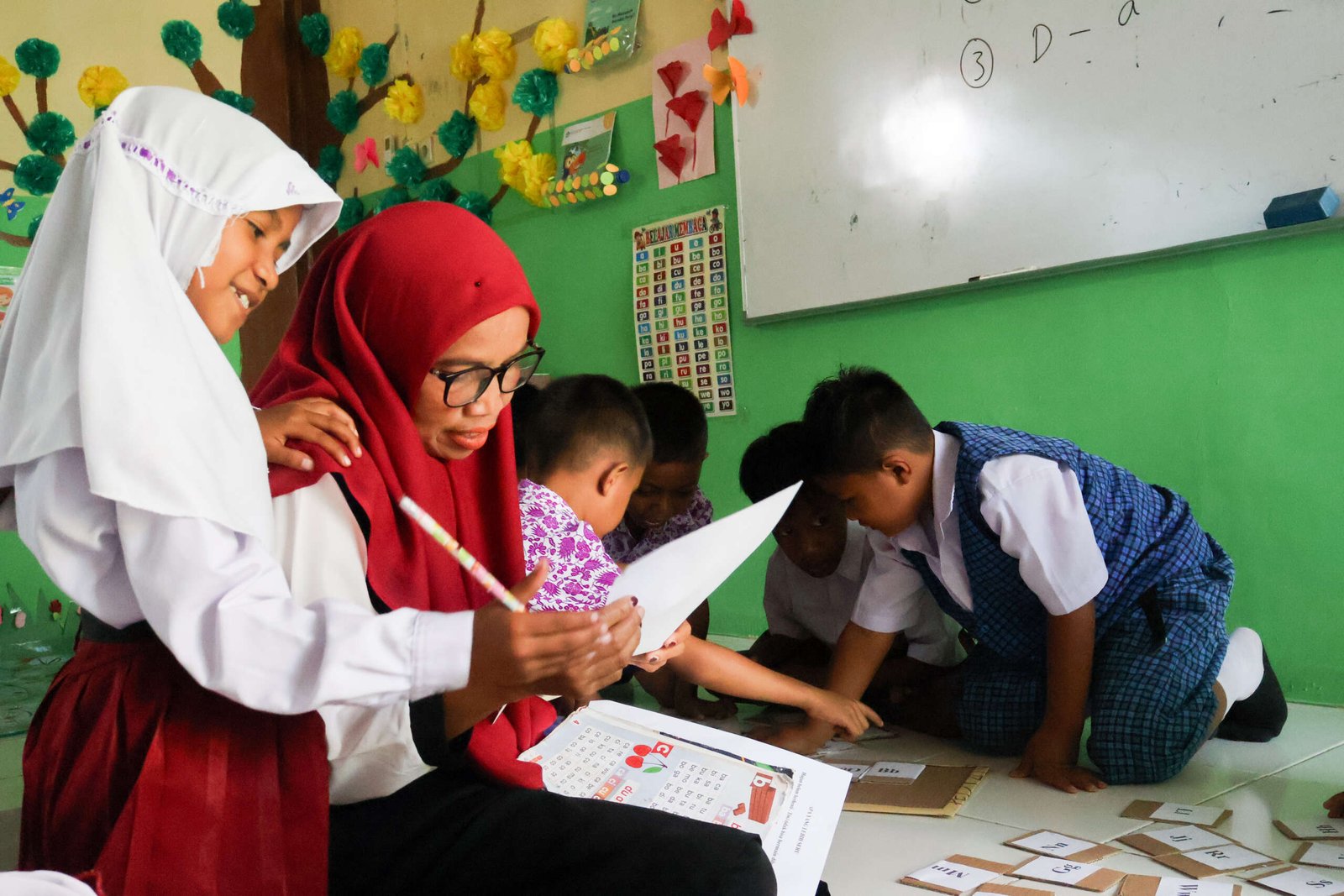
Within a classroom, not all children learn at the same pace or in the same way. Dahrina, a Grade 2 teacher at one of KREASI’s partner schools, came to realize this more clearly after participating in training sessions and receiving ongoing support through the KREASI Program.
Before joining the training, Dahrina did not use assessments to understand her students’ learning abilities. When she wanted to find out whether a child could recognize letters, she would simply ask them directly.
“Before the KREASI training, I didn’t know how to conduct assessments. When children started school, I would simply ask if they already knew the letters,” Dahrina recalled.
Through the KREASI training, Dahrina learned how to use assessments to better understand each child’s learning needs. The assessment results provided a clearer picture of her students’ abilities and learning levels. Based on this information, she began grouping students according to their skills and providing support that matched their individual needs.
In addition to learning about assessments, Dahrina also transformed the way she teaches. Before participating in the training, classroom activities tended to follow a predictable routine. After the morning prayer, students would usually submit their homework and begin writing activities, while literacy activities were not yet part of the daily learning process.
“Before the training, we would enter the classroom and immediately start writing. There were no literacy activities such as five to ten minutes of reading at the beginning of the lesson. Looking back, the learning process felt quite monotonous,” she said.
After joining the KREASI program, Dahrina also changed the way she prepared students for learning. She now takes time to encourage her students, ask how they are doing, and provide dedicated time for literacy activities before lessons begin. She has also come to understand the importance of using learning materials and teaching aids. While she previously relied heavily on textbooks, she now incorporates tools such as letter cards to support instruction.
“My perspective has changed. I realized that teaching should involve learning materials that help children stay focused. I need to be creative so that students can understand lessons more quickly,” Dahrina explained.
When teaching literacy, Dahrina now follows a more structured approach. She introduces sounds, letters, and syllables before moving on to reading comprehension and more complex learning tasks.
“Through the training, I learned that literacy should be taught step by step. Children need to first become familiar with sounds, then letters, then syllables, before moving on to understanding texts. This has made my teaching much more purposeful,” she said.
Her growing understanding of children’s needs has also changed the way she views the learning environment. Although a reading corner had already existed in her classroom, she had never fully utilized it as a tool to support literacy development.
“Our school had already created a reading corner, but at the time we didn’t really understand its purpose. I thought it was simply classroom decoration. After participating in the training, I learned how to maximize the reading corner to support children’s literacy development. Now I have added alphabet displays, uppercase and lowercase letters, and vocabulary posters that students can refer to while learning in the reading corner,” Dahrina explained.
What was once simply a table with a few books has now become a vibrant literacy space filled with educational displays and learning materials. According to Dahrina, students have become much more enthusiastic about reading and learning since she improved the reading corner and changed her teaching approach.
The changes are also evident in how she manages her classroom. Previously, when students became distracted or inattentive, Dahrina primarily relied on verbal reminders. Today, she uses classroom agreements that were developed together with her students as a shared reference for behavior and expectations.
When she is working with one group and another group begins to make noise, she simply reminds them about the classroom agreements. The students then reflect on the commitments they made together and adjust their behavior accordingly.
“I emphasize that our classroom agreement is a promise, and promises should not be broken. It is also a way of helping build their character,” said Dahrina. The many lessons Dahrina gained through the KREASI training have gradually become part of her daily classroom practice. These changes have given her more effective ways to understand her students’ needs and adapt learning activities to match their abilities. As a result, the classroom experience has become more engaging, inclusive, and responsive to every child’s learning journey.
_____
KREASI (Kolaborasi untuk Edukasi Anak Indonesia) adalah program peningkatan kualitas pendidikan dengan memperkuat literasi, numerasi, dan pendidikan karakter. KREASI di Pulau Morotai dikelola Save the Children dan diimplementasi oleh Stimulant Institute, dengan pendanaan Global Partnership for Education (GPE) serta dukungan Pemerintah Kabupaten Pulau Morotai dan Mitra Pendidikan Indonesia yang dipimpin Kementerian Pendidikan Dasar dan Menengah (Kemendikdasmen) dan Kementerian Agama (Kemenag).
Penulis: Ayutama Putri Jordy | Editor: Andika Ramadhan | Foto: Ayutama Putri Jordy/KREASI/Stimulant Institute/Save the Children