


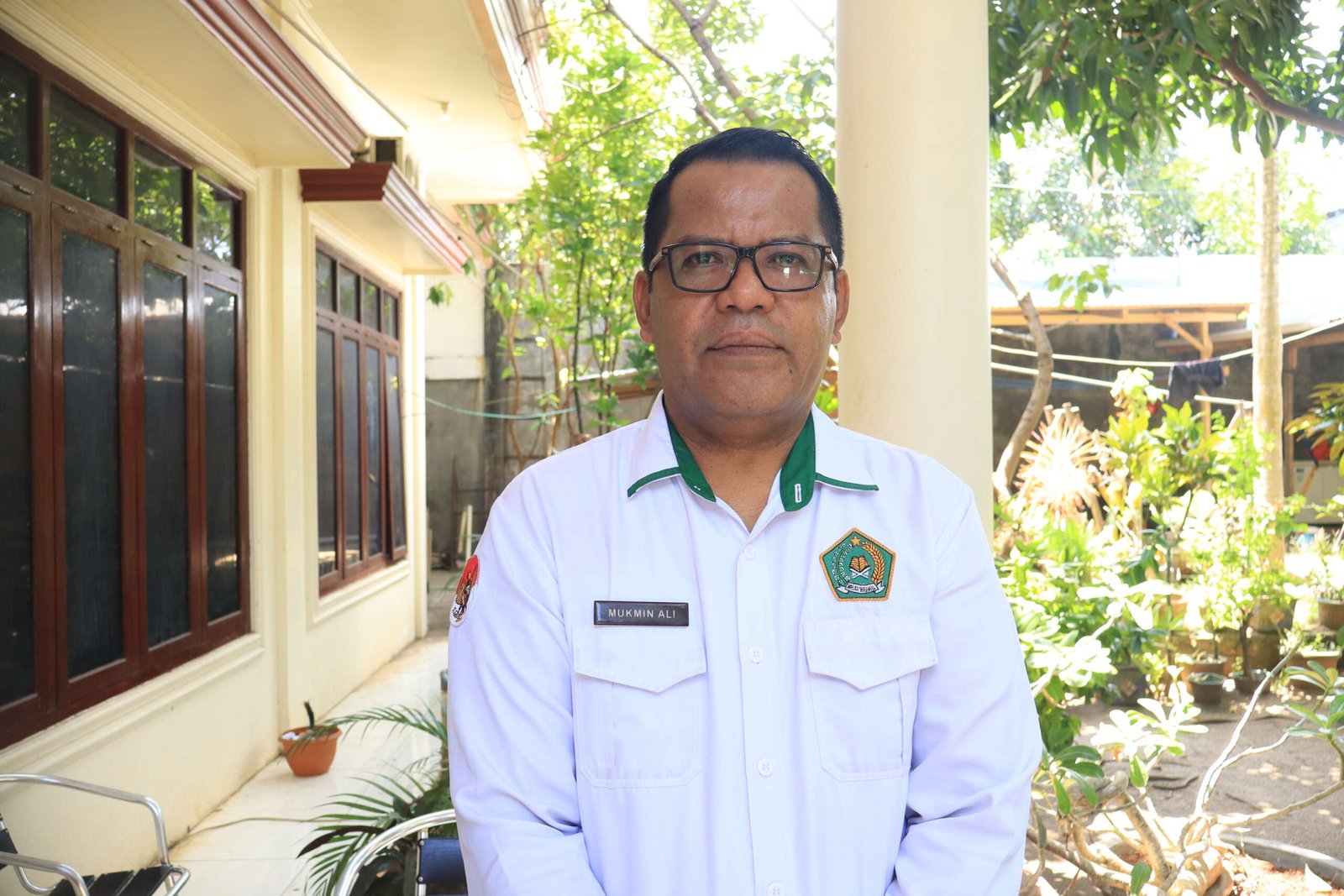
When the KREASI Program was first introduced in Pulau Morotai, Mukmin Ali, Head of the Islamic Education Section (Kasi Pendis) at the Ministry of Religious Affairs Office of Pulau Morotai District, admitted that he did not fully understand the program’s direction. As an official responsible for supporting and overseeing madrasahs in the district, he initially questioned the purpose and foundation of the various activities being introduced to schools.
“At first, I wondered what this program was really about. I was unsure of its direction and questioned the basis for its implementation,” Mukmin recalled.
However, as he became more involved in KREASI activities and mentoring processes, his doubts gradually turned into confidence. Through a deeper understanding of the program, Mukmin came to see that KREASI is firmly grounded in government regulations and aligned with national education policies.
“It turned out that the program is based on government regulations, laws, and ministerial policies. Once I became involved, I realized that its focus is on education and child protection,” he said.
For Mukmin, this alignment is particularly important because KREASI’s objectives support the Ministry of Religious Affairs’ efforts to develop child-friendly madrasahs that promote students’ holistic growth and development. Through various training and mentoring activities, teachers and school leaders have gained a stronger understanding of how to prevent and respond to issues affecting children.
According to Mukmin, before receiving support from KREASI, many schools handled student-related issues in relatively simple ways without having clear procedures in place. One common example was verbal bullying among students, which was often addressed only through counseling without a more comprehensive prevention and response system.
“In madrasahs, there are sometimes cases where students tease one another verbally. We used to address those situations mainly through counseling. At that time, there was no clear framework for preventing or handling such cases. After receiving support from KREASI, teachers gained a much better understanding of the steps that need to be taken,” he explained.
As the program progressed, Mukmin observed increasingly visible changes within madrasahs. Schools began developing clearer mechanisms for creating safe and supportive learning environments for students. The approaches adopted by schools also continued to evolve in line with government policies, ensuring that they remained relevant to the needs of both students and educators.
In his role as Kasi Pendis, Mukmin regularly visits madrasahs and coordinates with principals and teachers. Through these interactions, he has witnessed firsthand how KREASI has influenced not only child protection efforts but also classroom learning practices.
“I regularly visit schools and coordinate with principals and teachers. They often talk about KREASI and the changes it has brought. There are students who need more time to understand lessons, and KREASI has helped address that challenge,” he said.
According to Mukmin, one of the most significant changes has been the renewed enthusiasm among teachers to continue learning and improving their professional practice.
“The most important change is the teachers’ spirit and motivation. Capacity development in madrasahs has improved significantly, from lesson planning to teaching methods. The program’s objectives and targets are being achieved,” he said.
The impact of these improvements extends beyond daily classroom activities. Mukmin noted that positive changes have also become evident through achievements at the provincial level. He pointed to the participation of madrasahs from Pulau Morotai in the Madrasah Literacy Movement (GALATAMA) organized by the Regional Office of the Ministry of Religious Affairs of North Maluku Province.
During GALATAMA 2025, madrasahs from Pulau Morotai began demonstrating stronger performance. According to Mukmin, teachers applied teaching methods introduced through KREASI mentoring to help students understand learning materials more effectively.
“Madrasahs had been receiving support from KREASI since early 2025, so teachers had already learned strategies to help students grasp lessons more quickly. The same methods were applied in preparing students for competitions. I asked where those methods came from, and the teachers said they had learned them from the KREASI team,” he explained.
The progress continued during GALATAMA 2026. According to Mukmin, the achievements of madrasahs from Pulau Morotai surpassed those of the previous year.
“This year was even more impressive than last year. Madrasahs from Morotai won more awards than before. The biggest factor behind their success at the provincial level was the teaching methods used by the teachers. Those methods had a significant impact on students’ performance and achievements,” he said.
For Mukmin, the impact of KREASI goes far beyond improvements in learning quality and student achievement. He has also seen how the program strengthens cross-sector collaboration to support the fulfillment of children’s rights.
According to him, KREASI has supported various government efforts, ranging from improving education quality to addressing issues related to birth registration and out-of-school children.
“KREASI collaborates closely with the government to improve education quality, including addressing issues such as birth certificates and children who have dropped out of school. This program is far more than a formality. We have felt the benefits of its implementation, especially through its field-based activities,” Mukmin said.
Ultimately, for Mukmin, the success of KREASI cannot be measured solely by the number of awards won by students. More importantly, it is reflected in the renewed motivation of teachers to continue learning, the strengthening of child protection systems within schools, and the growing collaboration between madrasahs, government institutions, and other stakeholders. These are the meaningful changes he has witnessed since the KREASI Program began its work in Pulau Morotai.
_____
KREASI (Kolaborasi untuk Edukasi Anak Indonesia) adalah program peningkatan kualitas pendidikan dengan memperkuat literasi, numerasi, dan pendidikan karakter. KREASI di Pulau Morotai dikelola Save the Children dan diimplementasi oleh Stimulant Institute, dengan pendanaan Global Partnership for Education (GPE) serta dukungan Pemerintah Kabupaten Pulau Morotai dan Mitra Pendidikan Indonesia yang dipimpin Kementerian Pendidikan Dasar dan Menengah (Kemendikdasmen) dan Kementerian Agama (Kemenag).
Penulis: Ayutama Putri Jordy | Editor: Andika Ramadhan | Foto: Ayutama Putri Jordy/KREASI/Stimulant Institute/Save the Children