


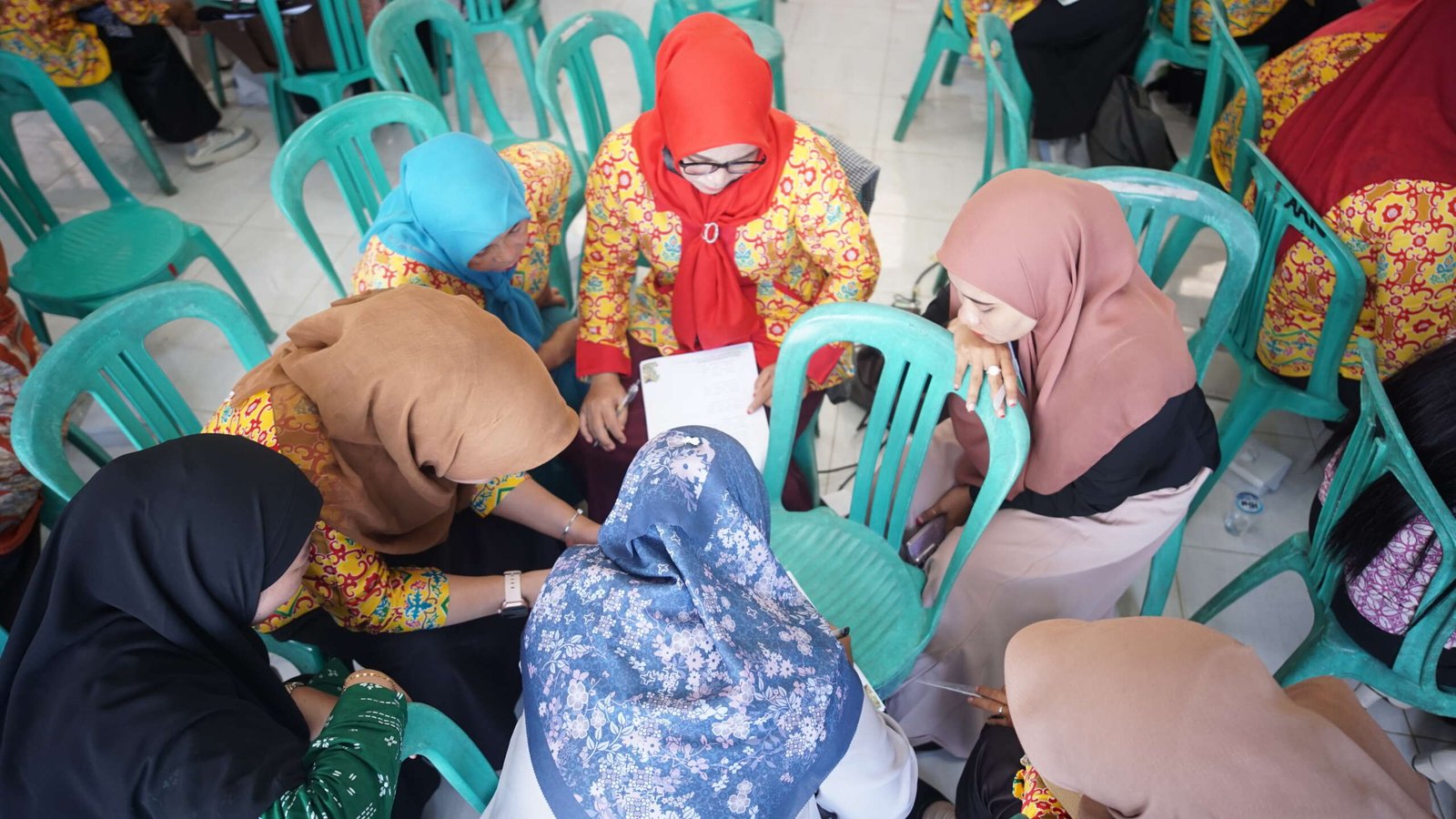
Ensuring that children enter primary school feeling safe, confident, and ready to learn is a crucial first step toward their long-term educational success. This principle became the central focus of the Joyful Preschool-to-Primary School Transition Campaign: Building Awareness and Support for 13 Years of Compulsory Education, held at a public primary school in Ketapang on 16 July 2026.
The event was a collaborative initiative between the Ketapang Bunda PAUD Working Group (Pokja Bunda PAUD) and the KREASI Program. The campaign aimed to strengthen the commitment of all stakeholders to creating adaptive, child-friendly learning environments from a child’s very first day of school.
In his remarks, Dendi Wijaya Saputra from the Primary and Secondary Education and Non-Formal Education Council of Muhammadiyah emphasized the importance of sustained and meaningful educational interventions, which currently reach seven sub-districts across Ketapang District.
“KREASI focuses on strengthening teachers’ capacities and improving foundational literacy and numeracy skills so they can be effectively integrated into classroom learning through appropriate teaching methods,” he said.
Lusia Dewi Nurjana Alexander Wilyo, Bunda PAUD of Ketapang District, introduced the TALAM UBI Movement (Transisi Langkah Anak Menyenangkan Menuju SD yang Unggul, Bahagia, dan Inklusif). The locally inspired term was chosen to make the transition program easier for communities to remember and understand.
“Through the TALAM UBI Movement, we want children’s transition from preschool to primary school to be smooth and enjoyable. We must prevent psychological barriers and feelings of fear when children enter a new learning environment. Our goal is to create a transition process that is excellent, joyful, and inclusive,” Lusia explained.
She also reaffirmed the policy prohibiting the use of reading, writing, and arithmetic tests as admission requirements for primary school.
“The main priority at the beginning of the school year is ensuring that children feel comfortable at school. Once they are emotionally ready, learning can take place gradually according to each child’s developmental stage,” she stated, while also emphasizing the importance of parental support at home.
“Children May Play, but We Must Not Play with Their Education”
Serving as the keynote speaker, education expert Ananto Kusuma Seta highlighted the importance of investing in Early Childhood Education based on the global research of Nobel Prize-winning economist James Heckman. Ananto emphasized that the golden age of childhood is a period when children’s brains are exceptionally responsive to everything they see, hear, and experience.
“If we make mistakes in education during these early years, we can never go back and undo them. Children may play, but we must not play with their education. Their future is shaped during these formative years. What we do today is essentially an investment in the nation’s future,” Ananto explained.
He further stressed that schools should be prepared to accommodate children’s diverse backgrounds and needs rather than expecting children to adapt immediately to the school environment.
“It is not the child who must adapt to the school; it is the school that must be ready to welcome every child with all the uniqueness they bring,” he said.
Based on the technical discussions conducted during the event, educators were encouraged to apply three key principles in early grade learning: mindful, meaningful, and joyful learning.
From these principles, three important recommendations emerged for teachers:
Emotional Well-being: Children learn more effectively when they feel safe, accepted, and emotionally secure. Building positive relationships between teachers and students is a critical foundation for successful learning.
Interactive Learning Methods: Children should be encouraged to think actively through open-ended questions and engaging learning experiences rather than passively receiving information.
School-Family Collaboration: A successful transition requires consistent two-way collaboration between teachers at school and parents at home.
Ultimately, the success of early childhood education should not be measured by immediate academic achievements such as the ability to read before entering primary school. Rather, true success is reflected in children’s confidence, independence, social skills, and intrinsic motivation to learn. Through this Joyful Preschool-to-Primary School Transition Campaign, KREASI hopes that more schools across Ketapang District will adopt inclusive and child-centered educational practices, contributing to the successful implementation of Indonesia’s 13-Year Compulsory Education Program.
_____
KREASI (Collaboration for the Education of Indonesian Children) is a program to improve the quality of education by strengthening literacy, numeracy, and character education. KREASI in Ketapang is managed by Save the Children and implemented by Majelis Dikdasmen dan PNF PP Muhammadiyah, with funding from the Global Partnership for Education (GPE), as well as support from the Government of Ketapang and Indonesia’s Local Education Group, led by the Ministry of Primary and Secondary Education (Kemendikdasmen) and the Ministry of Religious Affairs (Kemenag).
Writer: Afriyandi Nur Huda | Editor: Andika Ramadhan | Photo: Afriyandi Nur Huda/KREASI/Majelis Dikdasmen dan PNF PP Muhammadiyah/Save the Children