


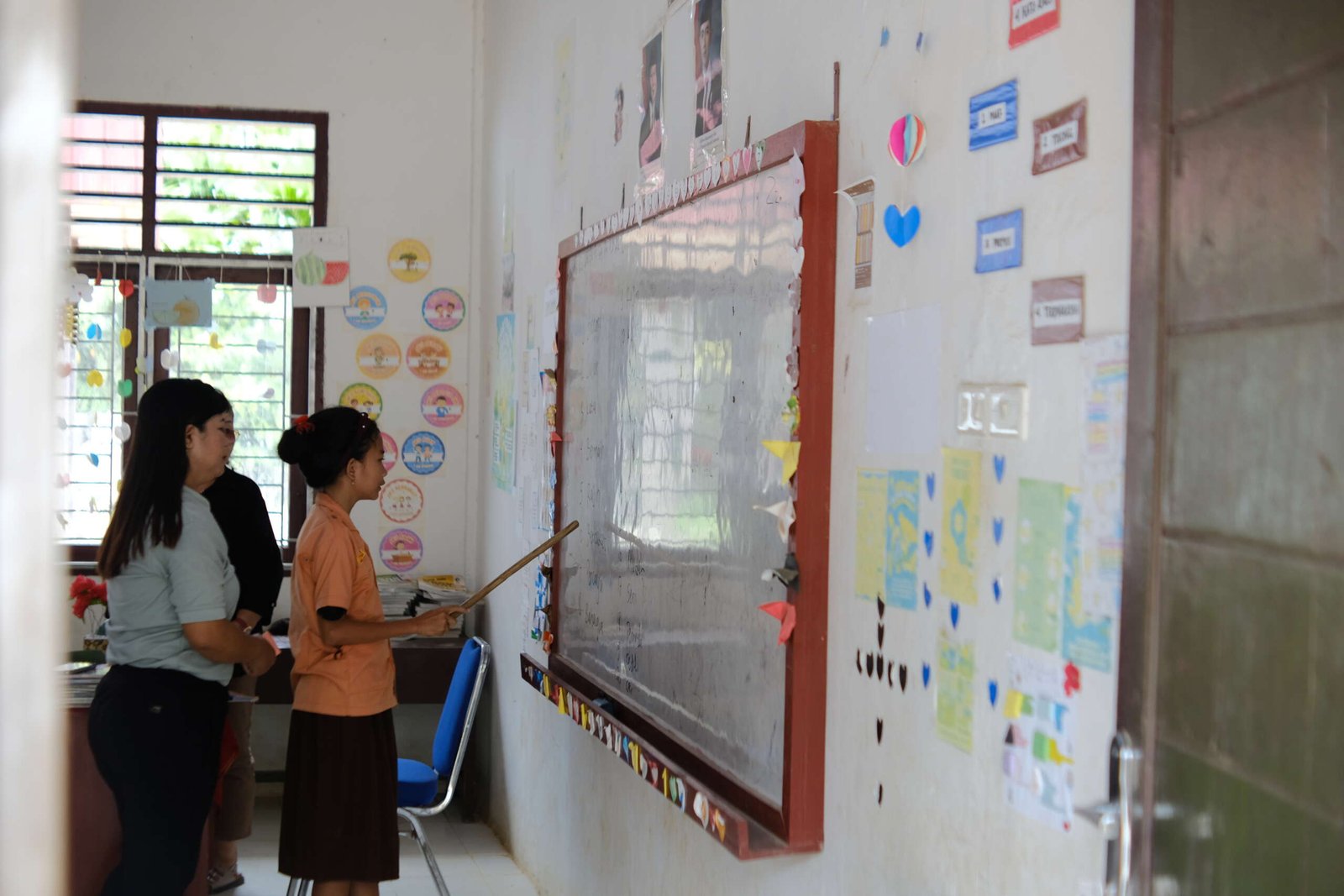
A simple idea shared among school principals has evolved into a meaningful initiative to help students improve their reading skills.
“Change does not always begin with a large-scale program, but with the courage to take the first step.” This spirit can be seen at a public elementary school in Sitolu Ori Subdistrict, Nias Utara, where a long-envisioned plan was finally transformed into concrete action through the establishment of an Additional Literacy Class.
Concern about students’ literacy skills became the starting point for this initiative. Based on observations and experiences of homeroom teachers during the learning process, several students, including those in upper grades, were still unable to recognize letters or read words fluently. This situation affected their ability to participate effectively in lessons across subjects and became a shared concern among the entire school community.
The concern grew stronger after the Nias Utara District Education Office encouraged schools to strengthen literacy skills as a shared responsibility. The goal was to ensure that every student possesses adequate reading skills before continuing their education to junior secondary school.
The idea of establishing an additional literacy class was not entirely new for the school. However, the plan became more refined after the principal participated in a Peer Learning activity facilitated by the KREASI Program. Through this forum, school principals shared experiences, challenges, and good practices in managing learning processes at their respective schools. One inspiring practice was the implementation of an additional literacy class in another school.
“The idea of an additional literacy class had actually been in our plans for quite some time. The encouragement from the Education Office further strengthened our intention. After participating in Peer Learning through the KREASI Program, we saw a real example from another school and became even more confident that we could implement a similar initiative. We felt that we were not working alone because there was a space where we could learn from and support one another,” said Invrah, the school principal.
Inspired by this experience, the school initiated discussions with teachers. As a result, it was agreed that the Additional Literacy Class would be held every Friday at 11:30 a.m., after regular school hours. The program officially began on 7 August 2026 and is attended by 28 students from Grades 2 through 6. Friday was selected by mutual agreement among teachers to ensure that the program would not interfere with regular classroom instruction.
To provide support tailored to students’ needs, participants were divided into two learning groups. Group A is designed for students who are still unable to recognize letters, while Group B serves students who can recognize letters but continue to face challenges in identifying and reading words. This arrangement allows teachers to provide more focused and appropriate support according to each child’s learning level.
The Additional Literacy Class represents a collaborative effort involving the entire school community. Every Friday, two teachers take turns facilitating the sessions according to a predetermined schedule. Parents have also demonstrated their support by attending socialization meetings and allowing their children to participate in additional learning activities outside regular school hours.
For the school, the KREASI Program has provided more than training opportunities. It has created a learning space where school principals can learn from one another through Peer Learning. This collaborative environment encourages principals to adapt good practices to meet their schools’ specific needs while strengthening their confidence that meaningful change can begin with simple actions.
“We hope that the KREASI Program will continue supporting schools, particularly by providing guidance on literacy teaching methods, implementation mechanisms, learning materials, and modules. In this way, the Additional Literacy Class can continue to grow into an increasingly effective activity that helps children learn to read,” Invrah added.
The school’s initiative also aligns closely with the approach of the Literacy and Numeracy Learning Club (CuC), which will be implemented during the second year of the KREASI Program. This early experience provides a strong foundation for the school to further strengthen literacy learning through the support and mentoring that will be offered in the next phase.
Although the initiative has only recently begun and its impact on students’ reading abilities cannot yet be measured, early signs of change are already visible. The school now has a dedicated schedule for literacy development, teachers are committed to supporting students beyond regular class hours, parents are actively involved, and the principal has successfully mobilized the entire school community to work together in addressing literacy challenges.
This initiative demonstrates that meaningful change does not always require waiting for a major program to begin. When schools are willing to take action, supported by collaboration among teachers, parents, local government, and learning opportunities facilitated by the KREASI Program, small steps can become the foundation for a stronger literacy culture.
Looking ahead, the school hopes that all students participating in the Additional Literacy Class will be able to recognize letters, read more fluently, and gain greater confidence in their learning. The school also hopes that continued support from the KREASI Program will further strengthen the implementation of this initiative and enable it to become a good practice that inspires other schools across Nias Utara.
Because when school principals learn from one another, inspiration does not remain within the walls of a discussion forum. It grows into real action that creates more opportunities for children to learn, develop, and build a brighter future.
_____
KREASI (Collaboration for the Education of Indonesian Children) is a program to improve the quality of education by strengthening literacy, numeracy, and character education. KREASI in Nias Utara is managed by Save the Children and implemented by Article 33 Indonesia, with funding from the Global Partnership for Education (GPE), as well as support from the Government of Nias Utara and Indonesia’s Local Education Group, led by the Ministry of Primary and Secondary Education (Kemendikdasmen) and the Ministry of Religious Affairs (Kemenag).
Writer: Calvin Telaumbanua | Editor: Andika Ramadhan | Photo: Calvin Telaumbanua/KREASI/Article 33 Indonesia/Save the Children