


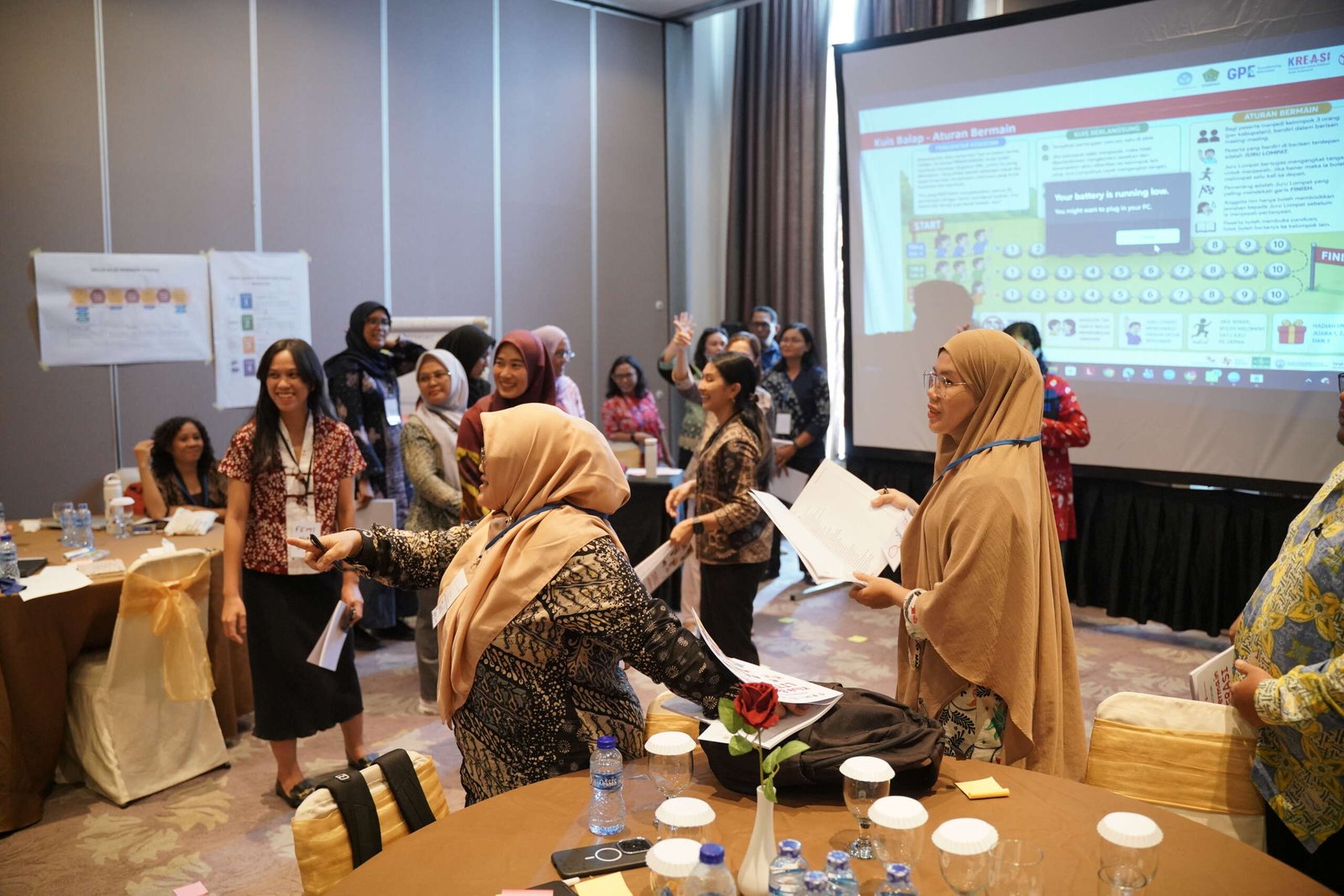
The KREASI Program organized a Capacity Building Workshop for District Facilitators of Literacy Catch-Up Clubs (CuC) from 27–31 July 2026 in Jakarta. The workshop brought together District Facilitators, Training Coordinators, CuC Officers, and KREASI technical team members from various program-supported districts.
The workshop was conducted alongside capacity-building activities for the Communication and Media and MEAL teams. The joint event was officially opened by Muhammad Yusro, Secretary of BKPDM at the Ministry of Primary and Secondary Education (Kemendikdasmen), and Abdul Basit, Head of the Subdirectorate of Curriculum and Student Affairs for Madrasahs at the Ministry of Religious Affairs (Kemenag), representing the Co-Chair of the Indonesia Education Partnership.
The training formed part of KREASI’s efforts to strengthen the quality of foundational education, particularly basic literacy for primary school students who require additional learning support.
Through the Teaching at the Right Level (TaRL) approach, Literacy Catch-Up Clubs are designed to help students learn according to their actual learning level, making the learning process more effective, inclusive, and engaging.
Throughout the training, participants explored a range of core topics that underpin the implementation of Literacy Catch-Up Clubs. These included an introduction to the program, key principles of Teaching at the Right Level (TaRL), play-based literacy learning, Social Emotional Learning (SEL), and the integration of child safeguarding principles into all learning activities.
Participants also engaged in practical sessions and simulations of literacy activities tailored to different student learning levels, including oral language development, letter and syllable recognition, word reading, sentence and paragraph reading, as well as comprehension of stories and texts. In addition, they learned how to use literacy assessments to group students based on their learning levels and to develop learning plans that respond to each child’s specific needs.
One of the key components of the training was a microteaching session conducted in schools. During this session, participants had the opportunity to facilitate Literacy Catch-Up Club activities directly with students, including conducting literacy assessments and managing instruction based on learning-level groups. Following the field practice, participants received constructive feedback from trainers to strengthen their facilitation skills and instructional practices.
Beyond technical capacity building, the training also equipped participants with adult learning facilitation skills. District Facilitators are expected to serve as trainers for Literacy Catch-Up Club Facilitators at the district level through participatory, reflective, and learner-centered training approaches.
The training also introduced peer learning, mentoring, and coaching mechanisms as part of the program’s quality assurance system. Through these approaches, facilitators are encouraged to continuously learn, share experiences, and support one another in addressing implementation challenges in their respective areas.
As a concluding activity, all participants developed Follow-Up Action Plans that will guide the delivery of Literacy Catch-Up Club Facilitator training in their districts. These plans are expected to ensure a systematic replication of the training and support high-quality implementation of Literacy Catch-Up Clubs across all KREASI-supported districts.
Through this initiative, KREASI reinforces its commitment to improving the foundational literacy skills of Indonesian children through a learner-centered approach supported by competent facilitators, strong mentoring systems, and sustained collaboration among government institutions, schools, communities, and implementing partners.