


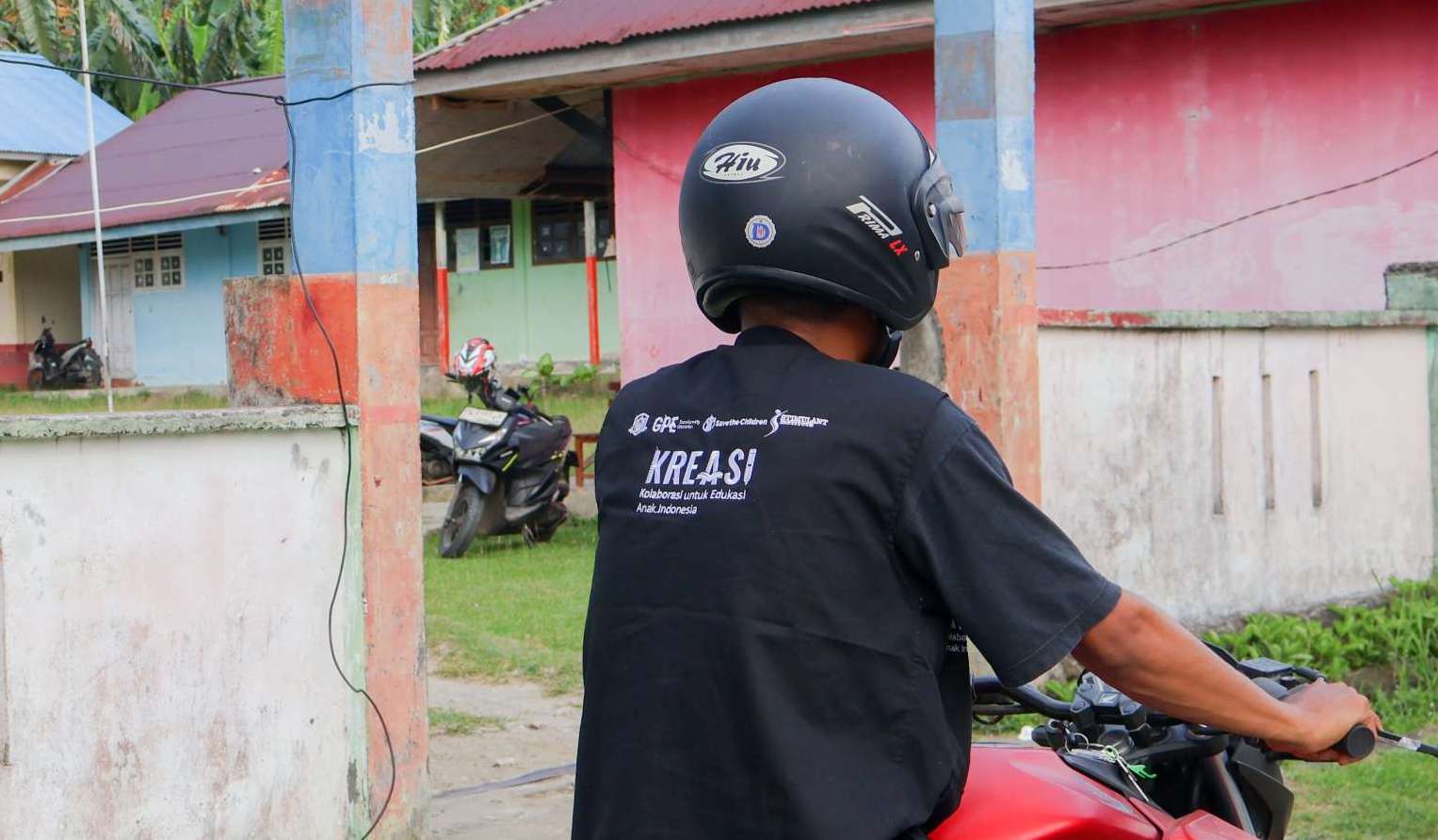
Consider yourself fortunate if your commute from home to work takes only a few minutes. In Pulau Morotai District, Maluku Utara Province, the Stimulant Institute team often needs hours to travel to and from their workplace.
Stimulant Institute is the local implementing partner organization for the KREASI (Collaboration for the Education of Indonesian Children) in Pulau Morotai.
The journey to KREASI-assisted schools often begins while the sky is still dark.
“We always discuss the preparations first within the internal team. What time should we leave tomorrow? Should we gather at the office or pick up each person from their boarding house? If the activity in Morotai Jaya Subdistrict starts at nine in the morning, I usually wake up at three in the morning to contact the team. The target is for everyone to be ready by four, and by five we are already on the road,” said Mansur, a staff member of Stimulant Institute.
The journey to Morotai Jaya, around 131 kilometers from Morotai’s town center in Daruba, takes approximately three and a half to four hours. Most of the roads are paved and relatively good. However, uphill roads, sharp turns, and several damaged sections with potholes force vehicles to move more slowly.
After traveling for around three and a half to four hours, the team usually arrives at about 8:30 a.m. They do not immediately begin the training. There is still around thirty minutes needed to prepare the room, set up equipment, and ensure all participants are ready to join the activity.
In the afternoon, another long journey awaits.
“The activity usually ends at around four in the afternoon. After cleaning up, we usually leave at around five in the afternoon and arrive back in Morotai Selatan at around eight in the evening,” said Mansur.
However, the return journey does not always go as planned. When it rains, several road sections are often flooded and become difficult to pass.
“If the weather starts to get bad, we have to speed up our preparations to go home. If we are even slightly late, several points along the road can become flooded and vehicles cannot pass,” Mansur said.
The challenges do not stop with the journey. Gathering training participants also requires considerable effort. Phone networks that often disappear mean coordination must be carried out well in advance. In some cases, the team has to visit schools or participants’ homes directly just to make sure they are aware of the training schedule.
“If schools are on holiday, we have to go to the teachers’ homes. There were also times when we had to check one by one because there was no signal. In some places, when the electricity goes out, the network automatically disappears too,” Mansur said.
These conditions also affect the implementation of training sessions. When the electricity goes out, the projector cannot be used. The room becomes hot because the fans also stop working.
A similar experience was shared by Okto, a Stimulant Institute staff member from Morotai Utara Subdistrict. As a local resident, he understands the terrain and travel challenges in the area very well.
“The road from Morotai Selatan to Morotai Utara is relatively good, although it takes around two hours. But from Gorua to Korago in Morotai Jaya, the road is damaged, so vehicles have to move slowly,” said Okto.
The long distance has even affected his personal decisions. Instead of spending up to four hours commuting every day, Okto chose to live in a boarding house while working in Morotai Selatan.
“Our working hours are from eight to five. If I commute every day from Morotai Utara to Morotai Selatan, all my time is spent on the road. That is why I decided to rent a boarding room in Morotai Selatan,” Okto said.
Even so, he said the fatigue always feels worthwhile when the activities run as expected.
“When the activity process goes according to plan and the participants’ achievements are also good, the tiredness feels paid off,” said Okto.
The Stimulant Institute team also continues to learn how to adjust training methods to field conditions. One lesson came from the implementation of pre-tests and post-tests during cluster-level teacher training.
During training sessions in Cluster 5 Morotai Utara and Cluster 6 Morotai Jaya, the team used a digital application to collect participants’ answers. However, limited internet access and the fact that some participants were not yet familiar with digital devices meant that the response process did not run optimally.
Based on that experience, the team changed its approach in the next cluster training. Instead of using a digital application, the evaluation was conducted using paper forms. As a result, during the training in Cluster 7 Morotai Jaya, the process ran more smoothly and the participants achieved much better results.
This experience serves as a reminder that the success of a training session is not always determined by the use of technology, but by the ability to adapt methods to conditions on the ground. In areas where internet access is not yet evenly available, a simpler approach can better support a more effective learning process.
For the Stimulant Institute team, hours of travel, waking up before sunrise, passing through uphill roads and sharp turns, facing damaged road sections, and adjusting training methods to various field limitations are all part of their commitment to ensuring that teachers in Morotai Utara and Morotai Jaya have equal learning opportunities. No matter how far the distance or how great the challenges, the spirit to keep learning, growing, and bringing better-quality education never fades.
In every step of the journey lies the belief that great change always begins with learning opportunities given to those who have long stood at the front line of education.
_____
KREASI (Collaboration for the Education of Indonesian Children) is a program to improve the quality of education by strengthening literacy, numeracy, and character education. KREASI in Pulau Morotai is managed by Save the Children and implemented by Stimulant Institute, with funding from the Global Partnership for Education (GPE), as well as support from the Government of Pulau Morotai and Indonesia’s Local Education Group, led by the Ministry of Primary and Secondary Education (Kemendikdasmen) and the Ministry of Religious Affairs (Kemenag).
Writer: Ayutama Putri Jordy | Editor: Andika Ramadhan | Photo: Ayutama Putri Jordy/KREASI/Stimulant Institute/Save the Children